

Introduction
Artificial Intelligence (AI) is changing the way businesses operate. From automating repetitive tasks to improving customer experiences and helping leaders make better decisions, AI has become a valuable tool for organizations of all sizes. Companies in retail, manufacturing, healthcare, finance, and many other industries are already using AI to improve efficiency and stay ahead of the competition.
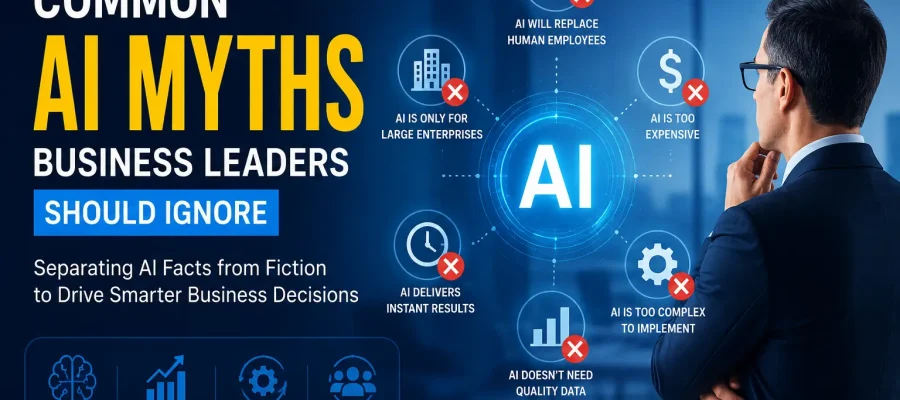
Despite its rapid growth, many business leaders are still hesitant to adopt AI. Much of this hesitation comes from myths and misconceptions rather than facts. Some believe AI is only for large enterprises, while others worry it will replace employees or require huge investments.
The truth is that AI is designed to help businesses work smarter—not harder. When implemented correctly, AI can automate routine tasks, uncover valuable insights from data, and support better business decisions without replacing human expertise.
In this blog, we’ll explore the most common AI myths, explain why they’re inaccurate, and discuss how organizations can successfully adopt AI to achieve long-term growth.
Why AI Myths Still Exist
Artificial Intelligence has received enormous attention over the last decade. While this has increased awareness, it has also created confusion. News headlines, movies, and social media often portray AI as something magical or dangerous, making it difficult for business leaders to understand its real capabilities.
Many organizations have also experienced failed technology projects in the past, making them cautious about adopting new innovations. Others simply lack the knowledge needed to understand how AI works and how it can solve everyday business problems.
In reality, AI is a practical technology that helps businesses analyze data, automate processes, identify trends, and improve decision-making. It is not a replacement for human intelligence but a tool that supports employees and leaders in making faster and smarter decisions.
Organizations that separate fact from fiction are better prepared to unlock the full value of AI.
Myth #1: AI Will Replace Human Employees
One of the biggest concerns surrounding AI is that it will eliminate jobs.
Reality
AI is designed to automate repetitive, rule-based tasks—not replace people.
Employees continue to provide skills that AI cannot replicate, such as creativity, leadership, emotional intelligence, critical thinking, and strategic planning.
For example:
- HR professionals use AI to screen resumes, but recruiters make hiring decisions.
- Finance teams automate reporting while analysts interpret financial results.
- Retail businesses use AI to forecast inventory, while managers decide purchasing strategies.
- Customer support teams use AI chatbots to answer common questions, allowing staff to focus on complex customer issues.
Instead of replacing employees, AI helps them become more productive by reducing manual work and allowing them to focus on higher-value activities.
Business Benefits
- Increased employee productivity
- Reduced repetitive work
- Faster reporting
- Better customer service
- Improved operational efficiency
Myth #2: AI Is Only for Large Enterprises
Many small and medium-sized businesses believe AI is too advanced or too expensive for them.
Reality
Modern cloud-based AI solutions have made artificial intelligence affordable and accessible for businesses of every size.
Today, even small businesses can use AI for:
- Sales forecasting
- Customer support chatbots
- Marketing automation
- Inventory management
- Business intelligence dashboards
- Financial reporting
Most AI platforms are subscription-based and require little upfront investment, making them suitable for growing businesses.
Rather than asking whether AI is affordable, organizations should consider how much time and money they currently lose through manual processes and inefficient decision-making.
Myth #3: AI Is Too Expensive
Another common misconception is that implementing AI requires millions of dollars.
Reality
AI projects can start small and expand over time.
Many organizations begin with simple solutions such as:
- Executive dashboards
- Automated reporting
- Predictive analytics
- Sales forecasting
- Customer segmentation
These projects often deliver measurable ROI by reducing manual work, improving reporting accuracy, and increasing operational efficiency.
A phased implementation approach allows businesses to see value quickly before investing in larger AI initiatives.
Myth #4: AI Delivers Instant Results
Some businesses expect AI to transform their organization overnight.
Reality
Like any business initiative, AI requires planning, quality data, testing, and continuous improvement.
Successful AI implementation involves:
- Defining business objectives
- Preparing clean data
- Training AI models
- Monitoring performance
- Optimizing continuously
Organizations that treat AI as a long-term strategy achieve better results than those expecting immediate success.
Myth #5: AI Doesn’t Need Quality Data
Some leaders assume AI can automatically fix poor-quality business data.
Reality
AI is only as effective as the data it receives.
Poor data leads to:
- Incorrect predictions
- Inaccurate reports
- Weak business insights
- Poor decision-making
Before implementing AI, organizations should establish strong data governance, standardized reporting, and centralized data storage.
High-quality data enables AI to generate accurate forecasts, identify business trends, and support strategic decisions.
Myth #6: AI Is Too Complex to Implement
Businesses often delay AI adoption because they believe implementation is technically difficult.
Reality
Modern AI platforms integrate with existing systems and require far less technical expertise than many organizations expect.
Businesses can start with:
- Business Intelligence dashboards
- Workflow automation
- Customer analytics
- HR analytics
- Predictive maintenance
- Inventory optimization
A phased implementation minimizes risk while delivering measurable business value.
Myth #7: AI Is Only Useful for Technology Companies
Some organizations believe AI only benefits software companies.
Reality
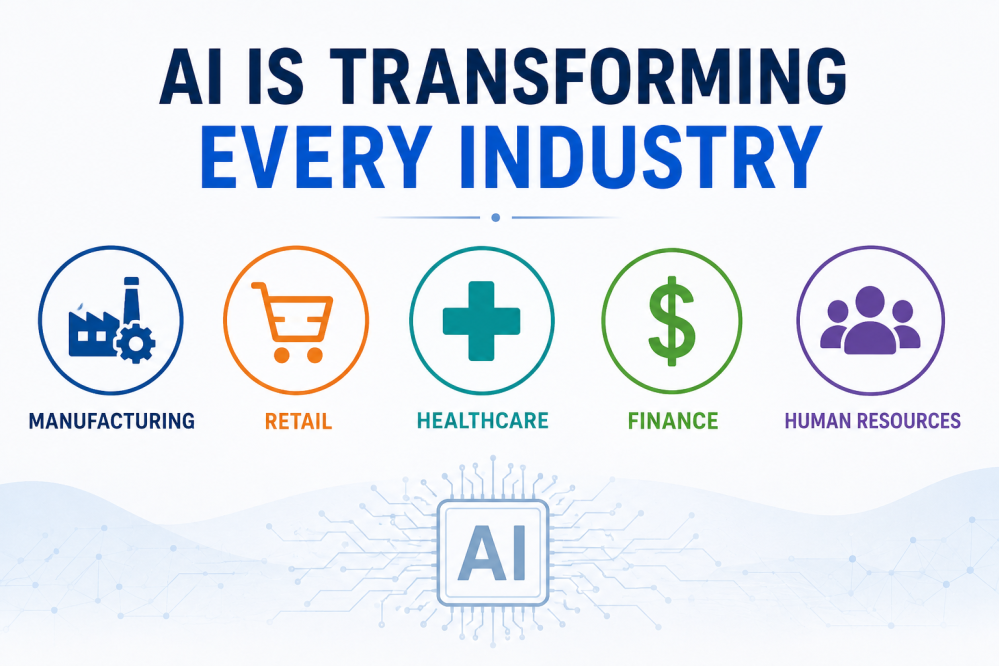
AI is transforming almost every industry.
Manufacturing
- Predictive maintenance
- Quality control
- Production planning
Retail
- Demand forecasting
- Inventory optimization
- Customer analytics
Healthcare
- Patient analytics
- Resource planning
- Clinical decision support
Finance
- Fraud detection
- Financial forecasting
- Risk management
Human Resources
- Workforce planning
- Employee retention
- Recruitment analytics
AI delivers value wherever businesses generate data.
Benefits of AI in Business
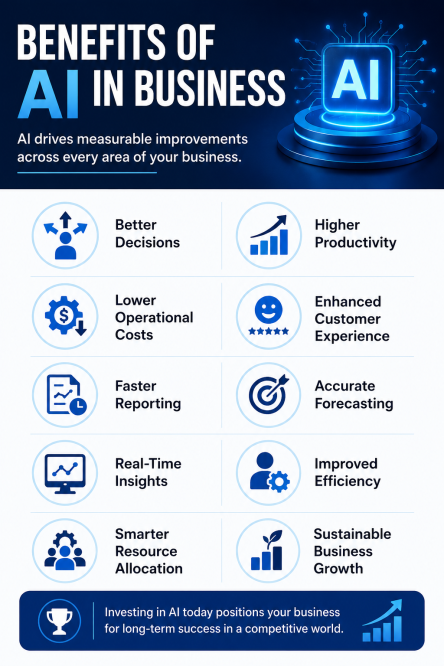
Businesses adopting AI experience measurable improvements across multiple areas.
Key benefits include:
- Better business decisions
- Increased productivity
- Reduced operational costs
- Improved customer experiences
- Faster reporting
- More accurate forecasting
- Real-time business insights
- Higher employee efficiency
- Improved resource allocation
- Sustainable business growth
Organizations that invest in AI today position themselves for long-term success in an increasingly competitive market.
Best Practices for AI Adoption
Successful AI implementation starts with solving real business problems rather than following technology trends.
Best Practices
- Identify clear business objectives.
- Begin with a pilot project.
- Ensure high-quality data.
- Train employees to use AI effectively.
- Measure business outcomes regularly.
- Expand successful AI projects across departments.
Businesses that combine AI with strong data analytics and business intelligence strategies achieve the best long-term results.
Conclusion
Artificial Intelligence is no longer a future technology—it is a practical business tool that helps organizations improve efficiency, reduce costs, and make better decisions.
Many companies delay AI adoption because of outdated myths, but the reality is very different. AI does not replace employees, require enormous budgets, or only benefit large enterprises. Instead, it helps businesses automate repetitive tasks, uncover valuable insights, and support smarter decision-making.
Organizations that embrace AI with a clear strategy, quality data, and measurable business goals will be better prepared to compete in an increasingly data-driven world.
At Wisecor Transformations, we help businesses implement AI, Data Analytics, Automation, and Business Intelligence solutions that deliver measurable business outcomes and long-term growth.
Frequently Asked Questions (FAQs)
1. What is AI in business?
AI in business refers to using Artificial Intelligence to automate processes, analyze data, improve decision-making, and increase operational efficiency.
2. Is AI only for large companies?
No. Modern AI platforms are affordable and scalable, making them suitable for businesses of all sizes.
3. Will AI replace employees?
No. AI automates repetitive tasks while allowing employees to focus on strategic and creative work.
4. What are the biggest benefits of AI in business?
AI improves productivity, reduces costs, enhances customer experiences, supports better forecasting, and enables data-driven decision-making.
5. How can businesses start implementing AI?
Begin with a small pilot project, prepare quality data, define business goals, measure results, and gradually expand AI initiatives across the organization.