

Introduction
Data has become one of the most valuable business assets. Every customer interaction, website visit, online purchase, and social media engagement creates information. Businesses collect this data every day. However, collecting information is not enough. Organizations must understand what the data means and how it can support business goals.
This is where Modern Data Analytics becomes important. It helps businesses turn raw information into meaningful insights. Instead of making decisions based on assumptions, companies can use data to understand customers, improve operations, and identify growth opportunities.
The rise of Cloud Data Analytics has made this process easier. Businesses can now store and analyze large amounts of information without investing in expensive infrastructure. Cloud platforms provide flexibility, scalability, and faster access to insights.
Today, organizations of every size use analytics to improve performance. Small businesses use it to understand customers. Large enterprises use it to optimize operations and support strategic planning.
As data volumes continue to grow, businesses that invest in analytics will gain a competitive advantage. They will make faster decisions, reduce risks, and discover opportunities that others may miss.
What Is Modern Data Analytics?
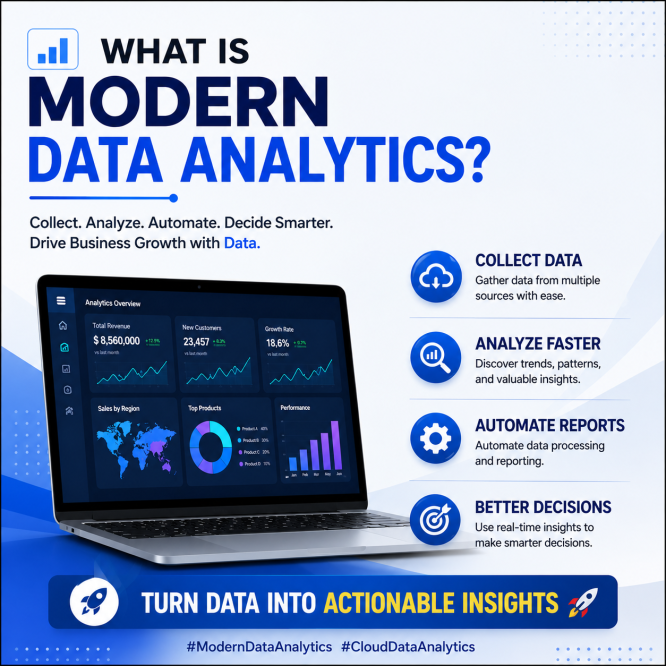
Modern Data Analytics refers to the process of collecting, organizing, analyzing, and visualizing data using advanced technologies and tools.
In the past, businesses relied heavily on spreadsheets and static reports. These methods worked when data volumes were small. Today, organizations generate information from websites, applications, CRM systems, marketing platforms, and connected devices.
Modern analytics helps manage this complexity.
A Modern Data Analytics Platform combines information from multiple sources into a single environment. This gives decision-makers a complete view of business performance.
Another major advantage is automation. Analytics platforms can automatically collect and prepare data. This reduces manual work and improves accuracy.
Businesses also use Modern Data Analytics Tools to identify patterns and trends. For example, a retailer can analyze customer purchase history to understand buying behavior. A healthcare provider can use analytics to improve patient services. A manufacturer can monitor equipment performance and reduce downtime.
Modern analytics supports better decision-making because it provides reliable and timely information.
Instead of reacting to problems after they occur, businesses can identify opportunities and risks earlier.
Why Businesses Need Modern Data Analytics
The business environment changes quickly. Customer expectations evolve, markets shift, and competition increases every year.
Organizations need accurate information to stay competitive.
Better Customer Understanding
Customers interact with businesses through many channels. These include websites, mobile applications, emails, social media platforms, and physical stores.
Modern Data Analytics helps organizations understand customer behavior. Companies can identify purchasing habits, product preferences, and customer needs.
These insights help businesses improve customer experiences and increase loyalty.
Faster Decision-Making
Speed is important in today’s business world.
Waiting for monthly reports is no longer practical. Analytics platforms provide real-time dashboards that allow managers to access information immediately.
As a result, businesses can respond quickly to opportunities and challenges.
Improved Efficiency
Every organization wants to improve productivity.
Data Analytics Tools help businesses identify inefficiencies and bottlenecks. Managers can monitor processes and make improvements based on actual data.
This often leads to cost savings and better operational performance.
Better Risk Management
Businesses face many risks, including fraud, operational issues, and security threats.
Analytics helps organizations identify unusual patterns and take action before problems become serious.
This improves business stability and reduces financial losses.
What Are Modern Data Analytics Tools?
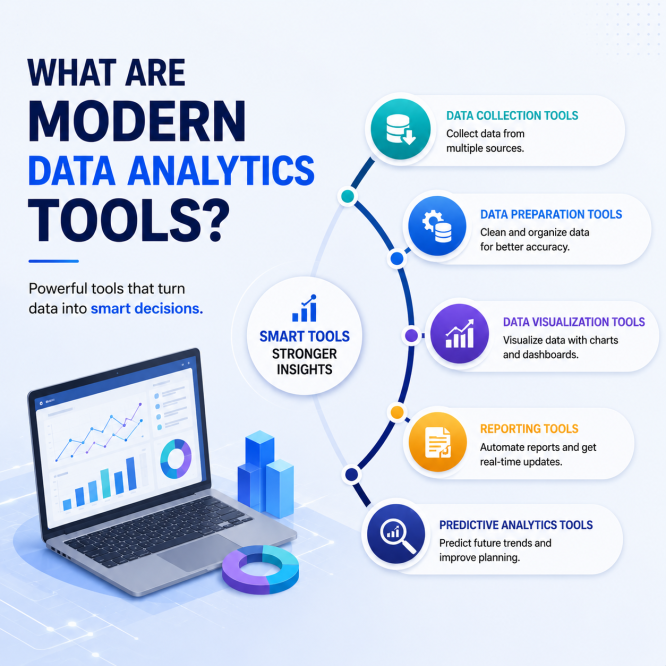
Modern Data Analytics Tools are software solutions that help organizations collect, process, analyze, and visualize information.
These tools simplify complex datasets and make insights easier to understand.
Data Collection Tools
Businesses use many applications every day.
Customer information may exist in one system while financial records are stored elsewhere. Analytics tools collect information from multiple sources and bring everything together.
This creates a centralized view of business operations.
Data Preparation Tools
Raw data often contains errors and inconsistencies.
Data preparation tools clean and organize information before analysis begins. This improves data quality and ensures more accurate insights.
Data Visualization Tools
Large datasets can be difficult to interpret.
A Modern Data Analytics Platform uses charts, graphs, and dashboards to present information in a simple format.
Visualization helps decision-makers identify trends quickly.
Reporting Tools
Reports remain an important part of business management.
Modern analytics tools automate report generation and provide access to updated information whenever needed.
Predictive Analytics Tools
Many analytics platforms now include predictive capabilities.
These features use historical data to forecast future outcomes. Businesses use predictive analytics to estimate demand, predict customer behavior, and improve planning.
Understanding Cloud Data Analytics
Cloud Data Analytics combines analytics capabilities with cloud computing technology.
Instead of relying on local servers, businesses use cloud platforms to store, manage, and analyze information.
The process starts with data collection. Information is gathered from websites, applications, databases, and operational systems.
This data is then transferred to a cloud environment where it can be processed and analyzed.
One major advantage of Cloud Based Data Analytics is scalability. Businesses can increase storage and computing resources whenever needed.
Another benefit is accessibility.
Employees can access reports and dashboards from different locations. This improves collaboration and supports remote work environments.
Data Analytics in Cloud Computing also reduces infrastructure costs. Organizations pay only for the resources they use, making analytics more affordable.
As businesses continue to generate more information, Cloud Computing and Data Analytics will play an increasingly important role in supporting growth and innovation.
Modern Data Analytics Tools in Big Data
Businesses create more data today than ever before. Every customer purchase, website visit, social media interaction, and mobile app activity generates information. Over time, this information grows into massive datasets.
Traditional reporting systems often struggle to handle these large volumes of information. This is where Modern Data Analytics Tools in Big Data become essential.
Big data analytics allows businesses to process large amounts of structured and unstructured information quickly. Instead of manually reviewing thousands of records, organizations can use analytics platforms to identify patterns and trends automatically.
For example, an e-commerce company may process millions of transactions every year. By using Big Data Analytics in Cloud Computing, the company can identify its most popular products, understand customer purchasing behavior, and optimize inventory management.
Financial institutions also use analytics to monitor transactions and detect unusual activity. Healthcare organizations use analytics to improve patient care and manage medical records more effectively.
Another advantage of big data analytics is forecasting. Businesses can analyze historical information and predict future outcomes. This helps organizations prepare for seasonal demand, market changes, and customer expectations.
As businesses continue to generate larger datasets, analytics tools will become even more important. Organizations that can turn large amounts of information into actionable insights will gain a significant competitive advantage.
Benefits of Cloud Computing and Data Analytics
The combination of Cloud Computing and Data Analytics has transformed the way businesses use information. Organizations can now access advanced analytics capabilities without investing in expensive infrastructure.
Lower Costs
Traditional analytics systems often require large investments in hardware, software, and maintenance.
With Cloud Based Data Analytics, businesses only pay for the resources they use. This reduces upfront costs and improves budget management.
Better Scalability
Data volumes continue to grow every year.
Cloud platforms allow businesses to increase storage and processing power whenever needed. This flexibility supports long-term growth and prevents performance issues.
Faster Access to Insights
Speed is critical in today’s business environment.
Cloud Data Analytics platforms process information quickly and provide real-time access to reports and dashboards. Decision-makers can respond faster to opportunities and challenges.
Improved Collaboration
Many organizations have employees working from different locations.
Cloud analytics makes it easy for teams to access the same information regardless of where they are located. This improves communication and supports collaboration.
Strong Security
Leading cloud providers invest heavily in security technologies.
Features such as data encryption, user access controls, and continuous monitoring help protect sensitive information.
As a result, many businesses find cloud-based analytics environments more secure than traditional systems.
Challenges Businesses Face With Analytics
While analytics offers many benefits, organizations also face several challenges.
Understanding these challenges helps businesses create more effective analytics strategies.
Data Quality Issues
Analytics results are only as good as the data being analyzed.
If information contains errors, duplicates, or missing values, the insights may not be accurate. Businesses must ensure data quality before analysis begins.
Multiple Data Sources
Many organizations store information in different systems.
Customer data may be stored in one platform while financial data exists elsewhere. Combining these sources can be difficult without the right analytics tools.
Skills and Expertise
Not every organization has experienced data professionals.
Businesses often need training programs or external support to maximize the value of analytics platforms.
Security and Compliance
Organizations must protect customer information and comply with industry regulations.
Strong governance policies and security controls are necessary for successful analytics initiatives.
Managing Growth
Data volumes continue to increase.
Businesses need scalable solutions that can handle future growth without affecting performance.
How to Choose the Right Modern Data Analytics Platform
Selecting the right Modern Data Analytics Platform is an important business decision.
The right platform should support current needs while providing flexibility for future growth.
Identify Business Goals
Organizations should first define what they want to achieve.
Some businesses focus on reporting and dashboards. Others may prioritize predictive analytics or operational improvements.
Understanding business objectives helps narrow platform options.
Evaluate Integration Capabilities
A good analytics platform should connect easily with existing systems.
This includes CRM software, ERP applications, databases, marketing platforms, and cloud services.
Strong integration capabilities reduce manual work and improve efficiency.
Consider Scalability
Data volumes rarely stay the same.
Businesses should choose a platform that can handle future growth without requiring major upgrades.
Focus on User Experience
An analytics solution should be easy to use.
Simple dashboards and intuitive interfaces encourage adoption across the organization.
Review Security Features
Security should always be a priority.
Organizations should evaluate encryption capabilities, access controls, compliance standards, and monitoring tools before selecting a platform.
Future Trends in Modern Data Analytics
Technology continues to evolve, and analytics is becoming more advanced every year.
Several trends are shaping the future of Modern Data Analytics.
Artificial Intelligence
Artificial Intelligence is making analytics smarter.
AI-powered systems can analyze large datasets, identify patterns, and generate insights much faster than traditional methods.
Businesses are increasingly using AI to improve decision-making and automate repetitive tasks.
Predictive Analytics
Organizations want to know what is likely to happen next.
Predictive analytics uses historical information to forecast future outcomes. This helps businesses improve planning and reduce uncertainty.
Real-Time Analytics
Companies no longer want to wait for reports.
Real-time analytics provides instant access to information and helps organizations respond quAutomationickly to changing conditions.
Automation is reducing manual effort across the analytics process.
Modern platforms can automatically collect, prepare, and analyze data. This improves efficiency and reduces human error.
Cloud-Native Analytics
Cloud-native solutions are becoming more popular.
These platforms are designed specifically for cloud environments and offer better flexibility, scalability, and performance.
Conclusion
Data has become one of the most valuable resources in modern business. However, data alone does not create value. Businesses must understand and use information effectively to achieve meaningful results.
This is why Modern Data Analytics has become a critical business capability. It helps organizations transform raw information into actionable insights that support better decisions.
At the same time, Cloud Data Analytics provides the flexibility and scalability needed to manage growing data volumes. Businesses can analyze information faster, reduce costs, and improve collaboration across teams.
Organizations that invest in analytics gain a competitive advantage. They understand customers better, improve operations, reduce risks, and identify growth opportunities more effectively.
As technologies such as artificial intelligence, automation, and predictive analytics continue to evolve, analytics will play an even larger role in business success.
The future belongs to organizations that can turn information into action. By embracing Modern Data Analytics, businesses can make smarter decisions and achieve sustainable growth.
Frequently Asked Questions
What is Modern Data Analytics?
Modern Data Analytics is the process of collecting, analyzing, and visualizing information using advanced technologies to support better business decisions.
What is Cloud Data Analytics?
Cloud Data Analytics uses cloud-based platforms to store, process, and analyze information instead of traditional on-premise systems.
How does Data Analytics in Cloud Computing work?
Data Analytics in Cloud Computing collects information from multiple sources, stores it in cloud environments, and uses analytics tools to generate insights and reports.
What are Modern Data Analytics Tools?
Modern Data Analytics Tools are software solutions that help organizations collect, process, analyze, and visualize business information.
What are the benefits of Cloud Computing and Data Analytics?
Cloud Computing and Data Analytics provide scalability, lower costs, improved collaboration, faster insights, and better business decision-making.