

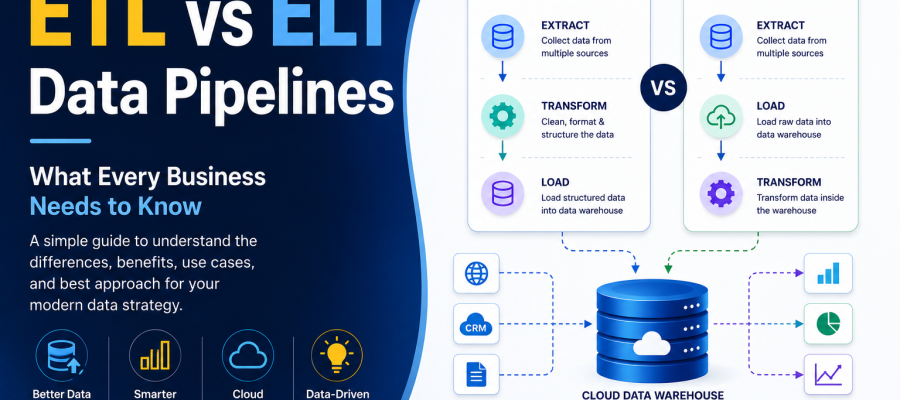
Data has become one of the most valuable assets for modern businesses. Every day, organizations collect information from websites, mobile applications, CRM systems, ERP software, social media platforms, e-commerce stores, and cloud applications. However, simply collecting data is not enough. Businesses need a reliable way to move, organize, and prepare data before it can be used for reporting, analytics, and decision-making.
This is where data pipelines play a critical role.
Data pipelines automate the process of moving data from one system to another while ensuring that the information remains accurate, consistent, and useful. Two of the most common approaches used in data integration are ETL (Extract, Transform, Load) and ELT (Extract, Load, Transform).
Although ETL and ELT may seem similar, they follow different workflows and are designed for different business requirements. Understanding the differences between ETL and ELT can help organizations choose the right data architecture, improve business intelligence, and support long-term growth.
In this guide, we’ll explore how ETL and ELT work, their advantages and disadvantages, real-world use cases, and how to determine which approach is best for your business
What is ETL?
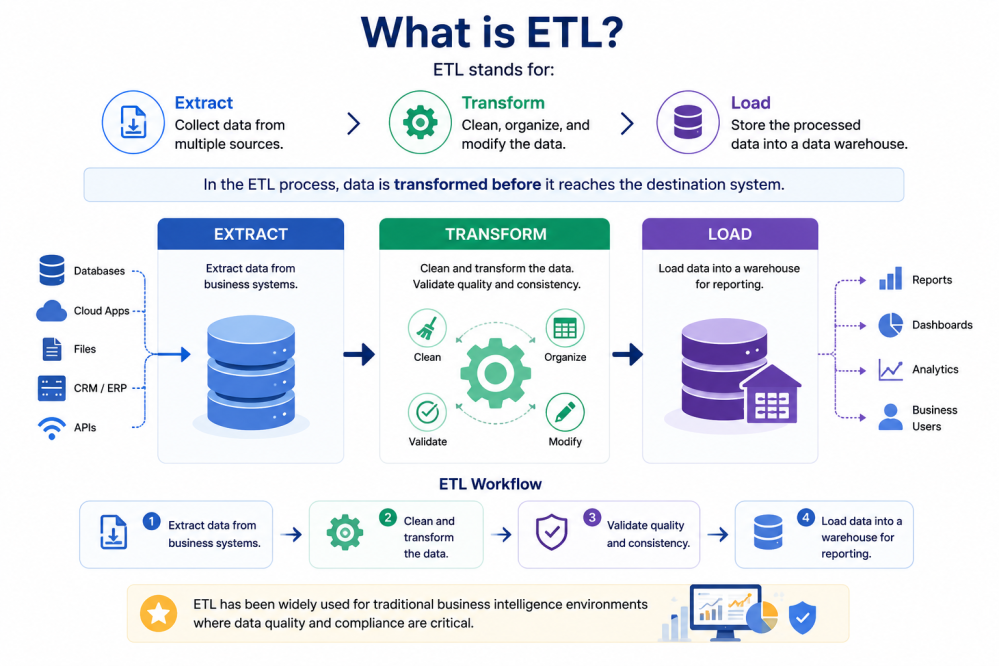
ETL stands for Extract, Transform, and Load. It is a traditional data integration method used to prepare data before storing it in a data warehouse.
The ETL process starts by extracting data from multiple business systems. These sources can include CRM platforms, ERP software, databases, spreadsheets, websites, cloud applications, APIs, and other operational systems.
Once the data is collected, it moves to the transformation stage. This step involves cleaning, validating, formatting, and standardizing the information. Duplicate records are removed, incorrect values are corrected, and business rules are applied to ensure consistency.
After transformation is complete, the processed data is loaded into a data warehouse where it can be used for reporting, dashboards, and business intelligence.
ETL Workflow
- Extract data from business systems.
- Clean and transform the data.
- Validate data quality and consistency.
- Load data into a warehouse.
- Generate reports and analytics.
Why ETL Matters
The biggest advantage of ETL is data quality. Since information is transformed before storage, only validated and structured data enters the warehouse. This reduces reporting errors and improves decision-making.
ETL is especially useful for organizations operating in highly regulated industries such as healthcare, banking, insurance, and government sectors.
Example of ETL
Imagine a retail company collecting sales data from multiple stores and online channels. Before storing the information, the ETL process removes duplicate orders, standardizes product names, corrects formatting issues, and validates transaction records.
The result is a clean and reliable dataset that can be used for accurate reporting and performance analysis.
What is ELT?
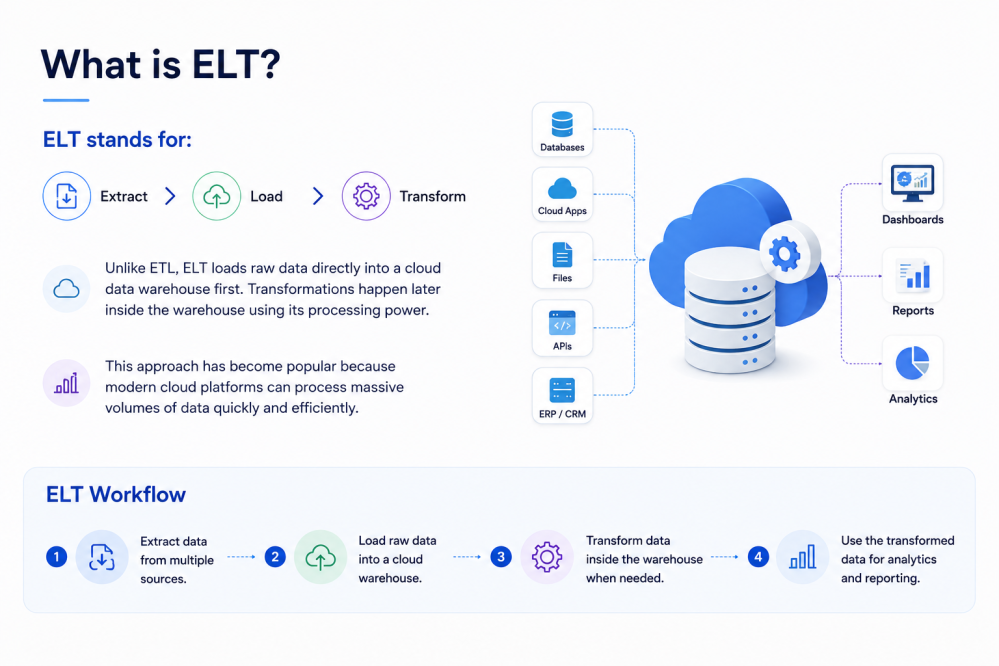
ELT stands for Extract, Load, and Transform.
Unlike ETL, ELT loads raw data directly into a cloud data warehouse before performing transformations. Instead of processing data outside the warehouse, transformations happen inside the warehouse using its computing power.
Modern cloud platforms such as Snowflake, BigQuery, and Amazon Redshift have made ELT increasingly popular because they can handle large volumes of data quickly and efficiently.
ELT Workflow
- Extract data from multiple sources.
- Load raw data into a cloud warehouse.
- Transform data when required.
- Use transformed data for analytics and reporting.
Why ELT Matters
ELT provides greater flexibility because raw data remains available inside the warehouse. Analysts can transform data whenever needed without repeatedly extracting it from source systems.
This makes ELT ideal for organizations working with large datasets, advanced analytics, machine learning, and real-time reporting.
Example of ELT
Consider an e-commerce company collecting customer activity from websites, mobile apps, and marketing platforms.
Using ELT, all raw customer interactions are loaded directly into a cloud warehouse. Analysts can then create different transformations depending on their reporting or analytics requirements.
This approach allows businesses to move faster and gain insights more quickly.
ETL vs ELT: Key Differences
Understanding the core differences between ETL and ELT helps businesses choose the right architecture.
| Feature | ETL | ELT |
| Transformation | Before loading | After loading |
| Data Storage | Traditional warehouse | Cloud warehouse |
| Speed | Slower for large datasets | Faster for big data |
| Scalability | Limited | Highly scalable |
| Cost | Higher infrastructure costs | Better cloud efficiency |
| Real-Time Analytics | Limited | Strong support |
| Data Volume | Moderate | Massive datasets |
The most important difference is timing. ETL transforms data before storage, while ELT stores raw data first and transforms it later.
This difference has a major impact on scalability, performance, analytics capabilities, and infrastructure requirements.
Why Data Pipelines Matter
A data pipeline is the foundation of every modern analytics system.
Without a structured data pipeline, organizations often face problems such as:
- Duplicate records
- Inconsistent reports
- Manual data preparation
- Delayed decision-making
- Poor customer insights
- Data quality issues
A well-designed pipeline automates data movement and ensures information reaches decision-makers quickly and accurately.
Benefits of Data Pipelines
✔ Faster reporting
✔ Better data quality
✔ Reduced manual effort
✔ Improved business intelligence
✔ Reliable analytics
✔ Better operational efficiency
✔ Improved customer insights
Organizations that invest in strong data pipeline architecture can make faster decisions and respond more effectively to market changes.
When Should Businesses Use ETL?
While ELT has gained popularity in recent years, ETL remains a highly valuable approach for many organizations. Businesses that prioritize data quality, governance, compliance, and security often choose ETL because it ensures data is cleaned and validated before entering the data warehouse.
ETL is particularly useful when organizations must comply with strict regulations. Industries such as healthcare, banking, insurance, and government agencies handle sensitive information that must meet legal and security requirements. In these environments, data errors can lead to compliance violations, financial penalties, and poor business decisions.
-
Businesses Should Use ETL When:
1. Data Quality Requirements Are Strict
Organizations that require highly accurate reporting often prefer ETL. Since data is transformed before loading, errors can be identified and corrected early in the process.
2. Regulatory Compliance Is Important
Industries subject to regulations such as GDPR, HIPAA, or financial reporting standards often use ETL to ensure data follows specific compliance rules.
3. Legacy Systems Are Involved
Many enterprises still rely on older systems that were designed before cloud computing became common. ETL integrates well with these environments.
4. Security Is a Top Priority
Because data is processed before storage, organizations can apply security policies and masking rules before sensitive information enters the warehouse.
-
Advantages of ETL
- Better data validation
- Strong governance controls
- Improved compliance management
- Higher data accuracy
- Consistent reporting standards
Although ETL may require more processing time, it provides a structured and controlled environment that many enterprises depend on.
ETL vs ELT for Business Intelligence
Business intelligence depends on having accurate, accessible, and timely data. Without reliable data, dashboards, reports, and analytics lose their value.
Both ETL and ELT support business intelligence, but they do so in different ways.
ETL for Business Intelligence
ETL creates highly structured datasets before data enters the warehouse. This approach ensures that reports are built using validated and standardized information.
Benefits include:
- Consistent reporting
- Reduced errors
- Improved governance
- Reliable KPI tracking
Traditional business intelligence environments often rely on ETL because executives need trusted and consistent reports.
ELT for Business Intelligence
ELT offers greater flexibility by allowing transformations to occur inside the warehouse.
Benefits include:
- Faster access to raw data
- More flexible analytics
- Better support for self-service reporting
- Real-time dashboard capabilities
Analysts can create multiple views of the same data without repeatedly extracting information from source systems.
Which Is Better?
For traditional reporting environments, ETL remains highly effective.
For modern analytics, interactive dashboards, predictive analytics, and data science projects, ELT often delivers better performance.
Many organizations combine ETL and ELT to gain the benefits of both approaches.
ETL vs ELT in Cloud Computing
Cloud computing has completely changed how organizations manage data.
Traditional data warehouses often required expensive infrastructure investments and long deployment cycles. Modern cloud platforms provide scalable storage and computing resources that can grow with business needs.
Cloud data warehouses such as Snowflake, Google BigQuery, and Amazon Redshift are specifically designed to support ELT workflows.
Why ELT Works Well in the Cloud
Cloud platforms separate storage and computing resources. This allows organizations to load large volumes of raw data without impacting performance.
Benefits include:
- Unlimited scalability
- Faster data processing
- Lower infrastructure costs
- Improved analytics performance
- Reduced operational complexity
ETL in Cloud Environments
Although ELT dominates modern cloud architectures, ETL still plays an important role.
Organizations handling regulated data often use ETL to ensure information is validated before storage.
As a result, many enterprises adopt hybrid architectures that combine ETL and ELT based on specific business requirements.
Cloud computing has made both approaches more powerful, giving businesses greater flexibility than ever before.
Common ETL and ELT Use Cases
Both ETL and ELT are widely used across industries, but their applications often depend on business requirements, data volume, and analytics goals. Understanding common use cases can help organizations choose the right approach for their data pipeline architecture.
ETL Use Cases
Financial Reporting
Banks, accounting firms, and financial institutions use ETL to ensure data accuracy before reports are generated. Financial reports often require strict validation and compliance checks, making ETL an ideal solution.
Regulatory Compliance
Industries such as healthcare and insurance must comply with regulations that govern how data is collected, stored, and processed. ETL helps organizations clean and validate data before it enters the warehouse.
Master Data Management
Organizations often store customer, product, and supplier information across multiple systems. ETL consolidates this information into a single source of truth.
Operational Dashboards
Businesses use ETL to generate accurate dashboards that track sales performance, inventory levels, operational efficiency, and customer metrics.
Enterprise Reporting
Large organizations rely on ETL for monthly, quarterly, and annual reporting because it provides structured and reliable datasets.
ELT Use Cases
Customer Behavior Analytics
E-commerce companies analyze customer interactions from websites, mobile apps, and marketing campaigns. ELT enables businesses to process large volumes of customer data quickly.
Marketing Analytics
Marketing teams use ELT to analyze campaign performance, website traffic, lead generation, and customer engagement metrics in near real time.
Machine Learning Projects
Data scientists often require access to raw data for experimentation and model training. ELT allows them to transform data when needed without losing access to original datasets.
Real-Time Reporting
Businesses that need live dashboards and real-time analytics often use ELT because data is available immediately after loading.
Large-Scale Cloud Analytics
Organizations processing millions of records daily use ELT to leverage the scalability of cloud data warehouses.
Both ETL and ELT can deliver significant business value when aligned with organizational goals and technology infrastructure.
How to Choose Between ETL and ELT
Choosing between ETL and ELT is not simply a technical decision. It is a business decision that affects reporting, analytics, scalability, compliance, and operational efficiency.
Before selecting an approach, organizations should evaluate their current infrastructure, future growth plans, and analytics requirements.
Choose ETL If:
Compliance Is Critical
Organizations operating in regulated industries often need strict control over data processing before storage.
Data Quality Must Be Guaranteed
If inaccurate data could lead to poor business decisions, ETL provides stronger validation and governance controls.
Legacy Systems Are Involved
Older enterprise systems often integrate more effectively with ETL workflows.
Security Requirements Are High
Sensitive information can be cleaned, masked, and validated before entering the warehouse.
Choose ELT If:
You Use Cloud Data Warehouses
ELT is designed to leverage the power of modern cloud platforms.
You Process Large Volumes of Data
Organizations dealing with big data often benefit from ELT’s scalability.
Real-Time Analytics Are Important
ELT provides faster access to raw data and supports near real-time reporting.
Flexibility Is a Priority
Analysts and data scientists can transform data whenever needed without rebuilding pipelines.
Consider a Hybrid Approach
Many enterprises combine ETL and ELT to gain the advantages of both methods.
For example:
- Financial data may use ETL for compliance.
- Marketing data may use ELT for real-time analytics.
- Customer behavior data may use ELT for machine learning projects.
This hybrid model allows organizations to balance governance, scalability, and performance.
Conclusion
The ETL vs ELT debate is not about determining a single winner. Instead, it is about identifying which approach best supports your organization’s goals, infrastructure, and data strategy.
ETL continues to play a vital role in industries where governance, compliance, security, and data quality are essential. By transforming data before loading it into a warehouse, ETL provides greater control and consistency.
ELT has emerged as the preferred approach for cloud-first organizations that need scalability, flexibility, and real-time analytics. Modern cloud data warehouses have made it possible to process enormous datasets efficiently while enabling advanced analytics and machine learning.
As organizations continue to generate more data, the importance of building efficient and scalable data pipelines will only increase. Whether you choose ETL, ELT, or a hybrid approach, the ultimate objective remains the same: transforming raw data into valuable business insights that drive smarter decisions, improve operational efficiency, and support long-term growth.
Businesses that invest in the right data pipeline architecture today will be better positioned to compete in an increasingly data-driven world.
Frequently Asked Questions (FAQ)
1. What is the difference between ETL and ELT?
The primary difference is the order of transformation. ETL transforms data before loading it into a warehouse, while ELT loads raw data first and performs transformations later inside the warehouse.
2. Which is better, ETL or ELT?
Neither is universally better. ETL is ideal for compliance-focused environments, while ELT is better suited for cloud analytics, scalability, and large datasets.
3. Why is ELT becoming more popular?
Modern cloud data warehouses have powerful processing capabilities that allow businesses to load data quickly and transform it later. This improves flexibility and scalability.
4. What are the benefits of ETL?
ETL provides:
- Better data quality
- Strong governance
- Improved compliance
- Consistent reporting
- Enhanced security
5. What are the benefits of ELT?
ELT offers:
- Faster processing
- Better scalability
- Real-time analytics
- Lower maintenance effort
- Greater flexibility
6. Can ETL and ELT be used together?
Yes. Many organizations implement hybrid architectures that combine ETL and ELT depending on data requirements.
7. Is ELT better for cloud data warehouses?
Yes. ELT is specifically designed to take advantage of cloud-native data warehouses such as Snowflake, BigQuery, and Amazon Redshift.
8. Which industries use ETL and ELT?
Industries including healthcare, banking, insurance, retail, manufacturing, logistics, e-commerce, and technology all use ETL and ELT to manage business data.
9. How do ETL and ELT support business intelligence?
Both approaches prepare data for reporting and analytics. ETL focuses on structured and validated datasets, while ELT provides greater flexibility and supports advanced analytics.
10. How do I choose the right data pipeline architecture?
Consider factors such as:
- Data volume
- Compliance requirements
- Cloud adoption
- Reporting needs
- Security requirements
- Scalability goals
- Budget constraints
The best architecture is the one that aligns with your business objectives and long-term growth strategy.