

In today’s digital business environment, data is the most important asset for any organization. Every company, whether small or large, generates massive amounts of data every day. This data comes from customers, sales, marketing campaigns, operations, websites, apps, and internal systems.
However, most businesses face a common problem – they collect a lot of data but do not use it properly.
This is where the concept of a data-driven culture becomes extremely important.
A data-driven culture means that every decision in the organization is made using data instead of assumptions or personal opinions. It means that businesses rely on facts, numbers, and analytics rather than guessing outcomes.
When companies adopt data-driven decision making, they become more accurate, more efficient, and more confident in their strategies.
Instead of saying “I think this will work,” teams start saying “the data shows this will work.”
This small shift completely transforms how a business operates.
A strong data-driven culture helps organizations:
- Make better decisions
- Reduce business risks
- Improve customer understanding
- Increase efficiency
- Grow faster in competitive markets
In simple words:
Data-driven culture means using real information to make smart business decisions.
WHAT IS DATA-DRIVEN CULTURE?
A data-driven culture is an organizational mindset where data becomes the foundation of all decision-making processes.
It means that employees and leaders trust data more than personal opinions or assumptions. Every decision is supported by analytics, reports, and measurable insights.
In a data-driven organization, data is not limited to technical teams. Instead, it is accessible across all departments such as:
- Marketing
- Sales
- Finance
- HR
- Operations
- Customer service
This ensures that everyone is working with the same truth.
For example:
- Marketing teams analyze campaign performance before planning new ads
- Sales teams study customer behavior to improve conversions
- HR teams track employee performance to improve retention
- Finance teams use data to control costs and improve budgeting
This creates transparency, alignment, and consistency across the organization.
In simple terms, a data-driven culture turns raw data into meaningful business decisions.
WHY DATA-DRIVEN DECISION MAKING IS IMPORTANT (DETAILED)
Data-driven decision making is extremely important in modern business because it removes uncertainty and improves accuracy.
Earlier, businesses relied on experience and intuition. While experience is valuable, it is not always reliable in fast-changing markets.
Today, customer behavior changes quickly, competition increases daily, and market trends shift constantly. In such conditions, guessing leads to mistakes.
Data helps businesses understand what is actually happening in real time.
For example, instead of guessing which product is performing well, companies analyze:
- Sales history
- Customer demand
- Market trends
- Seasonal behavior
- Feedback data
This helps businesses make more accurate decisions.
Key Importance Areas:
✔ Reduces Guesswork
Decisions are based on facts instead of assumptions.
✔ Improves Speed
Teams can act quickly using real-time dashboards.
✔ Reduces Risk
Wrong decisions are minimized because data highlights problems early.
✔ Improves Forecasting
Businesses can predict future demand and trends.
✔ Improves Customer Understanding
Companies can understand what customers actually want.
In short, data-driven decision making makes business more intelligent and predictable.
BENEFITS OF A DATA-DRIVEN ORGANIZATION (DETAILED)
A data-driven organization performs better because every decision is based on insights rather than guesswork.
One of the biggest advantages is clarity. When data is available, there is no confusion about performance. Everything becomes measurable.
Another major benefit is faster decision-making. Leaders do not wait for long reports. They use dashboards that show real-time performance.
Key Benefits Explained:
✔ Better Performance Tracking
Companies can track sales, marketing, HR, and operations using KPIs.
✔ Improved Customer Experience
Businesses understand customer behavior and improve services accordingly.
✔ Higher Efficiency
Manual work is reduced, and automation increases productivity.
✔ Better Profitability
Companies identify profitable areas and reduce unnecessary costs.
✔ Stronger Competitive Advantage
Organizations using data-driven transformation move faster than competitors.
Over time, these benefits lead to sustainable business growth.
HOW DATA-DRIVEN CULTURE WORKS IN REAL BUSINESS (DETAILED)
A data-driven culture works through a structured flow of data collection, processing, and decision-making.
First, data is collected from multiple sources such as CRM systems, websites, apps, social media platforms, and sales tools.
Then this raw data is stored in centralized systems like cloud databases or data warehouses.
After that, the data is cleaned and organized. This step is important because raw data often contains errors, duplicates, or missing values.
Once cleaned, the data is analyzed using tools like:
- Power BI
- Tableau
- Excel dashboards
- AI-based analytics systems
These tools convert raw data into visual insights like charts and dashboards.
Finally, managers and teams use these dashboards to make decisions quickly.
This system ensures that decisions are always based on real-time information.
BUILD DATA-DRIVEN CULTURE (FOUNDATION LEVEL)
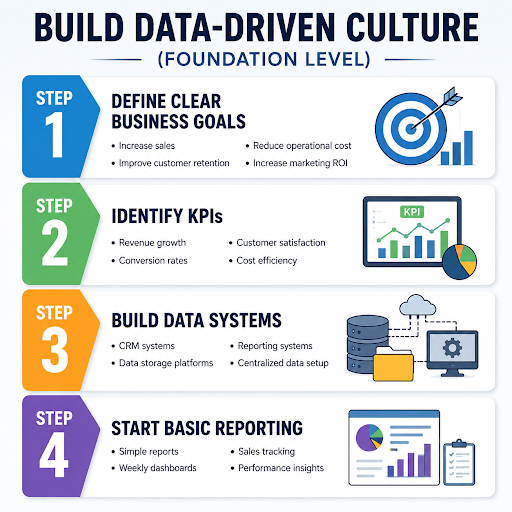
Building a business data culture starts with strong foundation steps.
✔ Step 1: Define Clear Business Goals
Every organization must first define what it wants to achieve.
Without goals, data has no direction.
For example:
- Increase sales by 20%
- Improve customer retention
- Reduce operational cost
- Increase marketing ROI
Clear goals help businesses focus on the right data.
✔ Step 2: Identify Key Performance Indicators (KPIs)
KPIs are the most important metrics in a business.
Instead of tracking everything, companies must focus only on:
- Revenue growth
- Conversion rates
- Customer satisfaction
- Cost efficiency
KPIs help measure success clearly.
Keywords:
KPI tracking system, business intelligence tools, performance measurement, data-driven decision making, data-driven organization
✔ Step 3: Build Basic Data Systems
Companies need proper systems to collect and store data.
This includes:
- CRM systems
- Data storage platforms
- Reporting systems
Without systems, data becomes unorganized.
Keywords:
data collection system, CRM analytics, business data culture, data-driven organization, data-driven culture
✔ Step 4: Start Basic Reporting
Before advanced analytics, companies should start with simple reports.
These reports help teams understand performance clearly.
WHY DATA IS THE CORE OF MODERN BUSINESS SUCCESS
To build a strong data-driven culture, it is very important to understand one core truth – data is the foundation of modern business success.
In earlier business models, companies depended on experience, market knowledge, and intuition. Decisions were made in boardrooms based on discussions, personal judgment, and assumptions. This approach worked in slow-changing markets.
But today’s business environment is completely different.
Markets are dynamic. Customer expectations change very fast. Competition is global and aggressive. In such a situation, relying only on experience is not enough.
Data provides clarity in this confusion.
Every business action creates data:
- When a customer clicks on a website, data is generated
- When a product is purchased, data is generated
- When a marketing campaign runs, data is generated
- When employees perform tasks, data is generated
This data is a reflection of reality.
A data-driven organization understands that this data is not just technical information it is business intelligence. It tells what is working, what is failing, and what needs improvement.
For example, a company might believe a marketing campaign is successful because it looks attractive. But data may show low engagement and poor conversion rates. Without data, this failure would go unnoticed.
This is why data is considered the “truth layer” of modern business.
DEEP SHIFT FROM TRADITIONAL THINKING TO DATA THINKING
One of the biggest transformations required for building a data-driven culture is the shift in mindset.
Most organizations operate on traditional thinking:
- “We have always done it this way”
- “My experience says this will work”
- “Let’s try and see what happens”
This approach is based on assumptions and experience.
However, a data-driven culture in companies replaces this mindset with evidence-based thinking.
Data thinking means:
- “What does the data say?”
- “What are the numbers showing?”
- “What trend is visible?”
- “What is the performance indicator telling us?”
This shift is not easy because it challenges human psychology. People naturally trust their experience and judgment. When data shows something different, it creates resistance.
For example, a senior manager may strongly believe that a product strategy is effective. But data may show declining sales and low customer retention. Accepting this requires openness and flexibility.
This is why organizations must gradually build trust in data.
They can do this by:
- Using simple dashboards instead of complex reports
- Showing small wins through data usage
- Encouraging data-based discussions in meetings
- Training employees on interpreting data
Over time, data becomes more trusted than opinion.
BUILDING A STRONG DATA INFRASTRUCTURE (DETAILED EXPLANATION)
A data-driven culture cannot exist without strong infrastructure. Infrastructure means the complete system that collects, stores, processes, and presents data.
A strong data infrastructure consists of multiple layers:
✔ 1. Data Collection Layer
This is the first step where data enters the system.
Data comes from:
- Customer interactions
- Websites and mobile apps
- CRM systems
- Sales tools
- Social media platforms
- Customer feedback systems
This raw data is extremely important because it represents real-world activity.
✔ 2. Data Storage Layer
Once data is collected, it needs to be stored securely and systematically.
Organizations use:
- Cloud storage systems
- Data warehouses
- Centralized databases
The purpose is to ensure all departments access the same version of data.
✔ 3. Data Processing Layer
Raw data is often messy and unstructured. It may contain errors, duplicates, or missing values.
So it must be cleaned and processed.
This includes:
- Removing duplicate records
- Fixing incorrect entries
- Standardizing formats
- Organizing data into structured form
Without this step, data analysis becomes unreliable.
✔ 4. Data Analysis Layer
In this stage, data is analyzed to extract insights.
Advanced tools like:
- Power BI
- Tableau
- Python analytics
- AI-based systems
convert raw data into meaningful patterns.
This is where business insights are created.
✔ 5. Data Visualization Layer
Humans understand visuals better than raw numbers.
So data is converted into:
- Charts
- Dashboards
- Graphs
- KPI scorecards
This makes decision-making easier for managers.
✔ 6. Security Layer
Data is sensitive and valuable. It must be protected.
Security ensures:
- No unauthorized access
- No data leaks
- Safe storage systems
- Controlled access permissions
Without security, data systems cannot survive.
IMPORTANCE OF DATA QUALITY IN BUSINESS DECISIONS
Data quality is one of the most critical parts of a data-driven organization.
Even the best systems fail if the data is incorrect.
Data quality means:
- Accuracy
- Completeness
- Consistency
- Timeliness
- Reliability
If data is poor, decisions become dangerous.
For example:
- Incorrect sales data may lead to wrong inventory planning
- Outdated customer data may lead to bad marketing decisions
- Missing data may hide business problems
Good data quality ensures:
- Correct analysis
- Better forecasting
- Reliable insights
- Strong decision-making
In simple terms:
“Bad data creates bad business decisions.”
ROLE OF LEADERSHIP IN DATA-DRIVEN CULTURE
Leadership is the backbone of any cultural transformation.
If leaders do not support data usage, employees will not adopt it.
In a successful data-driven organization, leaders:
- Use dashboards in meetings
- Ask data-based questions
- Avoid opinion-based decisions
- Encourage transparency
- Promote analytics tools
When employees see leaders using data, they naturally start trusting data.
Leadership creates the environment where data becomes part of everyday thinking.
Without leadership support, data initiatives often fail.
HOW DATA IS USED IN DAILY BUSINESS OPERATIONS
In a mature data-driven culture, data is not limited to reports. It becomes part of daily operations.
Different departments use data differently:
✔ Marketing Teams
They analyze:
- Campaign performance
- Customer engagement
- Conversion rates
- ROI of ads
✔ Sales Teams
They track:
- Leads
- Closures
- Revenue trends
- Customer behavior
✔ HR Teams
They monitor:
- Employee performance
- Retention rates
- Hiring effectiveness
- Productivity levels
✔ Finance Teams
They analyze:
- Budget performance
- Revenue vs cost
- Profit margins
- Financial forecasting
✔ Operations Teams
They track:
- Workflow efficiency
- Production speed
- Resource utilization
This ensures that every department is aligned with data.
KPI FRAMEWORK FOR DATA-DRIVEN CULTURE (DETAILED EXPLANATION)
A data-driven culture cannot function without KPIs (Key Performance Indicators). KPIs are measurable values that help organizations track performance.
Without KPIs:
👉 Data becomes meaningless
👉 Decisions become unclear
👉 Growth becomes unmeasurable
✔ BUSINESS KPIs
Business KPIs measure overall company performance.
👉 Revenue Growth Rate
This shows how fast a company is increasing its income over time. It helps understand whether the business is expanding or slowing down.
👉 Profit Margin
This shows how much profit the company earns after expenses. It helps in understanding financial health.
👉 Customer Acquisition Cost (CAC)
This measures how much money is spent to acquire a new customer. Lower CAC means better efficiency.
👉 ROI (Return on Investment)
This shows how much profit is generated from investments. It is one of the most important financial KPIs.
✔ MARKETING KPIs
Marketing KPIs help understand campaign effectiveness.
👉 Click-Through Rate (CTR)
It measures how many people clicked on an ad compared to how many saw it. Higher CTR means better engagement.
👉 Conversion Rate
This shows how many visitors turned into customers.
👉 Engagement Rate
It measures how users interact with content like likes, comments, shares.
👉 Lead Generation
It tracks how many potential customers are generated through marketing efforts.
✔ SALES KPIs
Sales KPIs measure sales performance.
👉 Sales Conversion Rate
Shows how many leads become paying customers.
👉 Average Deal Size
Shows the average value of each sale.
👉 Lead-to-Customer Ratio
Shows efficiency of the sales process.
✔ HR KPIs
HR KPIs help measure employee performance.
👉 Employee Retention Rate
Shows how many employees stay in the company.
👉 Hiring Efficiency
Measures how quickly and effectively new employees are hired.
👉 Productivity Score
Measures employee output and performance.
KPIs are the backbone of data-driven decision making because they make everything measurable.
Keywords:
data-driven culture, data-driven organization, data-driven decision making, business intelligence culture, analytics strategy
DATA MATURITY MODEL (ENTERPRISE LEVEL EXPLAINED)
Every organization goes through different stages before becoming fully data-driven.
✔ STAGE 1: DATA AWARENESS
At this stage:
- Companies collect data
- But do not use it properly
- Decisions are still intuition-based
Data exists but has no value yet.
✔ STAGE 2: REPORTING STAGE
At this stage:
- Basic reports are created
- Monthly or weekly reports are used
- Decisions are still slow
Data is visible but not powerful yet.
✔ STAGE 3: ANALYSIS STAGE
At this stage:
- Companies use dashboards
- Teams start analyzing performance
- Data starts influencing decisions
This is where data-driven organization begins.
✔ STAGE 4: PREDICTIVE STAGE
At this stage:
- AI and machine learning are introduced
- Companies start forecasting future outcomes
- Decision-making becomes proactive
Businesses start predicting instead of reacting.
✔ STAGE 5: FULL DATA-DRIVEN CULTURE
This is the highest stage.
At this stage:
- Every decision is based on data
- All departments use analytics
- Leadership fully trusts data
- AI systems support decisions
This is a fully mature data-driven organization.
FINAL IMPLEMENTATION ROADMAP
To build a strong data-driven culture, organizations must follow a structured roadmap.
✔ STEP 1: DATA COLLECTION
Businesses must collect data from:
- Customers
- Sales systems
- Websites
- Marketing platforms
Without data, nothing can be analyzed.
✔ STEP 2: DATA CLEANING
Raw data is cleaned by:
- Removing errors
- Fixing duplicates
- Standardizing formats
Clean data = accurate decisions.
✔ STEP 3: DASHBOARD CREATION
Dashboards are built using tools like:
- Power BI
- Tableau
They convert complex data into simple visuals.
✔ STEP 4: EMPLOYEE TRAINING
Employees are trained to:
- Understand dashboards
- Use KPIs
- Make data-based decisions
✔ STEP 5: LEADERSHIP ADOPTION
Leaders must:
- Use data in meetings
- Avoid opinion-based decisions
- Encourage analytics thinking
✔ STEP 6: AI & ADVANCED ANALYTICS
Companies introduce:
- Predictive analytics
- Machine learning
- Automation
✔ STEP 7: FULL DATA CULTURE
Finally:
- Data becomes part of daily operations
- Every decision is data-backed
- Organization becomes fully intelligent
Building a data-driven culture is not just about tools or technology. It is a complete transformation of how an organization thinks and operates.
A data-driven organization does not rely on assumptions. It relies on facts, insights, and real-time information.
Companies that adopt data-driven decision making become:
- Faster
- Smarter
- More accurate
- More profitable
- More competitive
In today’s world, data is not optional. It is the foundation of success.
Organizations that fail to adopt data will fall behind, while those who embrace it will lead the future.
FAQ – Data-Driven Culture in Organizations
1. What is a data-driven culture?
A data-driven culture is an organizational approach where all business decisions are made using data, analytics, and factual insights instead of assumptions or personal opinions. It ensures better accuracy and performance in decision-making.
2. Why is data-driven decision making important?
Data-driven decision making is important because it reduces guesswork, improves accuracy, increases efficiency, and helps businesses make faster and smarter decisions based on real-time insights.
3. What are the benefits of a data-driven organization?
A data-driven organization improves performance tracking, customer understanding, profitability, forecasting, and operational efficiency. It also helps businesses stay competitive in the market.
4. What tools are used in data-driven culture?
Common tools include Power BI, Tableau, Google Data Studio, Excel dashboards, and AI-based analytics platforms that help in data visualization and decision-making.
5. How do companies become data-driven?
Companies become data-driven by collecting clean data, using KPIs, implementing analytics tools, training employees, and encouraging leadership to use data in every decision.
6. What are KPIs in data-driven culture?
KPIs (Key Performance Indicators) are measurable metrics used to track business performance such as revenue growth, conversion rate, customer retention, and ROI.
7. What is the role of AI in data-driven organizations?
AI helps organizations with predictive analytics, automation, customer behavior analysis, fraud detection, and smarter decision-making using large data sets.
8. What are the stages of data maturity?
The stages include:
- Data Awareness
- Reporting Stage
- Analysis Stage
- Predictive Stage
- Full Data-Driven Culture
9. How does leadership impact data-driven culture?
Leadership plays a key role by promoting data usage, making data-based decisions, and encouraging employees to trust analytics over opinions.
10. What is the future of data-driven organizations?
The future of organizations is fully data-driven, where AI, machine learning, and predictive analytics will automate decision-making and improve business performance.