

Introduction
Data is growing faster than ever. Every time a customer visits a website, buys a product, opens an app, or interacts on social media, new data is created.
For businesses, this data is valuable. It can reveal customer preferences, market trends, and business performance. However, collecting data is only the first step. The real value comes from understanding it and using it to make better decisions.
This is where Cloud Data Analytics plays an important role.
Cloud analytics allows businesses to collect, store, process, and analyze data using cloud-based technologies. Instead of investing in expensive servers and infrastructure, organizations can use cloud platforms to manage and analyze information more efficiently.
Today, companies of all sizes use Cloud Computing Data Analytics to improve operations, increase revenue, and deliver better customer experiences. From retail stores to healthcare providers, cloud analytics helps organizations turn raw data into useful business insights.
In this guide, you will learn what cloud data analytics is, how it works, its key benefits, common challenges, and real-world use cases.
What Is Cloud Data Analytics?
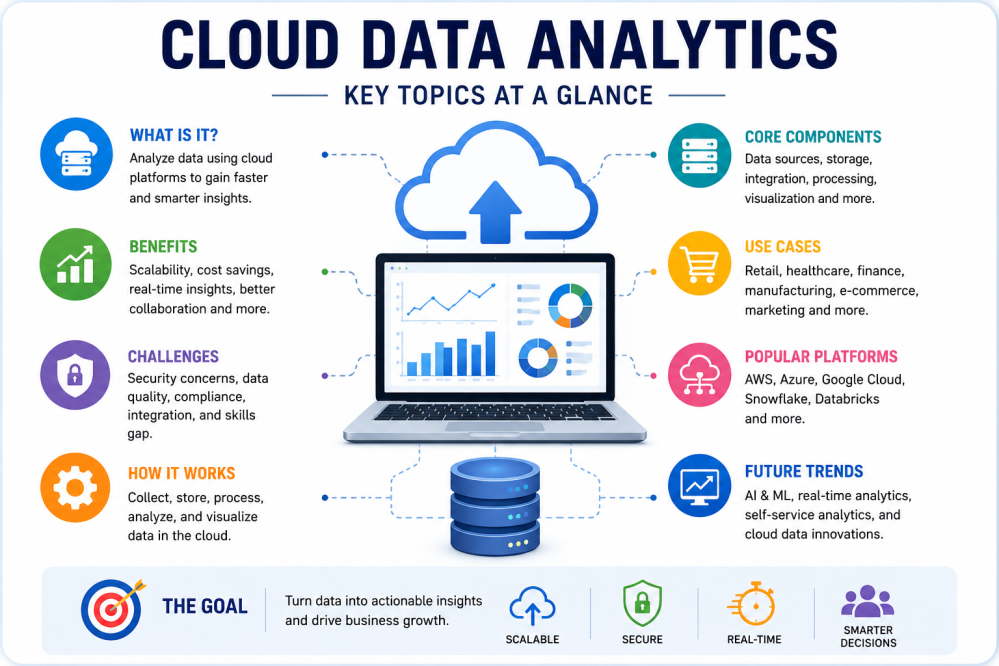
Cloud Data Analytics is the process of analyzing data using cloud-based tools and services.
In the past, businesses stored and analyzed information on local servers. While this approach worked for smaller datasets, it became difficult as data volumes increased.
Today, organizations generate information from many sources, including:
- Websites
- Mobile apps
- CRM systems
- ERP software
- Social media platforms
- IoT devices
Managing all this information on local systems can be expensive and complex.
Cloud analytics solves this problem. It allows businesses to store and process data on cloud platforms that can scale as data grows.
A typical Cloud Based Data Analytics solution includes:
- Data collection tools
- Cloud storage
- Data processing engines
- Analytics software
- Dashboards and reports
The goal is simple. Businesses want to transform raw data into useful insights that support decision-making.
For example, an online retailer can track customer purchases and identify popular products. A healthcare provider can analyze patient records to improve services. A manufacturer can monitor equipment performance and reduce downtime.
Because cloud analytics offers flexibility and scalability, it has become an essential part of modern business operations.
How Cloud Data Analytics Works
Many people think analytics is complicated. In reality, the process follows a few simple steps.
1. Data Collection
The first step is gathering information.
Businesses collect data from many sources, including:
- Websites
- Mobile applications
- Customer databases
- Sales systems
- Marketing platforms
- Connected devices
This information is sent to a cloud environment for storage and analysis.
2. Data Storage
After collection, the information is stored securely in the cloud.
Businesses often use:
- Cloud databases
- Data warehouses
- Data lakes
These systems can store large amounts of information without requiring expensive hardware.
3. Data Processing
Raw data is rarely ready for analysis.
Before businesses can use it, the data must be cleaned and organized. This process removes errors, duplicates, and incomplete records.
Good data quality leads to more accurate insights.
4. Data Analysis
Once the information is prepared, analytics tools begin analyzing it.
The system looks for:
- Patterns
- Trends
- Customer behaviors
- Business opportunities
These insights help organizations make informed decisions.
5. Data Visualization
The final step is presenting information in a simple format.
Most analytics platforms use:
- Charts
- Graphs
- Dashboards
- Reports
Visualization makes complex information easier to understand and share.
Why Businesses Are Moving to Cloud Data Analytics
Businesses need accurate information to stay competitive.
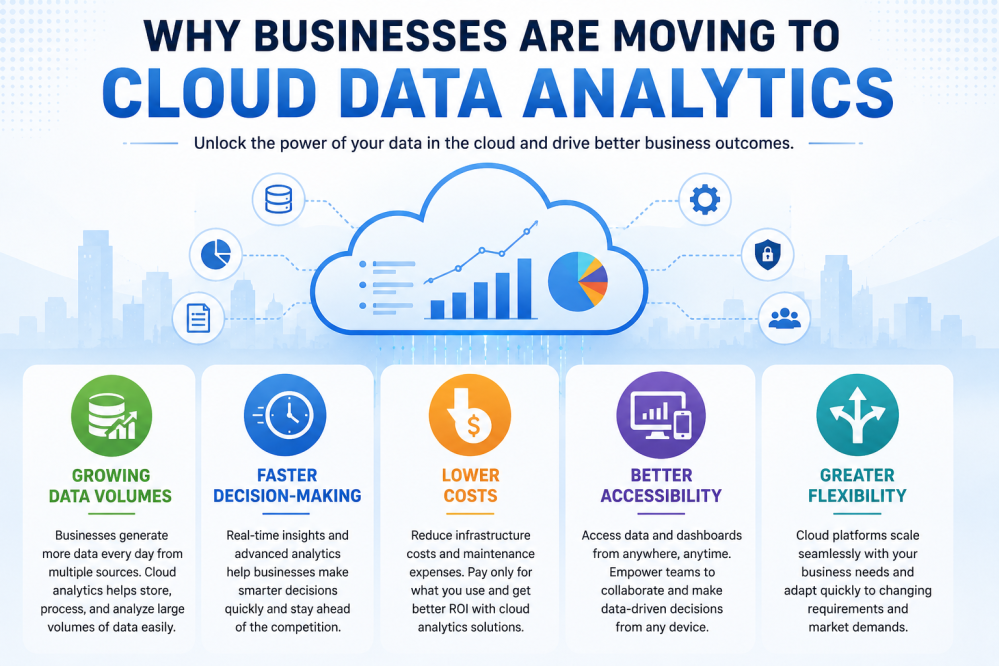
Cloud analytics provides the speed, flexibility, and scalability required in today’s market.
Growing Data Volumes
Every year, businesses generate more information.
Traditional systems often struggle to handle this growth.
Cloud platforms make it easy to store and process large datasets without major infrastructure upgrades.
Faster Decision-Making
Business leaders cannot wait days or weeks for reports.
Cloud analytics provides real-time access to important information.
This allows organizations to react quickly to changing market conditions.
Lower Costs
Building and maintaining data infrastructure can be expensive.
Cloud platforms reduce these costs because businesses only pay for the resources they use.
This makes advanced analytics more affordable.
Better Accessibility
Employees can access cloud-based dashboards from almost anywhere.
This is especially important for organizations with remote teams and multiple office locations.
Greater Flexibility
As business needs change, cloud platforms can scale up or down easily.
Organizations can increase storage and computing power without purchasing new hardware.
Core Components of Cloud Data Analytics
Several important components work together to make cloud analytics successful.
Data Sources
Data comes from many places.
Examples include customer databases, websites, applications, social media platforms, and connected devices.
The more relevant data businesses collect, the more valuable their insights become.
Data Storage
Information must be stored securely.
Cloud platforms provide flexible storage solutions that can handle both structured and unstructured data.
This allows businesses to manage growing datasets efficiently.
Data Integration
Many organizations use multiple software systems.
Data integration combines information from these systems into one location.
This creates a complete view of business operations.
Data Processing
Processing tools prepare information for analysis.
They clean, organize, and transform data into a usable format.
This step improves accuracy and reliability.
Data Visualization
Visualization tools present insights through charts, graphs, and dashboards.
These tools help decision-makers understand information quickly and take action.
Benefits of Cloud Data Analytics
Cloud analytics offers several advantages for businesses.
Scalability
One of the biggest benefits is scalability.
Businesses can increase storage and computing resources whenever needed.
This makes it easier to manage growing amounts of data.
Cost Savings
Cloud platforms reduce infrastructure expenses.
Organizations do not need to purchase expensive servers or maintain large data centers.
They only pay for the resources they use.
Faster Insights
Modern cloud systems process information quickly.
This allows businesses to access insights faster and make better decisions.
Real-Time Analytics
Many cloud platforms support real-time monitoring.
Businesses can track performance, identify issues, and respond immediately.
Better Collaboration
Cloud-based dashboards can be accessed by multiple teams.
This improves communication and helps departments work together more effectively.
Strong Security
Leading cloud providers invest heavily in security technologies.
Features such as encryption and access controls help protect sensitive business information.
Challenges of Cloud Data Analytics
Cloud analytics offers many benefits, but it also comes with challenges. Businesses should understand these challenges before starting a cloud analytics project.
Data Security Concerns
Data is one of the most valuable assets a business owns. When information is stored in the cloud, organizations must ensure it remains secure.
Businesses often handle sensitive information such as customer records, financial data, and business documents. If this data is not protected properly, it can create serious risks.
To reduce security concerns, organizations should use:
- Data encryption
- Multi-factor authentication
- Access controls
- Regular security monitoring
Choosing a trusted cloud provider is also important.
Data Quality Issues
Analytics is only as good as the data being analyzed.
If information contains errors, missing values, or duplicate records, the results may not be accurate. Poor-quality data can lead to poor business decisions.
Organizations should establish data quality processes that clean and validate information before analysis begins.
Compliance and Regulations
Many industries must follow strict regulations.
For example, healthcare organizations must protect patient data, while financial institutions must follow data privacy laws.
Businesses using cloud analytics must ensure they meet industry compliance requirements.
Integration Complexity
Many companies use multiple software platforms.
Customer data may be stored in one system while financial information exists in another.
Connecting all these systems can sometimes be challenging. Proper planning and integration tools help simplify this process.
Skills Gap
Modern analytics platforms are powerful, but they require knowledge and expertise.
Some organizations struggle because they do not have enough data professionals on their teams.
Training employees and working with analytics experts can help solve this problem.
Cloud Data Analytics vs Traditional Analytics
Many businesses still use traditional analytics systems. However, cloud analytics provides several advantages that make it a preferred choice for modern organizations.
Infrastructure
Traditional analytics requires physical servers and hardware.
Organizations must purchase, maintain, and upgrade this equipment regularly.
Cloud analytics removes this burden by providing infrastructure through cloud service providers.
Scalability
Traditional systems have limited capacity.
When data grows, businesses often need expensive upgrades.
Cloud platforms can scale instantly to handle larger workloads.
Cost
Traditional analytics usually involves high upfront investments.
Businesses must pay for servers, software licenses, maintenance, and IT support.
Cloud analytics uses a pay-as-you-go model. This makes it more affordable for many organizations.
Accessibility
Cloud dashboards can be accessed from almost anywhere.
Traditional systems often require access through company networks.
This flexibility makes cloud analytics ideal for remote and hybrid work environments.
Maintenance
Cloud providers handle software updates, security patches, and infrastructure management.
This reduces the workload for internal IT teams.
Comparison Table
| Feature | Traditional Analytics | Cloud Data Analytics |
| Infrastructure | On-Premise Servers | Cloud-Based |
| Scalability | Limited | Highly Scalable |
| Cost | High Upfront Cost | Pay-As-You-Go |
| Accessibility | Restricted | Anywhere Access |
| Maintenance | Internal IT Team | Managed by Provider |
| Speed | Moderate | Faster Processing |
Popular Cloud Data Analytics Platforms
Several cloud platforms help businesses collect, process, and analyze data.
Each platform offers unique features based on business needs.
Google Cloud Analytics
Google Cloud provides powerful analytics services for organizations that need scalability and advanced data processing.
Popular tools include:
- BigQuery
- Looker
- Dataflow
- Cloud Storage
These solutions help businesses analyze large datasets quickly.
Microsoft Azure Analytics
Microsoft Azure offers a wide range of analytics services.
Organizations use Azure to:
- Store data
- Build dashboards
- Run analytics workloads
- Integrate AI capabilities
Azure is especially popular among businesses already using Microsoft products.
Amazon Web Services (AWS)
AWS is one of the largest cloud providers in the world.
Its analytics services include:
- Amazon Redshift
- Athena
- EMR
- QuickSight
These tools help businesses process and analyze massive amounts of information.
Snowflake
Snowflake is a cloud-native data platform designed for analytics and data sharing.
It supports multiple cloud providers and offers excellent scalability.
Databricks
Databricks combines data engineering, analytics, and artificial intelligence in one platform.
Many organizations use Databricks for big data projects and machine learning initiatives.
Industry Use Cases of Cloud Data Analytics
Cloud analytics is used across many industries.
Different organizations use it to solve different business challenges.
Retail Analytics
Retail companies use analytics to understand customer behavior.
By studying purchasing patterns, businesses can:
- Improve inventory management
- Personalize marketing campaigns
- Increase customer satisfaction
Analytics helps retailers make smarter decisions about products and promotions.
Healthcare Analytics
Healthcare providers generate large amounts of patient data.
Cloud analytics helps organizations:
- Improve patient care
- Monitor health trends
- Reduce operational costs
- Support research initiatives
Healthcare teams can access information quickly and make informed decisions.
Financial Services Analytics
Banks and financial institutions rely heavily on data.
Analytics helps them:
- Detect fraud
- Assess risk
- Improve customer experiences
- Monitor transactions
Real-time analytics is especially important in the financial sector.
Manufacturing Analytics
Manufacturers use cloud analytics to improve efficiency.
Analytics platforms can monitor equipment performance and identify maintenance needs before failures occur.
This reduces downtime and improves productivity.
E-Commerce Analytics
Online businesses depend on customer data.
Analytics helps them understand:
- Shopping behavior
- Product performance
- Conversion rates
- Marketing effectiveness
These insights help improve sales and customer engagement.
Marketing Analytics
Marketing teams use analytics to measure campaign performance.
They can track:
- Website traffic
- Lead generation
- Customer engagement
- Advertising ROI
This helps marketers optimize their strategies and improve results.
How to Implement Cloud Data Analytics
Implementing cloud analytics requires a clear strategy.
Businesses should follow a structured approach to achieve the best results.
Define Business Goals
Start by identifying business objectives.
Ask questions such as:
- What problems need solving?
- Which metrics matter most?
- What decisions will analytics support?
Clear goals improve project success.
Assess Existing Data Sources
Organizations should understand where their data comes from.
This includes:
- CRM systems
- ERP software
- Marketing tools
- Databases
- External sources
A complete data inventory helps avoid gaps.
Select the Right Platform
Different platforms offer different capabilities.
Businesses should compare features, costs, security, and scalability before making a decision.
Build Data Pipelines
Data pipelines move information from source systems into analytics environments.
Well-designed pipelines improve efficiency and accuracy.
Create Dashboards and Reports
Dashboards help users understand information quickly.
Businesses should focus on metrics that support decision-making.
Monitor and Improve
Analytics is not a one-time project.
Organizations should continuously review performance and make improvements over time.
Future Trends in Cloud Data Analytics
Technology is changing quickly. As businesses generate more data, cloud analytics platforms continue to evolve.
Several trends are shaping the future of Cloud Data Analytics.
Artificial Intelligence and Machine Learning
Artificial intelligence (AI) is becoming a major part of analytics.
Modern platforms can automatically identify patterns, detect anomalies, and generate insights without requiring extensive manual work.
Machine learning models help businesses:
- Predict customer behavior
- Improve forecasting
- Detect fraud
- Automate decision-making
As AI becomes more advanced, analytics will become faster and more accurate.
Real-Time Analytics
Businesses no longer want to wait hours or days for reports.
They need information immediately.
Real-time analytics allows organizations to monitor operations as events happen.
For example:
- Retailers can track sales instantly.
- Banks can detect suspicious transactions immediately.
- Manufacturers can monitor equipment performance in real time.
This helps businesses respond faster and reduce risks.
Self-Service Analytics
In the past, analytics often depended on technical teams.
Today, many platforms provide self-service tools.
Business users can create dashboards, run reports, and explore data without writing code.
This makes analytics more accessible across the organization.
Predictive Analytics
Predictive analytics uses historical data to estimate future outcomes.
Businesses use predictive models to:
- Forecast demand
- Predict customer churn
- Optimize inventory
- Improve financial planning
As cloud platforms become more powerful, predictive analytics will become a standard business capability.
Data Lakehouse Architecture
Many organizations are moving toward Data Lakehouse architectures.
A lakehouse combines the flexibility of a data lake with the performance of a data warehouse.
This approach helps businesses manage structured and unstructured data in a single environment.
As data volumes continue to grow, lakehouses are expected to become more popular.
Best Practices for Successful Cloud Data Analytics
A successful analytics strategy requires more than technology.
Organizations should follow best practices to maximize value.
Focus on Data Quality
Accurate insights depend on accurate data.
Businesses should regularly review, clean, and validate their information.
Poor data quality can lead to poor decisions.
Establish Strong Governance
Data governance defines how information is collected, managed, and used.
Clear governance policies improve security, compliance, and consistency.
Train Employees
Analytics tools are only effective when people know how to use them.
Organizations should provide training programs that improve analytics skills across teams.
Measure Business Impact
Every analytics initiative should support business goals.
Track key performance indicators (KPIs) to measure the impact of analytics projects.
This helps justify investments and identify improvement opportunities.
Continuously Improve
Business needs change over time.
Analytics strategies should evolve as new technologies, challenges, and opportunities emerge.
Regular reviews help organizations stay competitive.
Conclusion
Data has become one of the most valuable assets in modern business.
Organizations that can collect, analyze, and act on data effectively gain a significant competitive advantage.
Cloud Data Analytics makes this possible by providing scalable infrastructure, advanced analytics capabilities, and real-time access to insights.
Businesses no longer need expensive hardware or complex on-premise systems to manage data. Cloud platforms offer flexibility, speed, and cost efficiency that support growth and innovation.
While challenges such as security, compliance, and integration must be addressed, the benefits often outweigh the risks.
Companies across industries are already using cloud analytics to improve customer experiences, optimize operations, reduce costs, and make better decisions.
As technologies such as artificial intelligence, machine learning, and predictive analytics continue to advance, cloud analytics will become even more powerful.
Organizations that invest in cloud analytics today will be better prepared for tomorrow’s data-driven economy.
Frequently Asked Questions (FAQs)
What Is Cloud Data Analytics?
Cloud Data Analytics is the process of collecting, storing, processing, and analyzing data using cloud-based platforms and services. It helps businesses gain insights without investing heavily in physical infrastructure.
How Does Cloud Data Analytics Work?
Cloud analytics collects data from different sources, stores it in the cloud, processes it, and presents insights through reports and dashboards.
What Are the Main Benefits of Cloud Data Analytics?
Some major benefits include:
- Scalability
- Cost savings
- Faster processing
- Real-time insights
- Better collaboration
- Improved decision-making
Which Industries Use Cloud Data Analytics?
Many industries use cloud analytics, including:
- Retail
- Healthcare
- Banking
- Manufacturing
- E-Commerce
- Marketing
What Are the Most Popular Cloud Analytics Platforms?
Popular cloud analytics platforms include:
- Google Cloud
- Microsoft Azure
- Amazon Web Services (AWS)
- Snowflake
- Databricks
Is Cloud Data Analytics Secure?
Yes. Most leading cloud providers offer strong security features such as encryption, identity management, access controls, and continuous monitoring.
However, businesses must also follow security best practices and compliance requirements.