


Introduction
Artificial Intelligence (AI) is no longer a technology of the future. It is already changing the way businesses operate and how people interact with technology every day. Whether you use a virtual assistant, receive product recommendations while shopping online, or unlock your smartphone using facial recognition, AI is working behind the scenes.
As AI continues to grow, two related terms are becoming increasingly common: Machine Learning (ML) and Deep Learning (DL). These technologies are often used interchangeably, but they are not the same. While they are closely connected, each has a different purpose, different capabilities, and different business applications.
Understanding the difference between AI, Machine Learning, and Deep Learning helps organizations choose the right technology for their goals. It also helps professionals, students, and decision-makers understand how modern intelligent systems work.
The relationship between these technologies is simple.
- Artificial Intelligence is the broad concept of building intelligent systems.
- Machine Learning is a subset of AI that enables systems to learn from data.
- Deep Learning is a specialized branch of Machine Learning that uses artificial neural networks to solve complex problems.
Together, these technologies are transforming industries such as healthcare, banking, retail, manufacturing, logistics, education, and marketing.
In this guide, you will learn:
- What Artificial Intelligence is
- What Machine Learning is
- What Deep Learning is
- How these technologies differ
- Their benefits and limitations
- Real-world business applications
- Which technology is best for different use cases
By the end of this article, you will have a clear understanding of how AI, Machine Learning, and Deep Learning work together to power modern digital transformation.
What Is Artificial Intelligence (AI)?
Artificial Intelligence, commonly known as AI, is the ability of computers and software systems to perform tasks that normally require human intelligence. These tasks include learning, reasoning, problem-solving, language understanding, decision-making, image recognition, and pattern detection.
Unlike traditional computer programs that follow fixed instructions, AI systems can analyze information, recognize patterns, and improve their responses over time. This ability makes AI valuable for solving problems that involve large amounts of data and complex decision-making.
Today, organizations across almost every industry use Artificial Intelligence to automate routine work, improve operational efficiency, and deliver better customer experiences.
Instead of replacing people, AI is mainly designed to assist them by reducing repetitive work and providing faster, data-driven insights.
Types of Artificial Intelligence
Artificial Intelligence is generally classified into three categories based on its capabilities.
Narrow AI (Artificial Narrow Intelligence)
Narrow AI is built to perform a single task or a limited set of tasks. It cannot think or operate beyond its specific purpose.
Examples include:
- Voice assistants
- Spam email filters
- Product recommendation systems
- Face recognition software
- Language translation tools
Almost every AI application used today falls into this category.
General AI (Artificial General Intelligence)
General AI refers to machines that can perform any intellectual task a human can perform.
Such systems would be capable of learning new skills, adapting to unfamiliar situations, solving different kinds of problems, and making independent decisions.
Although researchers continue working toward this goal, General AI has not yet been achieved.
Super AI (Artificial Super Intelligence)
Super AI is a theoretical concept describing machines that become more intelligent than humans in every aspect.
These systems would possess advanced reasoning, creativity, emotional intelligence, and decision-making abilities.
At present, Super AI exists only as a concept and has not been developed.
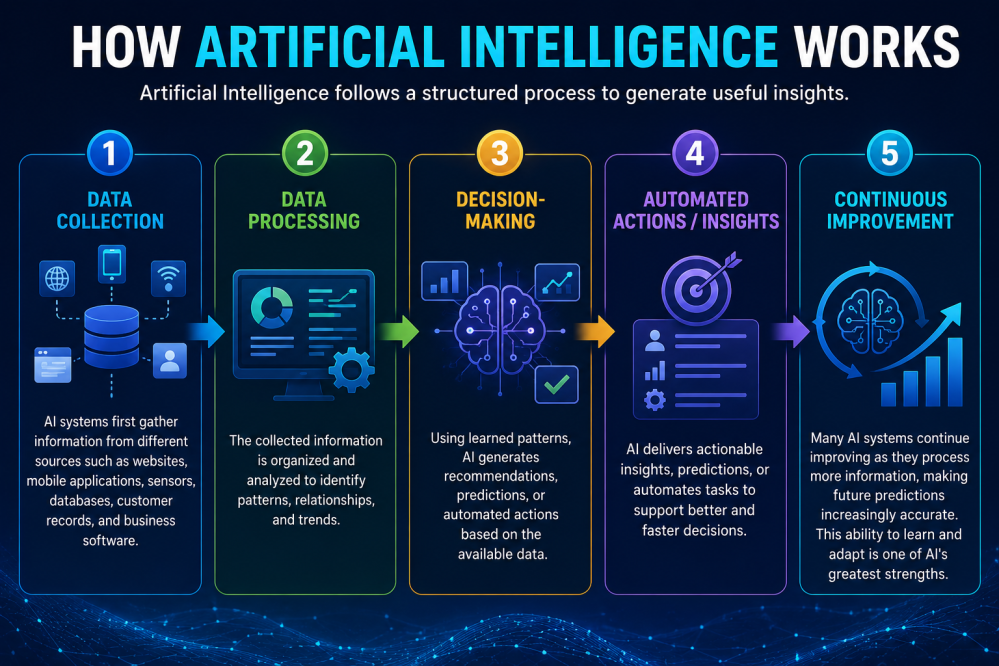
How Artificial Intelligence Works
Artificial Intelligence follows a structured process to generate useful insights.
Data Collection
AI systems first gather information from different sources such as websites, mobile applications, sensors, databases, customer records, and business software.
Data Processing
The collected information is organized and analyzed to identify patterns, relationships, and trends.
Decision-Making
Using learned patterns, AI generates recommendations, predictions, or automated actions based on the available data.
Continuous Improvement
Many AI systems continue improving as they process more information, making future predictions increasingly accurate.
This ability to learn and adapt is one of AI’s greatest strengths.
Real-World Applications of Artificial Intelligence
Artificial Intelligence is already improving everyday experiences for millions of people.
Virtual Assistants
Applications such as Siri, Alexa, and Google Assistant understand spoken language and help users complete tasks more efficiently.
Recommendation Systems
Streaming platforms and online shopping websites analyze customer behavior to recommend movies, music, or products that match user preferences.
Customer Support
Businesses use AI-powered chatbots to answer common customer questions around the clock, reducing waiting times and improving service quality.
Navigation and Traffic Management
Navigation apps analyze live traffic conditions and recommend the fastest travel routes.
Fraud Detection
Banks and financial institutions monitor transactions in real time to detect suspicious activities and prevent fraud before it occurs.
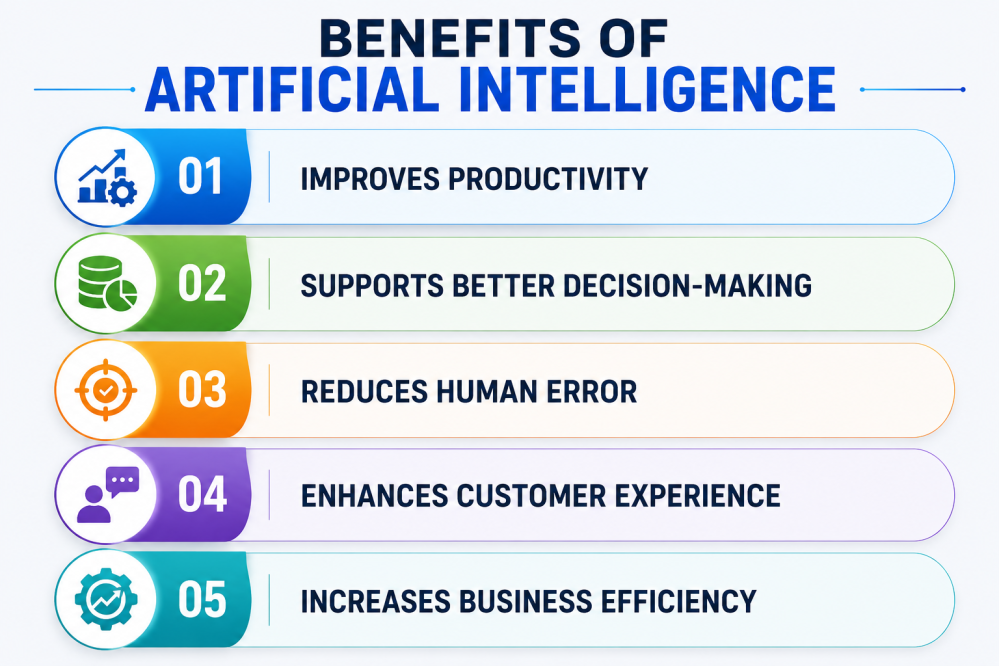
Benefits of Artificial Intelligence
Artificial Intelligence offers several advantages for organizations of all sizes.
Improves Productivity
AI automates repetitive administrative work, allowing employees to focus on strategic and creative activities.
Supports Better Decision-Making
By analyzing large datasets within seconds, AI helps organizations make faster and more informed decisions.
Reduces Human Error
AI systems follow consistent rules and processes, improving accuracy across business operations.
Enhances Customer Experience
Personalized recommendations, intelligent chatbots, and automated support services create better customer interactions.
Increases Business Efficiency
Organizations can optimize operations, reduce costs, and improve overall performance using AI-driven automation.
What Is Machine Learning?
Machine Learning (ML) is one of the most important branches of Artificial Intelligence.
Instead of programming a computer with detailed instructions for every possible situation, Machine Learning enables systems to learn from historical data and improve through experience.
This means the computer identifies patterns on its own and uses those patterns to make predictions or decisions.
As more quality data becomes available, the model continuously becomes more accurate.
Because of this capability, Machine Learning has become one of the most widely adopted technologies in modern business.
Organizations use Machine Learning to improve forecasting, personalize customer experiences, detect fraud, optimize inventory, and automate decision-making.
How Machine Learning Works
Machine Learning follows a structured learning process.
Step 1: Collect Data
The system gathers information from websites, CRM systems, ERP platforms, sensors, mobile applications, and other business sources.
Step 2: Prepare the Data
The collected information is cleaned by removing errors, duplicate records, and missing values.
High-quality data produces better results.
Step 3: Train the Model
The algorithm studies historical information to identify relationships between different variables.
This learning process enables the model to recognize similar patterns in new data.
Step 4: Test the Model
The trained model is evaluated using new datasets to measure prediction accuracy.
Step 5: Improve Performance
As additional data becomes available, the Machine Learning model continues improving automatically.
This continuous learning process makes ML valuable for businesses that generate growing amounts of information.
What Is Deep Learning?
Deep Learning (DL) is an advanced branch of Machine Learning that enables computers to solve highly complex problems by learning from large amounts of data. While traditional Machine Learning models often require humans to identify important features in a dataset, Deep Learning automatically discovers those features on its own.
The technology is inspired by the human brain. It uses artificial neural networks, which consist of multiple layers that process information step by step. Each layer extracts more detailed information, allowing the system to recognize patterns with remarkable accuracy.
Deep Learning is particularly useful when working with unstructured data such as images, videos, speech, and natural language. Because of its ability to process massive datasets, it has become a key technology behind many modern AI applications.
Today, businesses use Deep Learning to improve automation, customer experiences, medical diagnosis, cybersecurity, and predictive analytics.
How Deep Learning Works
Deep Learning models learn through a series of interconnected layers called neural networks. Each layer performs a specific task before passing information to the next layer.
Instead of relying on manually programmed rules, the model gradually learns patterns through repeated training.
Step 1: Input Layer
The learning process begins with raw data.
The input may include:
- Images
- Videos
- Audio recordings
- Documents
- Customer information
- Sensor data
This information enters the neural network for analysis.
Step 2: Hidden Layers
The hidden layers perform the actual learning.
Each layer identifies increasingly detailed features.
For example, when recognizing a human face:
- The first layer detects lines and edges.
- The second layer identifies shapes.
- The third layer recognizes facial features.
- The final layers identify the person’s identity.
This layered learning process enables Deep Learning models to solve complex recognition problems.
Step 3: Output Layer
After processing all the information, the final layer generates a prediction or classification.
Examples include:
- Detecting whether an email is spam.
- Identifying diseases from medical images.
- Translating one language into another.
- Recognizing objects in photographs.
The more quality data the model receives, the more accurate its predictions become.
Real-World Applications of Deep Learning
Deep Learning powers many technologies that people use every day. Its ability to process large datasets makes it valuable across different industries.
Healthcare
Hospitals use Deep Learning to analyze X-rays, MRI scans, and CT images.
Doctors can identify diseases more quickly and improve diagnosis accuracy with AI-assisted image analysis.
Banking and Finance
Banks monitor millions of transactions every day.
Deep Learning identifies suspicious activities and helps prevent financial fraud before it causes significant losses.
Retail and E-commerce
Online retailers study customer behavior to recommend products based on browsing history and previous purchases.
These recommendations improve customer satisfaction and increase sales.
Manufacturing
Manufacturers use Deep Learning to monitor production equipment.
The technology predicts machine failures before they happen, reducing downtime and maintenance costs.
Autonomous Vehicles
Self-driving vehicles rely on Deep Learning to recognize roads, pedestrians, traffic signs, and nearby vehicles.
These systems continuously process environmental information to improve driving safety.
AI vs Machine Learning vs Deep Learning
Although these three technologies are closely connected, they are not identical.
The easiest way to understand their relationship is to think of three nested circles.
- Artificial Intelligence is the largest category.
- Machine Learning is a subset of Artificial Intelligence.
- Deep Learning is a subset of Machine Learning.
Every Deep Learning model is a Machine Learning model.
Every Machine Learning model belongs to Artificial Intelligence.
However, not every AI system uses Machine Learning, and not every Machine Learning solution uses Deep Learning.
Each technology is designed to solve different types of business problems.
Artificial Intelligence focuses on building intelligent systems.
Machine Learning focuses on learning patterns from historical data.
Deep Learning specializes in solving highly complex problems using neural networks.
Key Differences Between AI, Machine Learning, and Deep Learning
Although AI, Machine Learning, and Deep Learning work together, they differ in several important ways.
| Feature | Artificial Intelligence | Machine Learning | Deep Learning |
| Definition | Broad field of creating intelligent systems | Branch of AI that learns from data | Branch of Machine Learning using neural networks |
| Goal | Mimic human intelligence | Learn patterns and make predictions | Solve highly complex problems automatically |
| Data Requirement | Moderate | High | Very High |
| Human Involvement | High | Moderate | Low |
| Feature Engineering | Mostly manual | Partly manual | Mostly automatic |
| Computing Power | Moderate | High | Very High |
| Best For | Automation and decision-making | Prediction and forecasting | Image, speech, and language recognition |
This comparison shows that the technologies complement one another rather than compete.
Organizations often combine all three to build intelligent business solutions.
When Should Businesses Use AI, Machine Learning, or Deep Learning?
Choosing the right technology depends on the business objective, the amount of available data, and the complexity of the problem.
Use Artificial Intelligence When
AI is ideal for automating repetitive tasks and improving operational efficiency.
Common examples include:
- Customer support chatbots
- Intelligent virtual assistants
- Workflow automation
- Smart document processing
Use Machine Learning When
Machine Learning is best for identifying trends and predicting future outcomes.
Typical business applications include:
- Sales forecasting
- Customer churn prediction
- Fraud detection
- Product recommendations
- Inventory optimization
Use Deep Learning When
Deep Learning is the right choice for highly complex problems involving unstructured data.
Examples include:
- Facial recognition
- Speech recognition
- Medical image analysis
- Self-driving vehicles
- Language translation
- Video analytics
Businesses should choose the technology that best matches their data, resources, and objectives rather than assuming one approach is always better than another.
Advantages of Artificial Intelligence
Artificial Intelligence has become a valuable technology for businesses because it helps improve efficiency, reduce manual work, and support better decision-making. Organizations across healthcare, finance, retail, manufacturing, and logistics use AI to solve business challenges and improve customer experiences.
Automates Repetitive Tasks
Many business activities, such as data entry, invoice processing, customer support, and scheduling, consume valuable time. AI automates these repetitive tasks, allowing employees to focus on creative and strategic work.
Improves Decision-Making
AI analyzes large volumes of structured and unstructured data within seconds. It identifies hidden patterns and provides insights that help managers make informed business decisions faster.
Enhances Customer Experience
Businesses use AI-powered chatbots, recommendation engines, and virtual assistants to deliver personalized customer experiences. Faster responses and relevant recommendations improve customer satisfaction.
Increases Operational Efficiency
AI reduces manual errors, speeds up business processes, and optimizes workflows. This leads to lower operational costs and higher productivity.
Supports Business Growth
Organizations can scale operations more effectively with AI-powered automation. As business data grows, AI continues to deliver valuable insights without significantly increasing manual effort.
Advantages of Machine Learning
Machine Learning helps organizations discover valuable insights from historical data. Instead of relying only on fixed business rules, ML continuously improves predictions as more information becomes available.
Better Predictions
Machine Learning analyzes historical trends to forecast future outcomes. Businesses use these predictions for demand forecasting, customer behavior analysis, and financial planning.
Detects Fraud Faster
Banks and financial institutions process millions of transactions every day. Machine Learning identifies unusual activities and alerts security teams before major fraud occurs.
Personalized Recommendations
Online stores, streaming platforms, and digital services recommend products or content based on customer preferences. Personalized experiences increase customer engagement and sales.
Continuous Learning
Unlike traditional software, Machine Learning models improve over time as they receive additional data. This allows businesses to make increasingly accurate decisions.
Advantages of Deep Learning
Deep Learning offers powerful capabilities for solving highly complex problems involving images, speech, video, and natural language.
Excellent Accuracy
Deep Learning models achieve high accuracy when trained using large datasets. This makes them suitable for applications where precision is essential.
Automatic Feature Extraction
Traditional Machine Learning often requires experts to manually identify important features in the data.
Deep Learning performs this process automatically, reducing development time and improving performance.
Processes Unstructured Data
Deep Learning can analyze images, videos, voice recordings, and text documents more effectively than many traditional algorithms.
Handles Complex Problems
Applications such as facial recognition, medical diagnosis, autonomous driving, and speech recognition rely on Deep Learning because of its advanced learning capabilities.
Real-World Business Applications
Artificial Intelligence, Machine Learning, and Deep Learning are transforming industries worldwide. Businesses use these technologies to improve efficiency, reduce costs, and deliver better services.
Healthcare
Hospitals use AI to manage patient records, Machine Learning to predict disease risks, and Deep Learning to analyze medical images such as MRI scans and X-rays.
Banking and Financial Services
Financial organizations use AI-powered chatbots for customer support, Machine Learning for fraud detection, and Deep Learning to assess financial risks and improve investment strategies.
Retail and E-commerce
Retail businesses analyze customer purchase history to recommend products, optimize pricing, and forecast inventory requirements.
Manufacturing
Manufacturers use predictive maintenance powered by Machine Learning and Deep Learning to monitor equipment and reduce unexpected downtime.
Marketing
Marketing teams use AI to automate campaigns, segment audiences, personalize customer journeys, and improve advertising performance.
Cybersecurity
Modern cybersecurity systems continuously monitor networks using AI and Machine Learning to detect suspicious activities and respond to threats faster.
AI vs Machine Learning vs Deep Learning vs Data Science
Artificial Intelligence, Machine Learning, Deep Learning, and Data Science are closely related, but each serves a different purpose.
Data Science focuses on collecting, cleaning, analyzing, and interpreting data to solve business problems.
Artificial Intelligence focuses on creating systems that simulate human intelligence.
Machine Learning enables those systems to learn from historical data.
Deep Learning uses advanced neural networks to solve complex tasks involving speech, images, and language.
Data Science provides the foundation by preparing the data needed for AI and Machine Learning models.Organizations often combine all four disciplines to build intelligent, data-driven solutions.
Challenges and Limitations
Although AI technologies offer significant benefits, organizations should understand their limitations before implementation.
Data Quality
AI models perform well only when trained using accurate, complete, and reliable data. Poor-quality data often leads to poor predictions.
High Infrastructure Costs
Advanced Deep Learning models require powerful hardware, cloud computing resources, and specialized software, increasing implementation costs.
Privacy and Security
Organizations must protect sensitive customer information using strong security policies, encryption, and access controls.
Skilled Professionals
Building AI solutions requires experienced data scientists, Machine Learning engineers, and AI specialists. Many organizations invest heavily in training and recruitment.
Ethical Concerns
Businesses should ensure AI systems remain transparent, fair, and free from bias while complying with industry regulations.
Future Trends in AI, Machine Learning, and Deep Learning
Artificial Intelligence continues to evolve rapidly. Businesses are investing heavily in intelligent technologies to improve innovation and remain competitive.
Several trends are expected to shape the future.
- Generative AI for content creation and software development
- AI Agents capable of performing multi-step business tasks
- Explainable AI for greater transparency
- Edge AI for faster local processing
- Responsible AI focused on fairness, security, and privacy
- AI-powered business automation across industries
Organizations that adopt these technologies early will be better prepared for future business challenges and opportunities.
Conclusion
Artificial Intelligence, Machine Learning, and Deep Learning are connected technologies, but each has a unique role in modern computing.
Artificial Intelligence is the broad field that focuses on creating intelligent systems. Machine Learning enables computers to learn from data without explicit programming. Deep Learning builds on Machine Learning by using neural networks to solve highly complex problems with exceptional accuracy.
Choosing the right technology depends on your business goals, available data, and technical requirements. While AI improves automation, Machine Learning delivers accurate predictions, and Deep Learning solves advanced recognition problems.
As organizations continue embracing digital transformation, these technologies will become even more important for improving efficiency, enhancing customer experiences, and driving business innovation.
Frequently Asked Questions (FAQs)
1. What is the main difference between AI, Machine Learning, and Deep Learning?
Artificial Intelligence is the broad concept of intelligent systems. Machine Learning is a subset of AI that learns from data, while Deep Learning is a specialized branch of Machine Learning that uses neural networks.
Included Keyword: AI vs Machine Learning vs Deep Learning
2. Is Deep Learning better than Machine Learning?
Not always. Deep Learning is better for complex tasks involving images, speech, and language, while Machine Learning works well for structured data and predictive analytics.
Included Keyword: Deep Learning vs Machine Learning vs AI
3. Which industries use AI the most?
Healthcare, banking, retail, manufacturing, logistics, education, marketing, and cybersecurity are among the largest users of Artificial Intelligence.
Included Keyword: AI Applications
4. Can small businesses use AI?
Yes. Many affordable AI tools help small businesses automate customer support, marketing, sales, reporting, and business operations.