


Artificial Intelligence often sounds complex inside organizations. Business teams hear about machine learning algorithms, datasets, neural networks, and AI agents, but how these systems actually learn is rarely explained in simple terms. This lack of clarity can create hesitation, poor expectations, or confusion during AI adoption.
The reality is that AI systems do not think or understand like humans. They learn by identifying patterns in data and improving their results over time. Once this process is understood at a basic level, AI becomes far less intimidating and much easier to evaluate from a business perspective.
This guide explains how AI systems learn using everyday language, focusing on data, learning approaches, and how insights turn into action inside business environments.
What does it actually mean when we say an AI system “learns”?
When people say an AI system is learning, they usually mean it is getting better at a task by using past data. There is no awareness involved. Learning is simply the process of making fewer mistakes as more examples are seen.
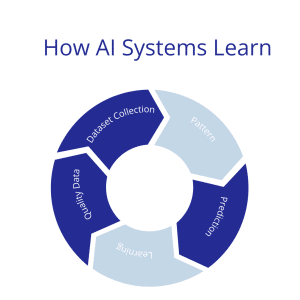
AI Learning Means Improving from Data
AI doesn’t have awareness; it gets better at tasks by using past examples and reducing mistakes over time.
Datasets Are the Foundation
A dataset is a collection of real-world examples—like sales, payments, text, or images—that teach the AI how to recognize patterns.
Pattern Recognition Drives Learning
AI scans datasets to find repeating patterns, such as common customer behaviors or frequently purchased products, without understanding why they occur.
Learning Happens Through Repetition
The system makes predictions, compares them to actual outcomes, and adjusts itself slightly. Over time, these small updates improve accuracy.
Data Quality Matters Most
High-quality, unbiased data is essential. Poor datasets lead to poor AI performance, no matter how advanced the algorithms are.
The role of data in learning: from raw datasets to validation
AI systems do not learn from a single report or dashboard. Learning requires different types of data, each playing a specific role in improving accuracy.
Most systems use three main stages of data:
- Training data to learn patterns
- Validation data in machine learning to check reliability
- Test data to measure real-world performance
Validation data is especially important. It ensures the system is learning useful patterns rather than memorizing past behavior. Without validation, AI systems may appear accurate but fail when conditions change.
For example, in customer segmentation using machine learning, validation checks whether customer groups still make sense for new users, not just past ones. This helps businesses trust the output and use it confidently.
This process also explains why AI projects take time. Data must be cleaned, reviewed, and updated. As new data flows in, systems adapt automatically, which is one of the key benefits of machine learning.
From a business perspective, data acts as the teacher. Better data leads to better decisions.
How different machine learning approaches support business goals
Not all AI systems learn the same way. The types of machine learning algorithms used depend on the business problem being solved.
Some systems learn from labeled examples, while others find patterns on their own. Understanding this helps businesses choose the right approach instead of relying on trial and error.
Common learning approaches include:
- Supervised learning, used for predictions like demand forecasting or fraud detection
- Unsupervised learning, used for market research and customer segmentation
- Reinforcement learning, used for adaptive decisions that improve through feedback
Behind many of these systems are neural networks. While the fundamentals of neural networks architectures, algorithms, and applications are technical, the business takeaway is simple: neural networks help AI systems handle complex data such as text, images, and speech.
This is why AI works well in areas like natural language processing solutions, payment analysis, and pattern recognition. Neural networks allow systems to learn from large, unstructured datasets that traditional software struggles with.
Choosing the right learning method affects accuracy, transparency, and scalability. This decision should always be guided by business goals, not technology trends.
From learning to action: AI agents, planning, and system structure
Learning alone does not create value. AI becomes useful when insights lead to action. This is where AI agents and system design matter.
A knowledge based agent uses stored information and logical rules to make decisions. This approach is useful in areas like payments or data security, where consistency and explainability are critical.
Agent architecture in AI defines how data, learning models, and decisions connect. An artificial intelligence block diagram typically shows data input, learning components, planning logic, and outputs working together.
Planning helps AI systems decide what action to take and in what order. The components of planning in AI support activities such as resource allocation, scheduling, and prioritization.
Most modern systems rely on cloud platforms. Discussions around AI vs cloud computing often arise because cloud-based services can open doors to leveraging AI at scale. Cloud infrastructure provides flexibility, storage, and computing power, while AI delivers intelligence.
As AI systems grow more capable, businesses also begin addressing limitations. Questions like what challenges does generative AI face with respect to data or what is one challenge in ensuring fairness in generative AI become important for responsible adoption.
Understanding the limits of generative AI and why data still matters
Generative AI has become popular because it can create text, images, and summaries quickly. While this capability is useful, it also comes with clear limitations that business teams need to understand.
One important concern is what challenges does generative AI face with respect to data. These systems learn from large volumes of historical information. If that data contains bias, gaps, or outdated assumptions, the outputs will reflect the same problems. Generative AI does not evaluate whether data is fair or accurate.
Another common question is what is one thing current generative AI applications cannot do. They cannot truly understand meaning or intent. Instead of reasoning, they predict the most likely response based on patterns. This is why human review is essential, especially in areas like payments, customer communication, and compliance.
Ensuring fairness is also difficult. When organizations ask what is one challenge in ensuring fairness in generative AI, the answer often relates to representation. If certain user groups or scenarios are missing from training data, the system may produce uneven or misleading results.
For businesses, generative AI should be used as a support tool, not a replacement for judgment. Clear guidelines and oversight are necessary for responsible use.
Predictive and prescriptive analytics and how AI supports decisions
Once AI systems learn from data, they help organizations move beyond reporting. This is where predictive and prescriptive analytics become valuable.
Predictive analytics focuses on forecasting future outcomes, such as demand, risk, or customer behavior. AI improves these predictions by learning from historical patterns and adjusting as new data becomes available.
Prescriptive analytics goes a step further by suggesting actions. Instead of only showing trends, it helps decision-makers understand what to do next. Together, predictive and prescriptive analytics support better planning and more consistent decisions.
These approaches are commonly used in customer segmentation using machine learning and AI for market research, where understanding future behavior drives strategy.
AI in cloud computing and business operations
As AI systems grow, infrastructure plays an important role. AI in cloud computing allows organizations to scale learning systems without heavy upfront investment.
AI delivers intelligence, while cloud platforms provide storage, computing power, and flexibility. Cloud-based services can open doors to leveraging AI by making experimentation and deployment easier for teams of all sizes.
AI learning also delivers value in daily operations. In AI in payments, systems learn transaction patterns to detect unusual activity. In AI in data security, learning models adapt as new threats emerge. These systems improve over time because they continuously learn from new data.
Conclusion
AI systems learn by analyzing data, identifying patterns, and improving through feedback. They do not think or understand intent, but they excel at handling complexity and scale.
For business teams, understanding these limits and strengths is essential. When paired with strong data foundations, governance, and human oversight, AI becomes a reliable tool for better decisions, efficiency, and long-term growth.
Frequently Asked Questions (FAQs)
How can non-technical teams monitor AI learning progress in companies?
Business teams can track AI outputs with dashboards showing accuracy, trends, and performance metrics without needing coding skills.
What are simple indicators that an AI system is improving over time?
Improved prediction accuracy, consistent decision patterns, and reduced errors indicate that an AI system is learning effectively.
How often should AI systems be updated with new business data?
AI models should be updated regularly, depending on data changes and business cycles, to remain accurate and relevant.
How do AI systems handle unexpected or new data in business applications?
AI adapts using retraining or feedback loops, learning from new examples to improve future predictions.
Can small businesses benefit from AI learning without large datasets?
Yes, even small datasets can train AI for targeted tasks, especially when combined with pre-trained models or incremental learning techniques.