


Banking and financial institutions generate enormous volumes of data every day through transactions, customer interactions, digital channels, and internal operations. This data, when analyzed correctly, becomes a critical foundation for improving decision making, managing risk, and understanding customer needs. Banking and financial services analytics focuses on turning complex financial data into meaningful insights that support stability, efficiency, and trust. As Data analytics financial ecosystems become more digital and interconnected, analytics plays an essential role in helping institutions navigate change with confidence.
Understanding the Scope of Banking and Financial Services Analytics
Banking and financial services analytics refers to the structured analysis of data produced across retail banking, corporate banking, lending, payments, and investment activities. It goes beyond simple reporting and looks deeper into patterns, behaviors, and long term trends.
Analytics helps financial institutions move from reactive decision making to proactive planning. Instead of responding to issues after they occur, banks can anticipate customer needs, identify potential risks, and improve operational consistency. This shift allows institutions to operate more transparently while aligning decisions with regulatory and customer expectations.
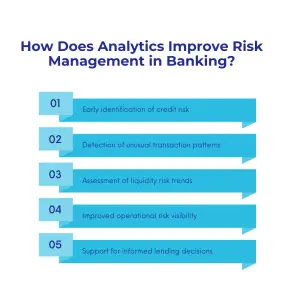
Early identification of credit risk
Analytics examines historical repayment behavior and account activity to identify early signs of credit stress. This helps banks evaluate borrower reliability before issues escalate. Decisions become more balanced between growth and risk control.
Detection of unusual transaction patterns
By monitoring transaction flows over time, analytics highlights behaviors that fall outside normal patterns. These insights help identify potential fraud or operational anomalies early. Faster detection reduces financial exposure and investigation time.
Assessment of liquidity risk trends
Analytics tracks cash flow movements and funding patterns across products and channels. This visibility helps institutions anticipate liquidity gaps before they affect operations. Planning becomes more stable under changing market conditions.
Improved operational risk visibility
Process level data analysis reveals breakdowns in workflows and system dependencies. This allows banks to address vulnerabilities that could lead to errors or service disruptions. Risk management becomes proactive rather than reactive.
Support for informed lending decisions
Analytics combines customer profiles, market data, and historical outcomes to guide lending strategies. Risk is evaluated using evidence rather than assumptions. This results in more consistent and sustainable credit decisions.
Customer Insights and Relationship Management in Financial Institutions
Understanding customers has become increasingly complex as banking services expand across digital and physical channels. Analytics helps financial institutions build a unified view of customer behavior across accounts, products, and touchpoints.
Customer analytics supports
- Identification of changing financial needs over time
- Segmentation based on usage patterns and engagement levels
- Understanding customer lifetime value trends
These insights help banks improve communication relevance and align offerings with actual customer intent. When customer relationships are guided by data rather than assumptions, trust and long term engagement improve naturally.
Fraud Detection and Transaction Monitoring Through Analytics
Financial fraud continues to evolve in sophistication, making traditional rule based detection less effective on its own. Analytics enables continuous monitoring of transactions to identify irregular patterns that may indicate fraudulent behavior.
By analyzing transaction frequency, location, and behavioral consistency, systems can flag anomalies for further review. This reduces false positives while improving response time. Effective fraud analytics protects both customers and institutions without disrupting legitimate transactions.
What Role Does Analytics Play in Regulatory Compliance?
Regulatory compliance is a constant challenge in the financial services sector. Analytics helps institutions manage compliance requirements more efficiently by improving data accuracy and traceability.
Regulatory analytics supports
- Monitoring of transaction records for audit readiness
- Consistent reporting aligned with regulatory standards
- Identification of compliance gaps across processes
With analytics driven reporting, banks can respond to regulatory changes faster and reduce the risk of penalties. Transparency becomes part of the operational process rather than a last minute effort.
Operational Efficiency and Cost Optimization in Banking
Banking operations involve multiple processes that must work seamlessly to maintain reliability. Analytics helps identify inefficiencies across workflows, systems, and resource allocation.
Operational analytics reveals bottlenecks in processes such as loan approvals, customer onboarding, and transaction settlements. By analyzing performance metrics over time, banks can streamline operations, reduce manual effort, and improve service consistency. These improvements support both cost control and customer experience without compromising accuracy.
Data Driven Decision Making Across Financial Products
Financial institutions offer a wide range of products, from savings accounts to credit instruments and investment options. Analytics helps evaluate how these products perform under different market and customer conditions.
Product analytics focuses on
- Usage trends across customer segments
- Performance consistency during economic changes
- Long term profitability patterns
These insights help institutions refine product strategies and adapt offerings to evolving customer expectations. Decisions based on evidence rather than intuition reduce risk and improve sustainability.
Building a Data Informed Culture in Financial Services
Analytics delivers the most value when it becomes part of everyday decision making rather than a separate function. A data informed culture encourages teams to rely on insights rather than assumptions.
This cultural shift involves improving data literacy, ensuring access to reliable information, and embedding analytics into planning processes. When teams trust data and understand its context, collaboration improves and decisions become more aligned across departments. Over time, analytics becomes a shared capability rather than a specialized tool.
Conclusion
Banking and financial services analytics plays a vital role in helping institutions manage complexity, reduce risk, and strengthen customer relationships. By transforming financial data into actionable insights, analytics supports smarter decision making across risk management, compliance, operations, and customer engagement. As financial environments continue to evolve, institutions that prioritize thoughtful and responsible use of analytics will be better equipped to maintain stability, transparency, and long term growth.
Frequently Asked Questions (FAQs)
How does analytics help banks manage risk?
Analytics helps banks spot risk patterns early by analyzing transaction and customer data. It provides clearer visibility into potential financial exposure. This supports timely and informed risk decisions.
Why do banks rely on data analytics for risk assessment?
Data analytics allows banks to evaluate risk using historical behavior and trends. It reduces guesswork in credit and operational decisions. This leads to more consistent risk evaluation.
Can analytics detect fraud in banking systems?
Analytics identifies unusual transaction behavior that may indicate fraud. Continuous monitoring helps catch issues early. This protects both customers and financial institutions.
How does analytics improve lending decisions in banking?
Analytics supports lending decisions by combining customer profiles with past outcomes. Risk levels are assessed more accurately. This results in safer and more sustainable lending.
What role does analytics play in banking operations risk?
Analytics highlights process inefficiencies and operational gaps. It helps prevent errors before they impact services. This strengthens overall banking stability.