


Every modern business works with data, whether it realizes it or not. Customer details, sales numbers, website visits, inventory records, and financial transactions are all forms of data. As businesses grow, this data increases quickly and spreads across multiple systems and tools.
At first, managing data feels simple. Teams use spreadsheets, basic reports, or manual tracking. Over time, these methods stop working. Information becomes scattered, reports do not match, and decisions start taking longer. Instead of helping the business move faster, data begins to slow it down.
This is the reality many modern businesses face today. They have more data than ever, but less clarity than they need. This gap between data availability and usable insight is where data consulting becomes important.
How Data Becomes Complex as Businesses Grow
As a business expands, its data journey also becomes more complex. New software is introduced, departments start using different tools, and information flows in from many sources. Sales, marketing, operations, and finance often work with their own versions of data.
Without a clear structure, data starts to lose its reliability. Numbers look different in different reports. Teams spend more time checking data than using it. Decision-makers struggle to understand which insights are correct.
Another challenge is speed. Traditional reporting looks at past performance. In modern markets, businesses need to understand what is happening right now. Customer behavior changes quickly, supply chains shift, and competition reacts faster. Without real-time data analytics, businesses are always one step behind.
Technology adoption adds another layer of complexity. Cloud platforms, analytics tools, and automation systems promise better results, but without the right planning, they create confusion instead of value. Data systems must work together smoothly, and this requires experience and strategy.
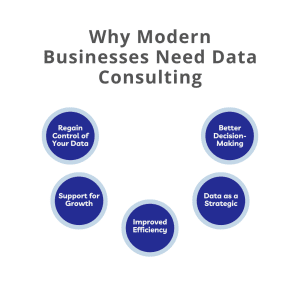
Data consulting helps businesses regain control of their data and use it with confidence. It focuses on creating order, clarity, and purpose around information. Instead of collecting data without direction, businesses learn how to align data with real goals.
Regain Control of Your Data
Data consulting helps businesses create order, clarity, and purpose around their information, ensuring data aligns with real business goals.
Better Decision-Making
Clean, well-managed, and accessible data enables leaders to make faster, informed decisions, reducing guesswork and supporting consistent outcomes.
Support for Growth and Scalability
Consultants guide businesses in moving to cloud analytics and modern data platforms, ensuring systems remain secure, reliable, and easy to expand.
Improved Efficiency
Structured data management and business intelligence services reduce time spent on report preparation, allowing teams to focus on analyzing insights and improving collaboration.
Data as a Strategic Asset
Data consulting transforms data from a technical challenge into a source of competitive advantage, helping businesses adapt, innovate, and succeed in a fast-changing environment.
Data Consulting Supports Cloud Adoption and Modern Data Systems
As businesses grow, their data systems must evolve. Many organizations start with on-premise setups or isolated tools that work well in the early stages. Over time, these systems struggle to handle increasing data volume, speed, and complexity. This is why modern businesses move toward cloud-based environments, and data consulting plays a crucial role in making this transition successful.
Cloud adoption is not only about moving data to new infrastructure. It involves redesigning how data is stored, processed, and accessed. Without proper planning, cloud migration can lead to higher costs, performance issues, and security risks. Data consulting ensures that cloud analytics is implemented in a structured and scalable way.
Consultants help businesses choose the right cloud deployment models based on needs, size, and growth plans. They also ensure that data flows smoothly between systems, enabling real-time access and consistent reporting. With the right architecture in place, businesses gain flexibility while maintaining control over their data.
Most importantly, data consulting ensures that cloud adoption aligns with business goals. Instead of adopting technology for its own sake, organizations build systems that support faster decision-making, better collaboration, and long-term scalability.
Governance and Security Shape Trust in Data
As data becomes central to business operations, trust becomes essential. Decision-makers must believe that the data they use is accurate, secure, and compliant. Data consulting helps build this trust through strong governance and security practices.
Data governance defines how data is collected, accessed, shared, and monitored across the organization. Without governance, data quickly becomes unreliable. Different teams may use different definitions, formats, or sources, leading to confusion and misaligned decisions.
Security is equally important. As businesses adopt cloud platforms and analytics tools, sensitive data must be protected. Data consulting supports cloud security monitoring and access control, ensuring that the right people can access the right data at the right time.
Governance and security also support compliance with regulations and internal policies. Businesses operating across regions or industries must ensure that data usage follows legal and ethical standards. Consultants help design frameworks that balance control with flexibility, allowing teams to work efficiently without unnecessary restrictions.
When governance and security are in place, data becomes a reliable foundation for decision-making. Teams collaborate more effectively, leaders trust insights, and the organization operates with confidence.
Businesses Struggle to Scale Data Without Consulting?
Many businesses attempt to scale their data systems on their own, but often face unexpected challenges. As data volume increases, systems become harder to manage, slower to respond, and more expensive to maintain.
One common issue is fragmentation. Different departments use separate tools and processes, creating silos. Data does not flow smoothly, and insights remain limited to individual teams. Without a unified strategy, scaling becomes inefficient and frustrating.
Another challenge is skill gaps. Data systems require expertise in architecture, analytics, and integration. Most businesses do not have all these skills internally. Data consulting fills this gap by providing experience and best practices that prevent costly mistakes.
Scaling data also requires planning for the future. Businesses must consider performance, cost, security, and flexibility. Without consulting support, organizations often react to problems instead of preparing for them. This leads to repeated redesigns and wasted resources.
Data consulting helps businesses scale with intention. It provides a roadmap that aligns technology, processes, and people, ensuring that growth is sustainable rather than chaotic.
How Data Consulting Creates Long-Term Business Value
Data consulting is not a short-term fix. Its true value lies in building a foundation that supports continuous improvement and innovation. When data systems are well-designed, businesses can adapt quickly to changes in the market.
One major benefit is improved efficiency. Automated data flows and structured reporting reduce manual work. Teams spend less time preparing data and more time analyzing it. This leads to better insights and faster responses.
Another benefit is better strategic alignment. Data consulting ensures that analytics and reporting focus on what matters most to the business. Instead of tracking everything, organizations concentrate on metrics that drive growth and performance.
Key long-term benefits of data consulting include:
- Strong data management practices that maintain consistency and reliability
- Scalable cloud analytics that support growth without disruption
- Clear governance frameworks that ensure trust and compliance
- Better collaboration across teams through shared insights
- A data-driven culture that supports innovation and adaptability
Over time, these benefits compound. Businesses become more agile, resilient, and competitive. Data evolves from a technical challenge into a strategic advantage.
Conclusion: Data Consulting as a Business Enabler
Modern businesses rely on data consulting because data alone is not enough. What matters is how data is structured, governed, and used to support decisions. Data consulting provides the guidance needed to turn information into action.
By supporting cloud adoption, strengthening governance, and enabling scalable growth, data consulting helps businesses operate with clarity and confidence. It reduces complexity, improves trust, and prepares organizations for future challenges.
As markets continue to change and data volumes increase, businesses that invest in strong data foundations are better positioned to succeed. Data consulting is not just about technology. It is about enabling smarter decisions, stronger strategies, and sustainable growth.
Frequently Asked Questions (FAQs)
When should a company consider hiring a data consulting firm?
Businesses should consider data consulting when reporting becomes slow, insights conflict across teams, or growth starts to strain existing data systems.
What is the difference between data consulting and data analytics services?
Data consulting focuses on strategy, structure, and governance, while analytics services focus on generating insights once the data foundation is in place.
How does data consulting support digital transformation initiatives?
By aligning data architecture, cloud platforms, and analytics with transformation goals, consulting ensures technology investments deliver measurable value.
Can data consulting improve collaboration between business teams?
Yes, unified data models and shared dashboards help teams work from the same information, reducing confusion and improving cross-functional alignment.
How does a business data strategy benefit long-term planning?
A clear data strategy ensures analytics efforts focus on meaningful metrics that support growth, performance tracking, and future scalability.
What role does data consulting play in cloud-based data analytics?
Consultants design cloud architectures that balance performance, cost, security, and scalability while enabling real-time access to data.
How do data consulting services reduce reporting delays?
By automating data pipelines and standardizing metrics, businesses can generate insights faster without manual data preparation.
2 Comments
Riva Collins
It’s no secret that the digital industry is booming. From exciting startups to need ghor
global and brands, companies are reaching out.
Obila Doe
It’s no secret that the digital industry is booming. From exciting startups to need ghor hmiu
global and brands, companies are reaching out.