


In today’s data-driven environment, organizations are inundated with vast amounts of information from multiple sources. While data holds enormous potential, it can only create value when properly collected, analyzed, and applied strategically. Data consulting helps businesses unlock the potential of their data by offering expert guidance, actionable strategies, and practical solutions that improve decision-making, operational efficiency, and long-term growth.
Data consulting is not just about managing large datasets. It focuses on understanding business goals, identifying insights, and implementing solutions that drive meaningful results. Companies that leverage data consulting can transform raw information into actionable intelligence, gain a competitive edge, and optimize internal processes.
What Is Data Consulting and Why Is It Important?
Data consulting involves providing expert advice on how organizations can effectively collect, manage, analyze, and utilize their data. It bridges the gap between raw information and strategic business insights, ensuring that decisions are backed by reliable evidence rather than assumptions.
Data consultants work to resolve challenges such as fragmented systems, inconsistent data quality, and outdated analytics practices. They focus on:
- Evaluating existing data infrastructure and processes
- Identifying opportunities for automation and process improvement
- Implementing analytics tools and dashboards to generate insights
- Aligning technology adoption with business objectives
- Ensuring governance, compliance, and data security
By addressing these areas, data consulting empowers businesses to make informed decisions, reduce inefficiencies, and create long-term organizational value.
What does a data consultant actually do?
A data consultant helps organizations use their data to solve problems and make better decisions. They work with businesses to improve how data is collected, stored and analyzed. For example, a consultant might audit what customer data to gather and which analytics tools to use, so a company can better target its audience. In practice, consultants build data models and dashboards, clean up data pipelines, and streamline reporting. As one source explains, data consultants guide businesses on data management and best practices, often identifying opportunities to scale systems and improve processes. In short, they turn raw data into clear insights that align with the company’s goals.
What Are the Benefits of Adopting Data-Driven Strategies?
Implementing data-driven strategies with the help of consulting allows organizations to harness the full potential of their information. Companies that adopt these strategies gain actionable insights, optimize operations, and improve customer engagement.
Some key advantages include:
- Improved decision-making: Leveraging analytics and business intelligence ensures decisions are data-backed.
- Operational efficiency: Streamlined data workflows and real-time analytics reduce delays and errors.
- Customer insights: Understanding behavior and trends helps tailor marketing, products, and services.
- Revenue growth: Predictive analytics identifies opportunities, allowing proactive planning.
- Risk management: Pattern analysis and anomaly detection support early identification of potential risks.
These benefits collectively transform the way businesses operate, strategize, and compete in the market, turning data into a true strategic asset.
Key Components of Data Consulting
Effective data consulting consists of several interconnected elements that ensure businesses maximize the value of their data. Understanding these components helps organizations prepare and engage successfully with consultants.
The essential components include data assessment, analytics strategy, implementation support, governance, and continuous monitoring. Consultants evaluate data quality, identify gaps, design roadmaps, and guide businesses through execution while ensuring security and compliance.
By addressing these elements systematically, organizations gain the knowledge, systems, and frameworks necessary for intelligent data utilization and long-term value creation.
How do you choose a data consulting partner?
Finding the right consulting partner starts by clearly defining your goals and needs. You should know what you want to achieve (your “endgame”) so you can target consultants with the right skills and focus. For example, if your goal is to migrate data to the cloud next year, hire someone with cloud expertise, not just on-premise skills. Check each firm’s industry experience: a great partner will have already built data solutions for companies like yours, which shows they understand your market’s unique challenges. Always ask for case studies or client references to see real outcomes this helps confirm they deliver measurable value.
Finally, trust your instincts about fit. A good consultant should communicate clearly, explain their methods, and adapt to your team (being methodical and agile). In short, pick someone who feels like a natural extension of your organization.
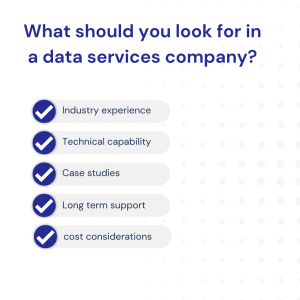
Selecting a consulting partner requires clarity and research. Start by identifying what you want to achieve. For example, if you plan a cloud migration next year, your partner must have cloud transformation expertise.
Industry experience:
A great partner understands your industry’s challenges. Their past projects show how well they can adapt to your requirements.
Technical capability:
Ensure they are experts in data engineering, BI, cloud, machine learning and database technologies.
Case studies and results:
Always ask for real examples. Evidence of improved revenue, reduced cost or optimized processes builds confidence.
Communication and cultural fit
The best consultants are transparent and collaborative. They should explain concepts in simple language and adjust to your working style.
Long term support
You need a partner who will stay connected after implementation. Support, maintenance, training and upgrades are essential.
Geographic and cost considerations
India remains a strong hub for high quality data services at competitive pricing. Companies worldwide choose Indian analytics partners because of expertise, skill availability and scale.
How can data consulting services deliver ROI?
Data consulting projects can deliver strong ROI when planned well. A common approach is to perform a cost-benefit analysis: compare the financial benefits from the project against its investment. Tangible gains might include higher sales, lower costs, or faster production cycles. For example, one real-life case saw an analytics initiative boost revenue by 33% and overall ROI by 25%. Don’t overlook intangibles: improvements in decision-making, efficiency, and employee satisfaction all add value. It helps to set baseline metrics (like current revenue or defect rates) before the project and then measure how they change. Even modest efficiency gains from data insights can quickly outweigh the consulting cost. When planned correctly, the strategic value of those insights – like reduced risk or faster decisions – often far exceeds what simple ROI estimates suggest.
When evaluating ROI, avoid common pitfalls. Make sure to account for all expenses (consultant fees, software licenses, training) and define clear objectives from the start. For example, leaving out indirect costs or not setting measurable goals can make ROI look worse than it really is. Over time, many companies find that the strategic value of insights (such as reducing risk or speeding up decisions) can far exceed initial estimates meaning even a small improvement today may pay dividends in the long run.
What are some real-world use cases or case study examples?
Data consulting can transform many aspects of a business. In marketing and sales, consultants use analytics to focus on the best leads or campaigns. For example, Walks of Italy (a tour company) used data-driven ad attribution and automated bidding to boost summer bookings by 33%, and saw ROI rise by 25%. In supply chains, consultants analyze logistics and vendor data to trim costs. By spotting bottlenecks and optimizing inventory, companies can “reduce lead times and improve inventory management,” cutting expenses and avoiding stockouts. Other examples include healthcare providers using analytics to predict patient needs, or retailers segmenting customers for personalized offers. These stories show how targeted data projects deliver real gains.
Integrating Cloud and Advanced Technologies
Modern data consulting goes beyond basic reporting and analytics, incorporating advanced technologies such as cloud computing, AI, and IoT. Consultants guide businesses in modernizing their data infrastructure and leveraging real-time analytics for faster, smarter decision-making.
Cloud adoption allows organizations to centralize data, improve accessibility, and scale analytics capabilities efficiently. Consultants provide strategies for cloud migration, data governance, and security frameworks, ensuring a smooth transition from legacy systems. Advanced tools such as predictive analytics, real-time dashboards, and IoT integration provide forward-looking insights, helping businesses anticipate trends, optimize operations, and enhance customer experiences.
By combining strategic goals with technology adoption, data consulting ensures businesses remain competitive and prepared in an increasingly digital and data-driven landscape.
Practical Implementation Strategies in Data Consulting
After establishing the importance of data consulting and foundational strategies in Part 1, organizations need to focus on how to implement data-driven initiatives effectively. Implementation is a critical step because even the best strategies and insights can fail without proper execution.
The first step is a comprehensive assessment of current data systems and workflows. Understanding how data is collected, stored, and analyzed allows organizations to identify gaps, redundancies, and inefficiencies. This analysis also highlights areas where automation, cloud adoption, or new analytics tools can have the most impact.
Designing a data architecture that aligns with business goals is the next crucial step. A well-defined architecture ensures smooth data flow across departments, reduces errors, and provides the foundation for real-time insights. Integration of modern data solutions and analytics tools is often necessary to achieve this.
Prioritization plays a key role in implementation. Organizations typically start with high-impact initiatives such as:
- Streamlining customer analytics to better understand buying behaviors
- Automating operational data pipelines to save time and reduce errors
- Enhancing dashboards and reporting for timely decision-making
- Establishing cloud-based data systems for scalability and remote access
- Incorporating security measures to ensure compliance and data protection
Focusing on these initial priorities ensures early wins, which build confidence and support for broader initiatives.
Change management is another essential aspect of implementation. Employees need guidance to adapt to new data tools and workflows. Training programs, workshops, and ongoing support help teams understand how to interpret data, generate insights, and apply these insights in their daily work. This ensures that the organization not only implements data solutions but also uses them effectively.
Real-time analytics further enhances implementation. By integrating live data streams into dashboards and reporting systems, organizations can monitor performance continuously, detect anomalies, and respond quickly to changing conditions. For example, a retail company may track inventory levels in real-time to prevent stockouts, while a logistics firm might use live tracking to optimize delivery routes and improve customer satisfaction.
Automation and cloud adoption are also key enablers. Automated data pipelines minimize manual interventions, reducing errors and freeing up resources for analysis. Cloud platforms provide flexibility, scalability, and accessibility, allowing teams to access data securely from any location. These technologies collectively create a responsive, data-driven environment where insights lead to actionable decisions.
Leveraging Data Consulting for Strategic Growth
Once data systems are implemented, the next step is leveraging them for long-term strategic growth. Data consulting helps organizations move beyond operational efficiency and focus on using insights to drive innovation, competitive advantage, and evidence-based decision-making.
One aspect is fostering a data-driven culture. Organizations benefit when employees across all levels use data to inform decisions. Dashboards, reports, and analytics platforms become tools for everyday operations rather than occasional review. A culture that values data encourages experimentation, measured risk-taking, and continuous improvement.
Advanced analytics plays a pivotal role in strategic growth. Organizations can move from descriptive analytics, which explains past performance, to predictive and prescriptive analytics, which forecast future outcomes and suggest optimal actions. For instance, predictive models in retail can anticipate customer trends, while in manufacturing they can prevent equipment failures through predictive maintenance.
Data governance and quality are foundational for long-term success. Establishing clear ownership, access controls, and validation processes ensures that data is accurate, consistent, and reliable. Continuous monitoring of data quality prevents errors from undermining strategic decisions and ensures that insights remain actionable.
Strategic alignment of data initiatives ensures that all analytics efforts contribute to organizational goals. Whether the focus is improving customer satisfaction, increasing revenue, optimizing operations, or enabling innovation, consultants help tie analytics projects directly to business objectives. This alignment maximizes the impact of data investments and ensures measurable outcomes.
Monitoring and performance evaluation are also critical. Organizations should track key metrics to determine the effectiveness of analytics initiatives, identify areas for improvement, and adjust strategies accordingly. Dashboards, real-time reporting, and automated alerts allow decision-makers to act proactively rather than reactively.
- Driving innovation by identifying untapped opportunities
- Enhancing operational efficiency through process analysis
- Improving customer experiences by understanding behavior and preferences
- Reducing risks using predictive models and anomaly detection
- Supporting strategic planning through evidence-based insights
Scalable growth is another key benefit of data consulting. As organizations expand, the volume and complexity of data increase. Consultants ensure that data architecture, pipelines, and analytics systems can handle growing demands without compromising performance or accuracy. Scalability ensures agility, responsiveness, and sustained value from analytics investments.
Industry-specific examples demonstrate the practical benefits of data consulting. E-commerce companies can use advanced analytics to optimize product recommendations, reduce cart abandonment, and improve retention. Healthcare organizations can enhance patient outcomes by predicting resource requirements and streamlining workflows. Retailers can monitor real-time sales and inventory to respond quickly to market changes, while financial institutions can detect fraud and manage risk efficiently.
By focusing on implementation strategies, advanced analytics, and strategic growth, organizations can transition from basic reporting to a fully data-driven decision-making ecosystem. This sets the stage for the next phase, where specialized applications, emerging trends, and forward-looking strategies will further enhance the value of data consulting.
Emerging Trends in Data Consulting
As organizations increasingly rely on data for decision-making, new trends are shaping the future of data consulting. One key trend is the rise of cloud-based analytics platforms. Moving data to the cloud allows businesses to access information from anywhere, scale systems easily, and leverage powerful analytics tools without heavy upfront investment.
Another trend is the growing use of real-time analytics. Businesses no longer need to wait for daily or weekly reports to understand performance. With live data streams, teams can make timely decisions, respond to changing market conditions, and improve operational efficiency.
AI and machine learning integration is also becoming common. Predictive analytics, anomaly detection, and automated insights allow organizations to anticipate customer behavior, optimize processes, and make data-driven decisions faster. Consultants guide businesses in selecting the right tools and strategies to adopt these emerging technologies effectively.
Data privacy and governance are equally critical trends. With increasing regulations and customer expectations, organizations must ensure that their data practices are secure, compliant, and transparent. Data consulting helps implement policies, monitoring systems, and controls to manage these risks while maintaining the value of analytics initiatives.
Industry-Specific Applications of Data Consulting
Data consulting is not one-size-fits-all; different industries benefit in unique ways. In retail, consultants help optimize inventory, forecast demand, and improve customer experiences using real-time analytics. Dashboards and BI tools allow retailers to track sales trends, identify high-performing products, and make timely pricing decisions.
In healthcare, data consulting supports patient care, resource management, and operational efficiency. Predictive models can forecast patient admissions, track treatment outcomes, and streamline scheduling. This ensures better care and optimized use of resources.
Financial services use data consulting to detect fraud, manage risk, and improve customer service. Analytics helps identify unusual transactions, assess creditworthiness, and monitor market trends. Dashboards provide a holistic view of portfolio performance, enabling proactive management.
Manufacturing benefits through improved supply chain management, predictive maintenance, and quality control. Data-driven insights allow factories to anticipate machine failures, optimize production schedules, and reduce downtime.
By applying data consulting strategies tailored to each industry, organizations can gain competitive advantages, reduce costs, and enhance overall performance.
Future of Data Consulting and Strategic Growth
The future of data consulting lies in continuous innovation and integration. Organizations are moving from basic reporting and dashboards to advanced analytics, AI-driven insights, and fully automated decision-making processes. Consultants help businesses stay ahead by adopting emerging technologies, scaling infrastructure, and training teams to interpret and act on data effectively.
Collaboration is key. Data consulting integrates IT, operations, marketing, and finance teams to ensure that analytics drives strategic decisions. By fostering a data-driven culture, organizations encourage every employee to use insights in their daily work, improving overall efficiency and innovation.
Sustainability is another emerging focus. Efficient data management reduces redundancy, improves resource utilization, and minimizes environmental impact. Consultants can advise on energy-efficient cloud solutions, storage optimization, and eco-friendly processes that align data strategy with corporate responsibility.
Strategic growth also requires continuous monitoring and adaptation. Data landscapes evolve rapidly, and organizations must refine their analytics models, dashboards, and reporting mechanisms over time. This ensures that insights remain relevant, accurate, and actionable.
Conclusion
Data consulting is more than managing and analyzing data—it is about transforming information into actionable insights that drive business growth. From assessing existing systems to implementing robust analytics platforms, real-time monitoring, and predictive models, organizations can harness the power of data to make informed decisions.
By embracing emerging trends, industry-specific applications, and strategic growth initiatives, businesses can unlock the full potential of data consulting. A well-planned data strategy not only improves efficiency and decision-making but also positions organizations to innovate, adapt, and stay competitive in an increasingly data-driven world.
Frequently Asked Questions (FAQs)
Why do growing companies struggle with data despite having modern tools?
As tools increase, data often becomes fragmented across systems, making it harder to trust reports or get a single, accurate view of performance.
How is data consulting different from basic reporting or analytics tools?
While tools show numbers, data consulting defines how data should be collected, governed, and aligned with business objectives to drive outcomes.
Can data consulting support cloud-based analytics without disrupting operations?
Yes, with proper planning, data consulting ensures cloud adoption is structured, secure, and scalable while minimizing risk and downtime.
How does data consulting improve operational efficiency across teams?
By automating data pipelines and standardizing reporting, teams spend less time preparing data and more time acting on insights.
What role does data consulting play in building a data-driven business strategy?
It aligns analytics initiatives with business priorities, ensuring data efforts support growth, performance tracking, and long-term goals.
How does data consulting help maintain trust in business data?
Through governance frameworks, quality checks, and access controls, data consulting ensures insights are accurate, secure, and consistent.
Is data consulting useful before adopting AI or advanced analytics?
Yes, strong data foundations are essential before implementing AI, machine learning, or predictive analytics to ensure reliable results.
How do data consulting services support long-term scalability?
They design architectures and processes that grow with the business, preventing performance issues as data volume and complexity increase.
What business outcomes can organizations expect from data consulting?
Improved decision speed, better visibility, reduced inefficiencies, stronger alignment across teams, and sustainable competitive advantage.