


Businesses today generate data from everywhere transactions, customers, supply chains, digital platforms, and internal systems. Yet, having data does not automatically mean having clarity. Many organizations struggle not because they lack data, but because they cannot turn it into reliable, timely, and actionable insight. This is where data consulting becomes relevant, especially for companies navigating growth, complexity, and digital change. From data management issues to cloud adoption challenges, data consulting helps address practical problems that directly affect decision-making and performance.
What happens when businesses collect data but cannot use it effectively?
One of the most common problems organizations face is scattered and poorly managed data. Data may exist across multiple systems such as ERP tools, CRM platforms, retail POS systems, or legacy databases. Without proper data management, teams spend more time searching for information than using it.
In retail, this challenge becomes even more visible. Retail analytics relies heavily on clean and connected data from sales, inventory, customer behavior, and pricing systems. When data is fragmented, insights arrive too late or are simply inaccurate. Data consulting helps design structured data pipelines, define ownership, and standardize formats so that analytics teams can focus on insight rather than cleanup.
Another issue is the lack of real-time visibility. Many businesses still depend on delayed reports generated at the end of the day or week. Real-time data analytics allows organizations to react faster to demand changes, system issues, or customer behavior. Without the right architecture, real-time analytics is difficult to implement. Data consultants help design systems that support streaming data and faster decision cycles without disrupting existing operations.
How does data consulting solve decision-making challenges?
Poor decision-making often stems from unclear or inconsistent reporting. Different teams may rely on different numbers for the same metric, leading to confusion and internal mistrust. This is where business intelligence services play a critical role.
Data consulting helps establish a single source of truth by aligning data definitions, metrics, and reporting structures. Through business intelligence consulting services, organizations can create dashboards that are intuitive, role-based, and aligned with business goals. Leaders gain confidence in the numbers they see, and teams can act without second-guessing data accuracy.
Another challenge is translating technical data into business understanding. Many decision-makers are not data specialists. They need insights presented in a clear and contextual way. Data consultants bridge this gap by combining technical expertise with business context, ensuring insights are understandable and relevant. This is especially important in industries like retail, where the role of information technology in retailing directly impacts pricing, promotions, and customer experience.
Cloud complexity and the problem of choosing the right approach
Cloud adoption introduces flexibility, but it also introduces complexity. Many businesses struggle to decide between different cloud deployment models in cloud computing, or whether to move systems at all. Questions around cost, performance, and security often delay progress.
Data consulting supports organizations during on-premise to cloud migration by evaluating workloads, data sensitivity, and scalability needs. Consultants help businesses understand the pros and cons of cloud computing and the pros and cons of cloud services in a practical context, not just theory. This prevents rushed decisions that lead to higher long-term costs.
Once systems move to the cloud, governance becomes a major concern. Cloud computing governance ensures data access, compliance, and cost control are managed properly. Alongside this, cloud security monitoring and security monitoring in cloud computing protect sensitive business and customer data. Data consultants help define policies, monitoring frameworks, and responsibilities so that cloud environments remain secure and manageable.
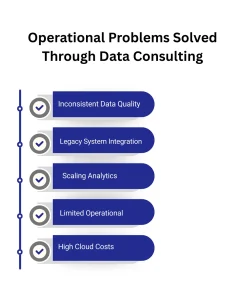
Inconsistent Data Quality
Data consulting ensures accurate and standardized data across departments, improving reporting and decision-making.
Legacy System Integration
Consultants connect old and new systems seamlessly, enabling smoother workflows and unified analytics.
Scaling Analytics
Scalable data pipelines and architectures allow analytics to keep up as data volumes grow.
Limited Operational Visibility
Real-time reporting provides timely insights, helping teams respond quickly to changes.
High Cloud Costs
Governance and monitoring frameworks optimize cloud usage, reducing unnecessary expenses.
Where do advanced analytics and AI consulting add real value?
As data maturity improves, many businesses reach a stage where basic reporting is no longer enough. They need deeper insights, forecasting, and pattern recognition. This is where advanced analytics and AI consulting become valuable, not as experimentation, but as problem-solving tools.
For example, in retail analytics, AI models can identify demand trends, optimize inventory levels, and improve pricing strategies. In other industries, real-time data analytics combined with AI can detect anomalies, predict system failures, or highlight customer churn risks. Data consulting ensures these solutions are built on reliable data foundations rather than isolated models that fail in production.
Another challenge businesses face is adopting AI without understanding its limitations. Data consultants help define where AI genuinely fits, how data should be prepared, and how results should be interpreted. This avoids unrealistic expectations and ensures AI supports decision-making instead of replacing it blindly.
Why is data engineering and integration the backbone of digital transformation?
- Legacy systems, inconsistent data formats, and manual processes can create bottlenecks that slow transformation.
- Data engineering consulting builds scalable and reliable pipelines to connect different systems seamlessly.
- Cloud engineering and cloud development services support analytics, applications, and integrations efficiently.
- Proper architecture design ensures alignment with cloud service providers while maintaining flexibility.
- Strong foundations are essential for cloud app development to ensure performance and data availability.
- Integration with new technologies like IoT allows real-time data to be captured, processed, and analyzed effectively.
- Without solid data engineering, high volumes of data become noise rather than actionable insights.
support long-term operational stability?
Beyond analytics, data consulting plays a role in ensuring systems remain stable and adaptable over time. DevOps consulting supports faster deployments and better collaboration between development and operations teams. When combined with data consulting, it ensures that analytics and data platforms evolve without frequent downtime or disruptions.
Cloud computing consulting services also help organizations manage growth by designing systems that scale with demand. This includes selecting appropriate cloud deployment models, managing costs, and maintaining performance as data volumes increase. Over time, this reduces operational risk and improves predictability.
Another often overlooked area is custom software examples where off-the-shelf tools do not meet business needs. Data consultants work with development teams to ensure custom solutions integrate cleanly with existing data ecosystems rather than creating new silos.
The broader role of data consulting in modern business environments
As businesses expand, data challenges become more interconnected. Data consulting is no longer limited to analytics alone. It overlaps with digital transformation consulting, cloud consulting services, and even domain-specific needs like data solutions India for region-specific compliance and infrastructure considerations.
By aligning data strategy with technology choices, governance, and business goals, data consulting helps organizations build systems that support growth rather than restrict it. The focus remains on clarity, reliability, and usability of data across the organization.
Ultimately, the problems solved by data consulting are practical and measurable. Clearer insights, faster decisions, reduced risk, and scalable systems allow businesses to focus less on fixing data issues and more on achieving strategic outcomes.
Conclusion
Data consulting helps businesses solve real operational problems, from managing scattered data to enabling real-time insights and secure cloud adoption. By combining structured data management, advanced analytics, and practical guidance, organizations can make faster, more confident decisions. The result is clearer insights, improved efficiency, and a stronger foundation for growth in today’s data-driven business environment.
Frequently Asked Questions (FAQs)
What is the role of data management in improving retail analytics performance?
Data management ensures that sales, inventory, and customer data are accurate and consistent, which helps retailers make faster and more informed decisions.
How can real-time data analytics help businesses respond to sudden market changes?
By processing and analyzing data as it is generated, real-time analytics allows companies to react immediately to demand shifts, operational issues, or customer behavior changes.
What are the key benefits of using cloud app development services for small businesses?
Cloud app development services provide scalability, lower infrastructure costs, and easier updates, allowing small businesses to deploy applications quickly and reliably.
How does AI consulting support predictive decision-making in retail and finance sectors?
AI consulting helps organizations implement predictive models that forecast sales, customer behavior, or financial risks, allowing proactive and strategic decisions.
Why is Internet of Things consulting important for manufacturing companies?
IoT consulting helps manufacturers collect, process, and analyze machine and sensor data in real time, improving efficiency, reducing downtime, and enabling smarter operations.