


What Is Predictive Analytics? A Business Guide With Real Examples
Businesses today operate in a world where data influences almost every decision. From customer purchases and website activity to inventory management and marketing campaigns, companies generate huge amounts of information every single day. But collecting data alone is not enough anymore. Businesses now want to know what is likely to happen next. This is where predictive analytics for business becomes one of the most valuable technologies in modern decision making.
Predictive analytics helps companies forecast future trends, understand customer behavior, reduce business risks, and improve operational efficiency. Instead of making decisions based only on historical reports, businesses can now use predictive models to prepare for future outcomes more accurately.
Many of the digital experiences people use daily are powered by predictive analytics. Ecommerce platforms recommend products based on shopping behavior. Streaming services suggest movies according to viewing history. Banks detect unusual transactions before fraud occurs. Airlines adjust ticket pricing depending on customer demand.
The biggest advantage of predictive analytics is that it allows businesses to move from reactive decision making to proactive planning. Companies no longer need to wait for problems to happen before taking action. They can identify patterns early and respond before challenges become serious.
In this detailed guide, we will understand what predictive analytics is, how it works, where businesses use it, and why it has become essential across industries.
What Is Predictive Analytics?
Predictive analytics is the process of using historical data, statistical models, artificial intelligence, and machine learning algorithms to predict future outcomes.
The main purpose of predictive analytics for business is to identify patterns in existing data and use those patterns to forecast what may happen in the future.
For example:
- Retail companies predict future product demand
- Banks predict loan risks
- Healthcare providers predict patient health risks
- Marketing teams predict customer behavior
- Ecommerce companies predict buying preferences
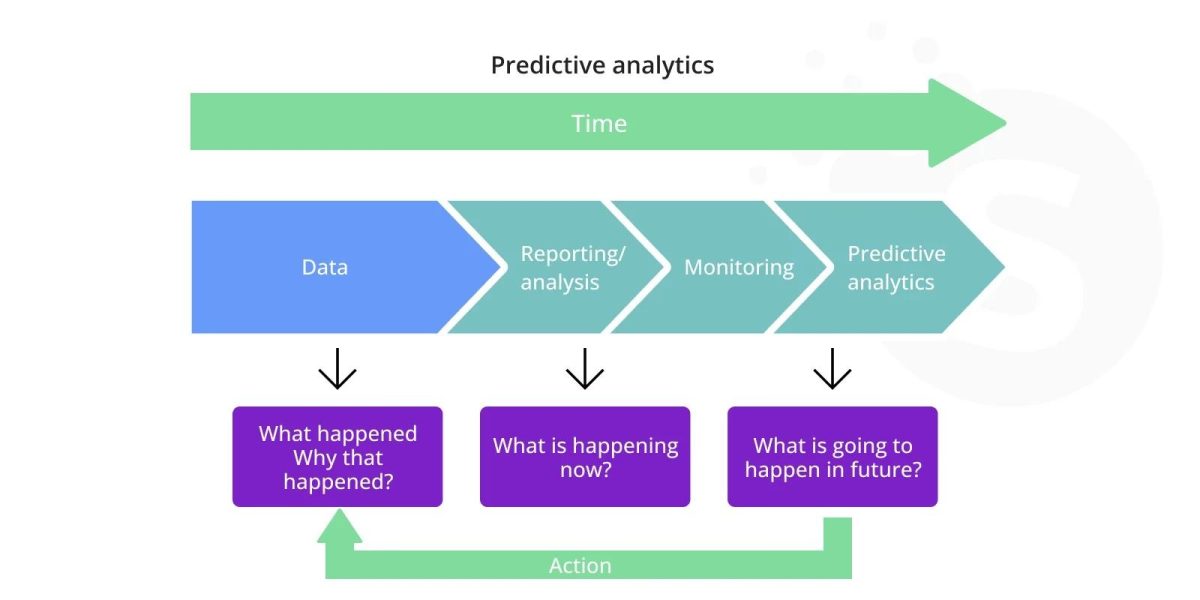
Unlike traditional reporting systems that explain past performance, predictive analytics focuses on future forecasting.
A simple way to understand predictive analytics is:
Traditional analytics answers:
“What happened?”
Predictive analytics answers:
“What is likely to happen next?”
This future focused approach helps businesses make faster, smarter, and more strategic decisions.
How Does Predictive Analytics Work?
Predictive analytics works by collecting large amounts of data and identifying patterns through advanced algorithms.
The process usually follows several important steps.
1. Data Collection
Businesses collect data from multiple sources such as:
- Customer databases
- Websites
- Mobile applications
- CRM systems
- Social media platforms
- Sales records
- Marketing campaigns
The more accurate and organized the data is, the better the predictions become.
2. Data Cleaning
Raw data often contains:
- Duplicate information
- Missing values
- Incorrect entries
- Unstructured records
Data cleaning removes these issues to improve accuracy.
3. Pattern Analysis
The system studies historical trends and identifies relationships between different data points.
For example:
A retail company may discover that umbrella sales increase before heavy rainfall predictions.
4. Predictive Modeling
Machine learning models analyze patterns and create prediction systems.
These models forecast:
- Customer behavior
- Product demand
- Revenue growth
- Fraud risks
- Inventory requirements
5. Forecast Generation
The final system generates predictions that businesses can use for decision making.
For example:
An ecommerce website may predict which products a customer is most likely to purchase next week.
Why Is Predictive Analytics Important for Businesses?
Today, businesses operate in highly competitive markets where fast decision making matters. Companies that understand future trends earlier often gain a competitive advantage.
This is why predictive analytics for business is becoming essential across industries.
Some major benefits include:
Improved Decision Making
Businesses can make decisions based on real data instead of assumptions.
Better Customer Understanding
Predictive systems help companies understand customer preferences, buying behavior, and engagement patterns.
Reduced Business Risks
Organizations can identify potential risks before they become major problems.
Higher Revenue Opportunities
Predictive insights help businesses target customers more effectively and improve sales performance.
Improved Operational Efficiency
Companies can optimize inventory, staffing, and logistics using demand forecasting.
Fraud Detection
Banks and financial institutions use predictive analytics to detect suspicious activities instantly.
What Are the Different Types of Predictive Analytics?
Predictive analytics includes multiple techniques used for different business objectives.
Classification Models
These models classify outcomes into categories.
Example:
Email systems identifying spam messages.
Regression Models
Regression models predict numerical values.
Example:
Predicting monthly sales revenue.
Time Series Forecasting
This method predicts future outcomes based on historical time patterns.
Example:
Forecasting holiday season demand.
Machine Learning Models
Machine learning systems continuously learn from data and improve predictions over time.
Example:
Netflix recommendation systems.
How Do Ecommerce Companies Use Predictive Analytics?

Ecommerce businesses are among the biggest users of predictive analytics.
Online stores collect customer data such as:
- Browsing behavior
- Search history
- Purchase activity
- Product preferences
- Cart abandonment patterns
Using this data, ecommerce platforms can:
- Recommend products
- Predict customer purchases
- Improve marketing campaigns
- Personalize user experiences
- Forecast inventory demand
For example, Amazon uses predictive algorithms to recommend products customers are most likely to buy based on previous purchases and browsing history.
This improves both customer experience and sales performance.
How Does Predictive Analytics Improve Marketing?

Modern digital marketing relies heavily on data.
Predictive analytics helps marketing teams understand:
- Which customers are likely to purchase
- Which campaigns may perform better
- Which users are likely to unsubscribe
- Which products customers may prefer
Using predictive marketing strategies, businesses can:
- Improve ad targeting
- Increase conversion rates
- Reduce advertising costs
- Personalize customer communication
For example:
Streaming platforms like Spotify recommend songs based on listening behavior using predictive models.
This increases user engagement and platform retention.
How Is Predictive Analytics Used in Healthcare?

Healthcare organizations use predictive analytics to improve patient care and operational efficiency.
Hospitals and healthcare providers use predictive systems for:
- Disease prediction
- Patient risk assessment
- Emergency room management
- Resource planning
- Treatment optimization
For example:
Hospitals may predict which patients are at higher risk of developing chronic diseases based on medical history and lifestyle data.
This allows doctors to provide early treatment and preventive care.
How Do Financial Companies Use Predictive Analytics?

Banks and financial institutions use predictive analytics extensively.
Some common uses include:
- Credit risk analysis
- Fraud detection
- Customer segmentation
- Investment forecasting
- Loan approval systems
For example:
Banks use predictive algorithms to detect unusual spending behavior that may indicate fraudulent activity.
If suspicious transactions are detected, the system can automatically trigger alerts.
This helps reduce financial losses and improve customer security.
What Role Does Artificial Intelligence Play in Predictive Analytics?
Artificial Intelligence and machine learning have significantly improved predictive analytics capabilities.
Traditional analytics systems relied mainly on manual statistical analysis. Modern AI powered systems can automatically:
- Learn from data
- Identify hidden patterns
- Improve forecasting accuracy
- Adapt to changing trends
Machine learning algorithms continuously improve predictions as more data becomes available.
This is why AI driven predictive analytics is becoming more accurate and valuable for businesses.
What Industries Use Predictive Analytics?
Today, predictive analytics is used across almost every industry.
Retail
- Inventory forecasting
- Customer recommendations
- Sales prediction
Healthcare
- Patient risk prediction
- Treatment planning
- Disease forecasting
Finance
- Fraud detection
- Risk management
- Investment analysis
Manufacturing
- Equipment maintenance prediction
- Production planning
- Supply chain optimization
Marketing
- Customer segmentation
- Campaign optimization
- Lead scoring
Logistics
- Delivery route optimization
- Demand forecasting
- Warehouse management
As businesses become more data focused, predictive analytics adoption continues growing rapidly.
What Are the Challenges of Predictive Analytics?
Although predictive analytics offers many advantages, businesses may also face certain challenges.
Poor Data Quality
Inaccurate or incomplete data reduces prediction accuracy.
High Implementation Costs
Advanced predictive systems may require skilled professionals and infrastructure investments.
Data Privacy Concerns
Businesses handling customer data must follow privacy regulations carefully.
Complex Integration
Integrating predictive systems into existing business operations may take time.
Skill Gaps
Companies often require experienced data analysts and data scientists to manage predictive models effectively.
Despite these challenges, the long term benefits of predictive analytics often outweigh the initial difficulties.
How Can Small Businesses Use Predictive Analytics?
Many people believe predictive analytics is only for large corporations, but that is no longer true.
Today, small businesses can also use affordable predictive tools through cloud platforms and AI based software.
Small businesses can use predictive analytics for:
- Sales forecasting
- Customer retention
- Inventory management
- Marketing optimization
- Demand prediction
For example:
A local retail business may predict seasonal demand trends to avoid overstocking or stock shortages.
This helps improve profitability and operational efficiency.
What Is the Future of Predictive Analytics?
The future of predictive analytics is strongly connected with artificial intelligence and automation.
As businesses generate more data, predictive systems will become:
- Faster
- More accurate
- More automated
- More accessible
Some future trends include:
- Real time predictive analytics
- AI powered automation
- Hyper personalized customer experiences
- Predictive cybersecurity
- Smart business forecasting
Businesses that adopt predictive analytics early are likely to gain stronger competitive advantages in the future digital economy.
Conclusion
Predictive analytics has transformed the way modern businesses operate. Instead of relying only on past reports and assumptions, companies can now use data to predict future outcomes and make smarter decisions.
From ecommerce and healthcare to finance and marketing, predictive analytics is helping organizations improve customer experiences, reduce risks, optimize operations, and increase profitability.
The growing importance of predictive analytics for business shows that data is no longer just a reporting tool. It has become a strategic business asset that helps companies prepare for the future more effectively.
As artificial intelligence and machine learning continue advancing, predictive analytics will become even more important for businesses of all sizes. Organizations that understand and adopt predictive technologies early will be better positioned to compete in the digital world.
Frequently Asked Questions
1. What is predictive analytics in simple words?
Predictive analytics uses historical data, machine learning, and statistics to predict future outcomes and trends.
2. Why is predictive analytics important for businesses?
Predictive analytics helps businesses improve forecasting, reduce risks, understand customers better, and make smarter decisions.
3. Which industries use predictive analytics?
Industries like healthcare, finance, retail, ecommerce, manufacturing, and marketing widely use predictive analytics.
4. Is predictive analytics part of artificial intelligence?
Predictive analytics often uses artificial intelligence and machine learning algorithms to improve forecasting accuracy.
5. Can small businesses use predictive analytics?
Yes, many affordable cloud based tools now allow small businesses to use predictive analytics for sales forecasting, customer analysis, and inventory management.
Turn Your Business Data Into Predictive Growth