


Artificial intelligence has moved from experimentation to structured adoption across industries. Yet many decision makers still ask a practical question: which business case is better solved by AI? The answer depends less on trends and more on operational reality. AI is most effective where data is abundant, where decisions repeat at scale, and where patterns are too complex for manual analysis.
A business problem becomes a strong AI candidate when it involves prediction, classification, anomaly detection, or personalization. When human capacity cannot continuously analyze large volumes of structured and unstructured data, AI begins to create measurable value. The following sections break down where AI fits best and how to evaluate its relevance.
What Makes a Business Problem Suitable for AI?
Not every operational challenge requires artificial intelligence. The strongest use cases share specific characteristics. They rely on large datasets, contain recurring decision logic, and benefit from learning over time. AI is particularly effective when outcomes improve as more data becomes available.
Another important factor is variability. If decision inputs constantly change, static rules quickly become outdated. Machine learning systems adapt to new data patterns without requiring constant manual redesign. When scale, variability, and prediction intersect, AI often becomes the more suitable solution.
Industries and Business Functions Where AI Delivers High Impact
AI adoption varies by sector, but certain industries consistently demonstrate stronger alignment with data driven decision models. These environments generate continuous streams of operational or behavioral data that can be analyzed for efficiency, risk mitigation, or personalization.
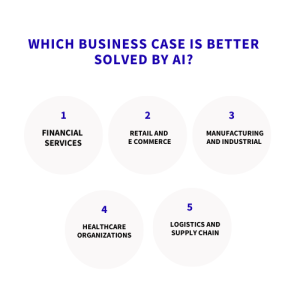
Financial services
AI helps financial institutions analyze large datasets for credit scoring, fraud detection, and risk evaluation. It improves accuracy in probability based decisions and supports faster, data driven responses. This strengthens risk control while enhancing customer experience and operational efficiency.
Retail and e commerce
Retail businesses use AI for demand forecasting, dynamic pricing, and personalized customer engagement. Machine learning improves inventory planning and product recommendations, leading to better conversion and reduced stock imbalances. It also supports real time decision making in competitive markets.
Manufacturing and industrial operations
AI enables predictive maintenance and automated quality inspection using sensor and visual data. This reduces equipment failure, minimizes downtime, and improves production efficiency. Continuous monitoring helps identify risks early and supports consistent operational performance.
Healthcare organizations
Healthcare providers use AI for diagnostic support, patient risk assessment, and workflow optimization. It improves clinical decision accuracy and operational efficiency while helping manage large patient data. This supports better outcomes and more effective resource planning.
Logistics and supply chain
Distribution networks rely on AI driven route optimization, demand planning, and inventory allocation modeling to improve efficiency.
These sectors illustrate a common theme: AI performs best where continuous data flow and outcome prediction directly influence financial or operational performance.
High Volume Data Processing and Pattern Recognition
Organizations often accumulate massive datasets but struggle to extract actionable insights in real time. AI excels in environments where manual analysis becomes impractical. Pattern recognition algorithms can detect anomalies, correlations, and trends that remain invisible in traditional reporting systems.
Fraud detection systems identify suspicious transaction behavior across millions of records. Telecommunications providers monitor network performance using anomaly detection models. Marketing teams analyze engagement patterns to predict churn risk.
When the business case depends on discovering hidden patterns in complex datasets, AI offers a distinct advantage over static analytics tools.
Can AI Improve Decision Making in Uncertain Environments?
Many core business decisions operate under uncertainty. Pricing strategies, inventory planning, marketing allocation, and credit evaluation involve probabilities rather than guarantees. AI models learn from historical outcomes to improve forecast accuracy and scenario analysis.
Predictive modeling in supply chain management estimates future demand by incorporating seasonality and behavioral signals. Risk assessment models in financial institutions evaluate borrower reliability using multidimensional data. These applications do not eliminate uncertainty, but they reduce guesswork and improve consistency.
If a business case revolves around forecasting, probability scoring, or scenario simulation, AI becomes a strategic enabler rather than a technical add on.
Customer Experience Optimization
Personalized engagement has become a competitive differentiator in digital markets. AI powered systems analyze behavioral signals to tailor recommendations and automate support interactions.
Behavioral segmentation
Machine learning based behavioral segmentation groups customers using real time actions such as browsing, engagement, and purchase behavior. This approach helps businesses deliver more relevant communication and personalized experiences. As models learn continuously, targeting becomes more accurate and improves customer retention.
Recommendation systems
Recommendation systems analyze user activity, preferences, and past purchases to suggest relevant products or content. This reduces decision friction and improves user experience. Over time, recommendations become more precise, supporting higher engagement and increased conversion.
Sentiment analysis
Natural language processing tools evaluate reviews and feedback to identify customer satisfaction trends.
In environments where personalization influences acquisition and retention, AI often outperforms static segmentation and manual targeting approaches.
When Is Automation a Better Fit Than AI?
AI should not replace straightforward automation. If a process follows clear, rule based logic with limited variability, workflow automation tools are often more efficient. For example, routing approvals based on predefined thresholds rarely requires machine learning.
AI becomes relevant when decision rules are too complex or dynamic to define explicitly. If exceptions frequently occur and patterns shift over time, adaptive learning models provide greater flexibility. Understanding this distinction prevents unnecessary complexity and supports better investment decisions.
Operational Efficiency and Predictive Maintenance
Asset heavy industries benefit significantly from predictive analytics. Instead of relying solely on scheduled inspections, AI systems analyze sensor data to detect early warning signs of failure.
Manufacturers monitor vibration patterns to prevent equipment breakdowns. Energy companies analyze operational metrics to predict infrastructure stress. Logistics providers optimize fleet routes using real time data inputs.
Where operational downtime leads to financial loss, predictive modeling delivers measurable efficiency gains and cost savings.
How to Evaluate the Business Impact of an AI Use Case?
Selecting the right AI business case requires structured evaluation. Organizations should define clear metrics such as cost reduction, revenue growth, improved accuracy, or reduced risk exposure. A measurable baseline allows teams to assess improvement objectively.
It is equally important to assess data readiness and implementation complexity. Some use cases offer high value but require extensive integration and governance preparation. Pilot testing with controlled datasets can validate feasibility before full deployment.
The most successful AI initiatives align technology capabilities with business objectives. AI should be introduced where it strengthens decision making, enhances operational resilience, and supports long term strategic goals.
Conclusion
Determining which business case is better solved by AI depends on scale, variability, data maturity, and the need for predictive intelligence. AI creates the strongest impact in environments driven by pattern recognition, probability based decisions, and continuous data streams. It is less suitable for static, rule driven processes that can be automated more simply.
Organizations that evaluate business value before technology selection are more likely to identify meaningful AI opportunities. When implemented with clear objectives and measurable outcomes, AI becomes a practical tool for improving efficiency, reducing uncertainty, and strengthening competitive positioning.
Frequently Asked Questions (FAQs)
How can businesses identify high impact artificial intelligence opportunities?
Businesses should start by evaluating processes that involve large datasets, repeated decisions, and measurable outcomes. Areas with forecasting, risk assessment, or personalization needs often present stronger AI adoption potential.
What factors determine whether artificial intelligence implementation will deliver measurable return on investment?
Clear performance metrics, quality historical data, and alignment with operational goals are critical. Organizations that define expected efficiency gains or revenue impact before deployment typically achieve better results.
How does data maturity influence artificial intelligence adoption in organizations?
AI systems depend heavily on structured, accurate, and accessible data. Companies with integrated data infrastructure and governance frameworks are more likely to implement reliable and scalable solutions.
Can small and mid sized companies benefit from artificial intelligence driven decision systems?
Yes, smaller organizations can benefit when use cases are clearly defined and aligned with business priorities. Cloud based tools and focused pilot projects reduce complexity and support gradual adoption.