


In today’s world, businesses generate enormous amounts of data from countless sources every single day. But here’s the uncomfortable truth – data sitting in silos does nothing. It doesn’t improve your operations, it doesn’t sharpen your strategy, and it certainly doesn’t grow your revenue. The value only appears when data is properly structured, analysed, and connected to real business decisions.
That’s exactly where data consulting comes in. A strong data consultancy approach doesn’t just help organisations manage their information – it transforms raw numbers into a genuine competitive advantage. From streamlining workflows to enabling predictive insights, the right data strategy touches every part of how a modern business operates.
What Is Data Consulting and Why Does It Matter?
At its core, data consulting is about expert guidance – helping organisations figure out how to collect, manage, analyse, and actually use their data effectively. It bridges the gap between having information and knowing what to do with it.
Most businesses, regardless of size or industry, run into similar walls. Data lives in different systems that don’t talk to each other. Quality is inconsistent. Reports take days to produce and still leave leaders with more questions than answers. Real-time visibility feels like a distant luxury.
Data consultants step into these situations and get to work. They evaluate what’s already in place, identify where automation can replace manual effort, implement the right tools and dashboards, align everything with the organisation’s actual goals, and make sure data governance, security, and compliance aren’t an afterthought.
The result is an organisation that can finally trust its numbers — and act on them confidently.
What Does a Data Consultant Actually Do?
The role goes well beyond running reports or building a few charts. A data consultant’s job is to help a business turn its data into meaningful, repeatable outcomes.
That means cleaning up the mess that most data environments quietly accumulate over time inconsistent formats, broken pipelines, duplicate records. It means designing reporting systems that give the right people the right information without three hours of manual work each week. It means building data models that surface genuine insights rather than just presenting raw numbers in a prettier format.
And it means making honest recommendations about tools and technologies not what’s fashionable, but what your team will actually use and be able to maintain.
In short: a data consultant converts complexity into clarity, and aligns that clarity with what the business is trying to achieve.
Benefits of Taking a Data-Driven Approach
Organisations that commit to data-driven strategies with proper consulting support tend to see change across several dimensions at once.
Decision-making improves almost immediately. When leaders have access to reliable, timely information, they stop guessing and start planning with real confidence. Strategic conversations shift from debating whose numbers are right to actually deciding what to do.
Operational efficiency follows. Automating repetitive data tasks and cleaning up workflows saves teams significant time that gets redirected toward work that actually requires human judgement.
Customer understanding deepens. Businesses that properly analyse behaviour patterns can tailor their products, services, and marketing in ways that feel relevant rather than generic. That personalisation drives retention and revenue.
Predictive analytics opens up new opportunities. Rather than reacting to what already happened, organisations begin to anticipate what’s coming — identifying trends, forecasting demand, and positioning ahead of the curve.
And risk management sharpens. Anomalies that used to go unnoticed for weeks get caught early, before they compound into genuine problems.
The Core Components of Data Consulting
Effective data consulting isn’t a single service – it’s a layered discipline. The best engagements cover several interconnected areas.
It starts with a data assessment: an honest look at what’s working, what’s broken, and where the biggest gaps are. From there, strategy development turns those findings into a clear roadmap – one that’s grounded in where the business actually wants to go, not just what’s technically possible.
Implementation support follows, which is where the visible work happens: deploying tools, building dashboards, establishing pipelines. But equally important is the data governance layer – defining who owns what, setting quality standards, and building the processes that keep everything running cleanly over time.
Finally, continuous monitoring ensures the system evolves rather than stagnates. Data needs and business priorities change, and the infrastructure supporting them should change too.
How to Choose the Right Data Consulting Partner
This decision matters more than most businesses realise. The wrong partner wastes time, budget, and internal goodwill. The right one can genuinely transform how an organisation operates.
Start by getting clear on your own goals. Are you trying to automate manual processes? Build better analytics? Move to the cloud? The answer shapes what kind of partner you need.
Look for genuine industry experience. A consultant who understands your sector already knows the common pitfalls, the relevant data sources, and the integrations worth building. That context saves significant time.
Assess technical depth. You want a partner with real capability across data engineering, business intelligence, cloud platforms, and ideally some machine learning — not a generalist who outsources the hard parts.
Ask for concrete evidence of outcomes. Case studies are a start, but real references and measurable results are what actually tell you whether someone delivers.
Pay attention to how they communicate. The best consulting relationships are built on transparency and genuine collaboration. If the early conversations feel like a sales pitch rather than a two-way exploration, that pattern tends to continue.
And think about the long term. You want a partner who builds your team’s capability alongside the technical work — not one who creates dependency.
How Data Consulting Delivers ROI
The return on a well-executed data consulting engagement tends to be larger, and faster, than organisations expect going in.
The tangible returns are straightforward: increased revenue through better targeting and opportunity identification, reduced operational costs through automation and efficiency, and faster decision-making that compounds over time. The intangible returns are harder to measure but equally real – better strategic alignment across leadership, improved day-to-day efficiency, and a workforce that feels equipped rather than frustrated.
Even modest improvements in how quickly a business can act on reliable information tend to outweigh the cost of the consulting engagement within the first year. And unlike a one-off technology purchase, the value of good data infrastructure grows as the business grows.
Real-World Use Cases
The impact of data consulting shows up differently across industries, but it shows up everywhere.
In marketing and sales, analytics identifies which campaigns are actually driving revenue and which are just generating noise – allowing teams to focus their effort and budget far more precisely.
In supply chain, optimised logistics data reduces costs, improves delivery reliability, and gives businesses the visibility to respond quickly when something goes wrong.
In healthcare, predictive models are improving patient care outcomes and helping administrators allocate resources more effectively – particularly in high-pressure environments where every decision carries real consequences.
In retail, customer segmentation based on real behaviour data enables personalised experiences that meaningfully improve retention and lifetime value.
What Should You Look For in a Data Service Company?
Six qualities that separate genuinely capable partners from the ones who just look good on paper
Choosing a data service company is one of those decisions that feels straightforward until you’re actually in the middle of it. Most firms claim to do everything. The question isn’t whether they offer these services — it’s whether they can actually deliver them for a business like yours.
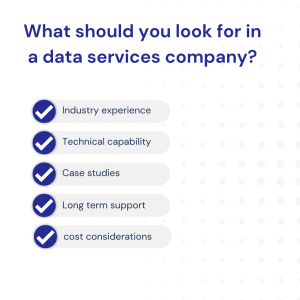
Industry Experience
A consultant with real sector experience arrives with context that accelerates everything. They already know the relevant data sources, the regulatory landscape, and the integrations worth building. Ask about specific projects in your industry — what the challenge was, what they built, and what actually changed as a result.
Technical Capability
Look for genuine depth across data engineering, business intelligence, cloud architecture, and machine learning — not a firm that claims to do everything without the team to back it up. Ask who will actually be working on your project, not just who’s presenting the proposal.
Case Studies and Proven Results
Push past the polished versions. Ask what went wrong mid-project and how it was handled. A firm that speaks honestly about past challenges is far more credible than one with a portfolio of frictionless success stories. If possible, speak directly with a past client in a similar industry.
Long-Term Support
Data infrastructure needs ongoing attention as your business evolves. Look for clearly defined support arrangements maintenance, training, and continued partnership after the initial engagement. The goal should be your team becoming more capable over time, not more dependent on outside help.
Cost Considerations
Costs vary widely based on scope, team seniority, and complexity. What you should insist on is clarity upfront – what’s included, what isn’t, and how costs might shift if scope changes. The better question isn’t “how much does this cost?” but “what return should we realistically expect, and when?”
Data Consulting vs. Data Analytics vs. Data Engineering
These terms often get blurred together, and the confusion leads businesses to invest in the wrong things at the wrong time.
Data consulting is the strategic layer – it combines assessment, planning, implementation, and business alignment across the full data lifecycle. Data analytics sits within that – it’s focused on extracting insights and producing reports from data that already exists. Data engineering is the infrastructure layer – building the pipelines, warehouses, and systems that make the data available in the first place.
Data consulting brings all three together into a coherent solution. Without the strategic layer, analytics and engineering often end up solving the wrong problems very efficiently.
Integrating Cloud and Advanced Technologies
Modern data consulting doesn’t operate in isolation from the broader technology landscape. Cloud computing has become central to how scalable, secure, and accessible data environments are built – and a good consultant helps organisations migrate, optimize, and manage their cloud infrastructure alongside their data strategy.
AI and machine learning are increasingly practical rather than theoretical. Anomaly detection, predictive forecasting, and natural language interfaces for data queries are real tools that organisations can use today — provided their data foundation is solid enough to support them.
Real-time dashboards are shifting the expectation from monthly reporting to continuous visibility. And IoT integration is extending data capture into physical operations in ways that were impractical just a few years ago.
Practical Implementation Strategies
Successful data transformation doesn’t require doing everything at once. The most effective approach starts with an honest assessment of current systems, then moves deliberately through architecture design, use case prioritisation, automation, and governance.
High-impact starting points tend to cluster around a few areas: customer analytics, automated data pipelines, real-time dashboards, and cloud migration. These deliver visible results quickly and build the internal confidence needed to tackle more complex work.
One factor that consistently determines success or failure is change management. Technology is the easier part. Getting teams to actually use new systems – and trust the data coming out of them – requires deliberate effort, good training, and leadership buy-in from the start.
Data Consulting for Strategic Long-Term Growth
The businesses that benefit most from data consulting aren’t the ones that treat it as a one-time project. They’re the ones that use it to build something lasting – a culture where data informs decisions at every level, not just in the boardroom.
That culture enables predictive and prescriptive analytics that move beyond describing what happened toward actively shaping what happens next. It deepens customer understanding in ways that drive loyalty rather than just transactions. It reduces strategic risk by replacing assumption with evidence.
Organizations that embed data thinking into how they operate don’t just make better individual decisions – they compound those improvements over time in ways that become increasingly difficult for competitors to match.
Data Consulting Trends in 2026
Several shifts are defining how the discipline evolves this year.
AI-driven analytics is moving from experimental to operational. Automated insight generation and predictive modelling are becoming standard expectations, not differentiators.
Real-time decision systems are replacing the old model of delayed reporting. Businesses are demanding live visibility, and the infrastructure to support it is becoming more accessible.
Data automation is reducing the manual burden on analytics teams, improving both accuracy and speed. Data democratisation is putting self-service analytics tools in the hands of non-technical teams across organisations. And a cloud-first approach is now the baseline, not the aspiration.
Industry-Specific Applications
In retail, the focus is on inventory optimisation and real-time sales tracking that prevents both overstock and lost sales. In healthcare, it’s predictive care models and the operational data that helps institutions run more efficiently. In finance, fraud detection and explainable risk management are the priorities. In manufacturing, predictive maintenance and supply chain visibility reduce costly downtime and waste.
Each of these industries has its own data landscape, its own regulatory environment, and its own definition of what a good outcome looks like. That’s why sector experience matters so much in a consulting partner.
The Future of Data Consulting
The trajectory points toward fully automated decision-making systems, AI-powered insight generation, and genuinely cross-functional collaboration – where data isn’t owned by one department but understood and used across the whole organisation.
Sustainability is also entering the conversation. Efficient data infrastructure isn’t just a cost question – it’s increasingly an environmental one too, as organisations look at the energy footprint of large-scale data processing.
Businesses that treat data strategy as a continuous discipline rather than a periodic project will be the ones best positioned to adapt as these shifts accelerate.
Conclusion
Data consulting isn’t really about data. It’s about giving organisations the clarity to make better decisions, the efficiency to operate without waste, and the foresight to anticipate what’s coming rather than just react to what’s already happened.
The businesses investing in serious data strategy today aren’t doing it because it’s fashionable. They’re doing it because the compounding advantages — in speed, in insight, in operational performance – are real, measurable, and increasingly difficult to catch up with if you start late.
Frequently Asked Questions
What is data automation consultancy? It’s the practice of replacing manual data collection, processing, and reporting with automated systems – improving both efficiency and accuracy, and freeing up teams to focus on actual analysis rather than data wrangling.
How much do data consulting services cost? It varies considerably based on scope, the tools involved, and the complexity of the existing environment. A focused engagement and a full-scale transformation are very different investments. The more useful question is usually about expected return relative to cost.
Is data consulting suitable for small businesses? Absolutely. Smaller businesses often see faster results because the scope is more contained and decisions can be made quickly. Even modest improvements in reporting and decision speed can have a significant operational impact at that scale.
What tools do data consultants typically use? Common choices include dbt, Fivetran, or Airbyte for pipelines; Snowflake, BigQuery, or Redshift for data warehousing; and Looker, Tableau, or Power BI for reporting. The right tools depend on your team’s capacity to maintain them, not just what’s technically impressive.
How long does a data consulting project take? A focused engagement can deliver meaningful results in six to eight weeks. A broader transformation typically runs three to six months. Starting somewhere specific rather than trying to solve everything at once is almost always the right approach.
Why do companies struggle with data despite having tools? Because tools don’t fix process problems. Data that’s fragmented, poorly governed, or misaligned with how decisions actually get made will produce unreliable outputs regardless of how sophisticated the software is. The strategy has to come before the technology.