

Businesses today generate more data than ever before. Every website click, customer purchase, social media interaction, and online search creates valuable information. But collecting data alone does not help a company grow. What really matters is how businesses use that data to make smarter decisions.
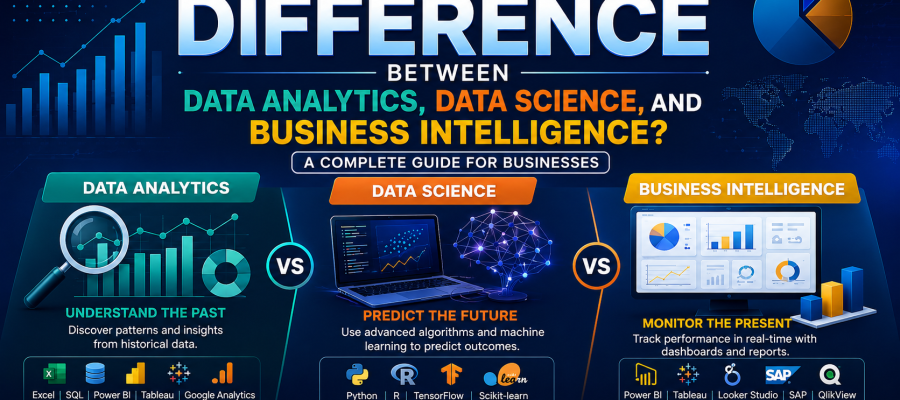
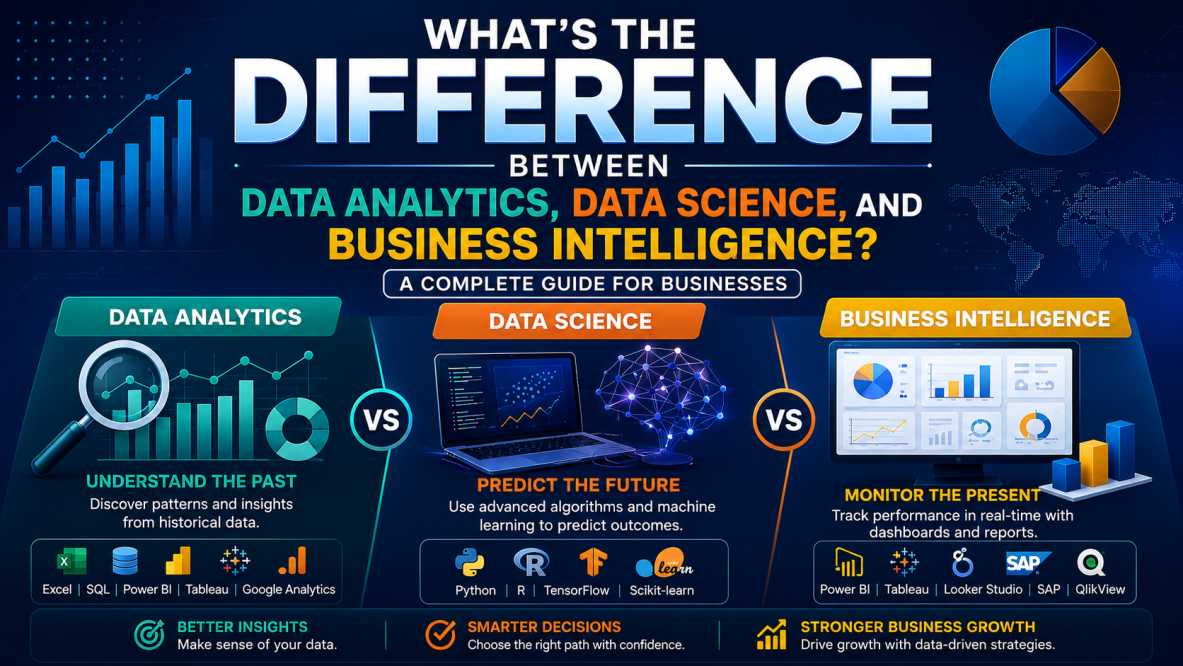
This is why terms like Data Analytics, Data Science, and Business Intelligence have become so common in the digital world. Many people think all three mean the same thing, but they actually solve different problems. Some help companies understand past performance, some help track current business activities, while others help predict future outcomes.
For business owners, marketers, startups, and even students entering the tech industry, understanding the difference between Data Analytics and Data Science is becoming increasingly important. It helps companies choose the right technologies, improve business reporting, and build stronger data driven decision making strategies.
The biggest reason companies invest in data technologies today is simple. Better data leads to better business decisions. Whether it is improving customer experience, increasing sales, reducing operational costs, or identifying new opportunities, data now plays a major role in modern business growth.
What is Data Analytics and Why is it Important for Businesses?
Data Analytics is the process of studying data to identify useful patterns, trends, and insights. It helps organizations understand what is happening in their business and why certain results are occurring.
For example, an ecommerce company may analyze customer purchase history to understand which products perform best during festive seasons. Similarly, a healthcare organization may study patient records to improve operational efficiency.
Data Analytics mainly focuses on historical and current business data. The goal is to improve business performance and support data driven decision making.
Businesses use Data Analytics for many purposes such as:
- Understanding customer behavior
- Tracking sales performance
- Improving marketing campaigns
- Reducing operational costs
- Measuring employee productivity
- Identifying business growth opportunities
Some commonly used Data Analytics tools include:
- Microsoft Excel
- SQL
- Power BI
- Tableau
- Google Analytics
Today, Data Analytics for businesses has become essential across industries like retail, finance, healthcare, education, and digital marketing because companies want more accurate insights instead of relying only on assumptions.
How Does Business Intelligence Help Companies Make Faster Decisions?
Business Intelligence, often called BI, focuses on transforming raw business data into reports, dashboards, and visual insights that are easier to understand.
The main purpose of Business Intelligence is to help organizations monitor performance in real time. Instead of manually reading spreadsheets full of numbers, business managers can view dashboards that instantly show revenue growth, sales trends, customer activity, and operational performance.
For example, a sales manager can quickly track:
- Daily revenue performance
- Region wise sales growth
- Top performing products
- Employee targets
- Customer engagement data
This helps businesses make faster and more practical decisions.
Unlike Data Science, Business Intelligence mainly focuses on reporting and visualization rather than future prediction. It helps organizations stay updated with current business activities.
Some popular Business Intelligence tools used by companies include:
- Power BI
- Tableau
- Looker Studio
- SAP BusinessObjects
- QlikView
As businesses continue handling massive amounts of information every day, Business Intelligence tools are becoming increasingly important for improving reporting efficiency and business visibility.
What Makes Data Science Different from Data Analytics?
One of the most common questions businesses ask today is about the difference between Data Analytics and Data Science.
Although both fields work with data, their goals are quite different.
Data Analytics mainly focuses on understanding historical data and identifying business insights. Data Science, on the other hand, combines programming, machine learning, artificial intelligence, and advanced statistics to predict future outcomes.
For example, streaming platforms like Netflix and Spotify use the role of Data Science in business to recommend content based on user preferences and viewing history. Ecommerce companies use machine learning algorithms to predict which products customers are most likely to purchase next.
Data Science usually involves:
- Predictive analysis
- Machine learning models
- Artificial intelligence systems
- Data automation
- Advanced statistical analysis
Data Scientists often work with large amounts of structured and unstructured data using programming languages like Python and R.
A simple way to understand this is:
Data Analytics explains what happened in the past.
Data Science predicts what may happen in the future.
Because of this predictive capability, Data Science has become highly valuable in industries like finance, healthcare, ecommerce, cybersecurity, and technology.
Which Skills are Required in Data Analytics, Data Science, and Business Intelligence?
Although these three fields are connected, the required skills are quite different.
A Data Analyst mainly focuses on reporting, trend analysis, and visualization. Skills like SQL, Excel, Power BI, Tableau, and analytical thinking are commonly required.
A Business Intelligence professional mainly works with dashboards, reports, KPI monitoring, and visualization systems. Knowledge of Business Intelligence tools is essential in this field.
A Data Scientist usually requires more advanced technical expertise. They often work with:
- Python programming
- Machine learning
- Artificial intelligence
- Statistical modeling
- Predictive systems
Because businesses now depend heavily on data driven decision making, professionals with Data Analytics, Data Science, and Business Intelligence skills are in high demand across industries worldwide.
Conclusion
In today’s digital business environment, understanding the difference between Data Analytics, Data Science, and Business Intelligence is becoming more important than ever. Although these fields are closely connected, each one serves a different purpose in helping organizations use data effectively.
Data Analytics mainly focuses on studying past and present data to identify trends, patterns, and business insights. It helps companies improve operations, understand customer behavior, and support better planning through accurate reporting and analysis.
Business Intelligence is more focused on dashboards, visualization, and real time monitoring. Businesses use Business Intelligence tools to track sales performance, monitor KPIs, and make faster decisions based on live business data. It allows managers and teams to clearly understand how the business is performing at any moment.
On the other hand, Data Science goes beyond analysis and reporting. It uses machine learning, artificial intelligence, and predictive models to forecast future outcomes. The growing role of Data Science in business is helping companies automate systems, improve customer experiences, and make smarter long term decisions.
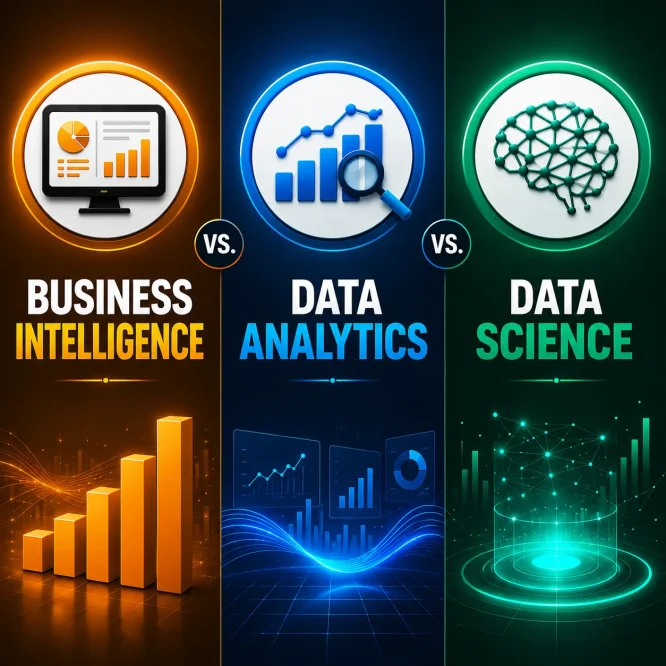
Many organizations today combine all three approaches to create stronger data driven decision making strategies. A company may use Business Intelligence dashboards for monitoring performance, Data Analytics for identifying trends, and Data Science for predicting future customer behavior.
As industries continue becoming more technology focused, the demand for professionals skilled in Data Analytics for businesses, machine learning, and reporting systems will continue growing. Companies that understand how to use data effectively will have a stronger competitive advantage in the future.
Frequently Asked Questions
1. What is the main difference between Data Analytics and Data Science?
The main difference between Data Analytics and Data Science is that Data Analytics focuses on understanding historical data, while Data Science focuses on predicting future outcomes using machine learning and artificial intelligence.
2. Why is Business Intelligence important for companies?
Business Intelligence helps organizations track performance, monitor KPIs, and make faster business decisions using reports and dashboards.
3. Which are the most popular Business Intelligence tools?
Some widely used Business Intelligence tools include Power BI, Tableau, Looker Studio, SAP BusinessObjects, and QlikView.
4. How does Data Analytics help businesses grow?
Data Analytics for businesses helps improve customer understanding, optimize marketing strategies, reduce costs, and support better business planning.
5. Is coding necessary for Data Science?
Yes, coding is an important part of Data Science because professionals often use programming languages like Python and R for machine learning and predictive analysis.