

Data has become one of the most valuable assets for modern businesses. However, collecting information is only the first step. Businesses also need the right strategies, technologies, and expertise to convert raw data into meaningful insights that support better decision-making.
As organizations across India increasingly adopt data-driven operations, investing in professional data consulting services has become important for improving efficiency, understanding customers, optimizing business processes, and identifying growth opportunities.
However, one of the biggest questions businesses face before starting a project is: How much do data consulting services cost in India in 2026?
The answer depends on several factors, including project complexity, data volume, technology requirements, consultant expertise, and the level of ongoing support required. Understanding these factors helps businesses plan their budgets, select suitable consulting partners, and avoid unnecessary expenses.
In this guide, we explore the average cost of data consulting services in India in 2026, different pricing models, factors affecting project costs, budgeting strategies, and ways businesses can maximize their investment.
What Is the Average Cost of Data Consulting Services in India in 2026?
The average cost of data consulting services in India varies depending on the project scope, business requirements, and technical expertise involved.
A small business that needs basic reporting or dashboard development will generally require a smaller investment than an enterprise implementing a complete data strategy, cloud architecture, or advanced analytics solution.
Here are some indicative cost ranges for different types of data consulting projects:
For hourly consulting engagements, businesses may encounter rates ranging from ₹2,000 to ₹12,000 or more, depending on the consultant’s experience and specialization.
These figures are indicative budgeting estimates, not fixed industry-wide rates or guaranteed vendor quotations. Actual costs can vary based on deliverable
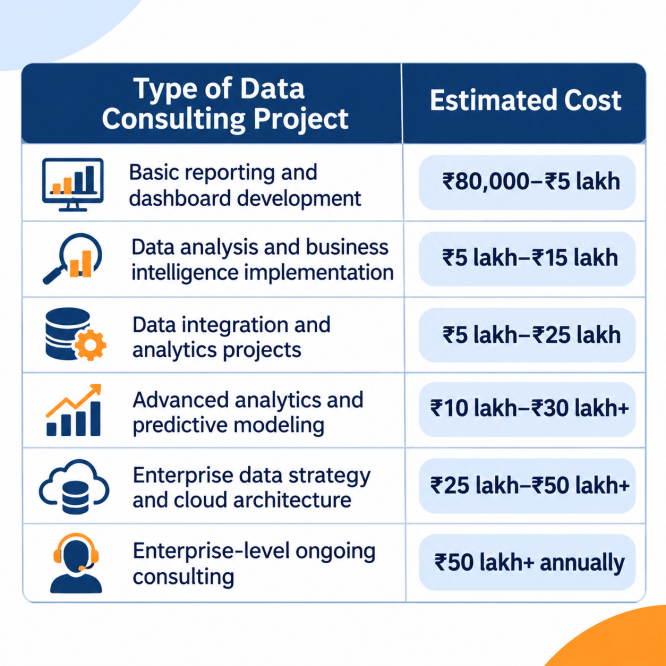 s, team size, technology licensing, project duration, and implementation requirements.
For example:
- A retail business may invest in dashboard development to monitor sales, inventory, and customer performance.
- A manufacturing company may require data integration to connect production, inventory, and operational systems.
- A financial services company may need advanced analytics to improve risk assessment and forecasting.
Each project requires different resources, which explains why data consulting costs can vary significantly.
Key Pricing Models Used in Data Consulting
Data consulting companies generally offer different pricing models depending on the nature of the engagement. Understanding these models helps businesses choose an arrangement that matches their budget, project duration, and expected outcomes.
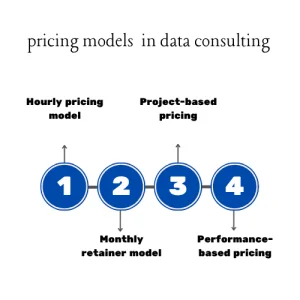
1. Hourly Pricing Model
The hourly pricing model is suitable for businesses requiring short-term consulting, technical assistance, or specialized expertise.
Under this arrangement, businesses pay consultants based on the actual hours spent working on the project.
Common applications include:
- Data quality assessments
- Analytics troubleshooting
- Technical consultations
- Existing dashboard improvements
- Data strategy discussions
For example, a business experiencing reporting errors may hire a data consultant for a few hours to identify the problem and recommend improvements.
Business benefit: This model offers flexibility and allows businesses to access expert guidance without committing to a long-term engagement.
However, costs can become unpredictable when project requirements change frequently. Setting clear hourly limits and deliverables can help control spending.
2. Project-Based Pricing
Project-based pricing involves agreeing on a fixed cost for a clearly defined project before work begins.
It is suitable for businesses that understand their requirements and need specific deliverables within an agreed timeline.
Common applications include:
- Power BI dashboard development
- Data warehouse implementation
- Data pipeline development
- Business intelligence solutions
- Data integration projects
For example, a company may hire a consulting firm to develop a centralized dashboard that combines sales, finance, and operational data.
The consultant and business agree on the scope, timeline, deliverables, and total project cost.
Business benefit: Fixed pricing provides better budget visibility, clearly defined expectations, and greater control over project expenses.
However, additional requirements outside the agreed scope may increase the final cost.
3. Monthly Retainer Model
The monthly retainer model is designed for businesses that need continuous data consulting support and optimization.
Instead of hiring consultants for individual projects, businesses pay a recurring monthly fee for ongoing expertise and assistance.
Services may include:
- Dashboard monitoring and optimization
- Regular data analysis
- Reporting improvements
- Data strategy consultations
- Performance monitoring
- Technical support and recommendations
For example, an eCommerce business may require monthly analytics support to monitor customer behavior, sales performance, marketing results, and inventory trends.
Business benefit: This model provides consistent access to consulting expertise and supports continuous improvements without repeatedly onboarding new consultants.
It is particularly useful for organizations with ongoing analytics requirements.
4. Performance-Based Pricing
Performance-based pricing connects consulting fees to predefined business outcomes or performance indicators.
Under this arrangement, some portion of the consulting fee may depend on measurable improvements agreed upon by both parties.
Possible performance indicators include:
- Improved reporting efficiency
- Reduced operational costs
- Faster data processing
- Better forecasting accuracy
- Improved process performance
For example, a consulting project may establish agreed targets for reducing manual reporting time or improving a specific operational metric.
Business benefit: This model connects consulting investment with measurable business objectives.
However, it requires clearly defined KPIs, reliable measurement methods, and agreement on how results will be evaluated. It is less common than hourly or project-based pricing.
Why Do Data Consulting Costs Vary Across Projects?
Data consulting costs are not fixed because businesses have different operational requirements, data environments, and growth objectives.
A company with organized data and established reporting systems may need only a few improvements. Another business may require extensive data cleaning, integration, infrastructure development, and analytics implementation.
Several factors explain these differences.
1. Project Complexity
The complexity of a project directly affects the time, resources, and technical expertise required.
Basic reporting improvements are generally simpler than developing predictive analytics models or implementing enterprise-wide data architecture.
Projects involving multiple departments, complex workflows, or advanced analytics usually require additional planning and implementation.
2. Data Quality and Availability
The condition of existing business data also influences consulting costs.
Businesses often store information across spreadsheets, databases, CRM systems, ERP platforms, and other applications.
When data is incomplete, duplicated, inconsistent, or poorly structured, consultants must spend additional time cleaning, validating, and organizing it before analysis can begin.
Better data quality can reduce preparation time and improve the reliability of project outcomes.
3. Technology Requirements
Different projects require different tools, platforms, and infrastructure.
For example:
- Power BI or Tableau for business intelligence and visualization
- SQL and Python for data analysis
- Cloud platforms for scalable data storage and processing
- ETL tools for data integration and transformation
- AI and machine learning frameworks for predictive analytics
The cost of implementation, software licensing, infrastructure, and ongoing maintenance can influence the overall investment.
4. Consultant Expertise
The experience and specialization of the consulting team also affect pricing.
A basic reporting project may require a BI developer, while an enterprise data transformation initiative may involve data architects, data engineers, analytics specialists, and project managers.
Specialized expertise generally requires a higher investment but may be necessary for complex business requirements.
5. Project Duration and Ongoing Support
Short-term projects usually have different cost structures from long-term consulting engagements.
A dashboard development project may require a few weeks, while a complete data transformation initiative may continue for several months.
Businesses requiring ongoing monitoring, optimization, and technical assistance should also include these expenses in their budgets.
Factors Affecting Data Consulting Pricing in India
Before estimating a project budget, businesses should evaluate the following factors:
- Data architecture complexity: Existing infrastructure, databases, and system requirements.
- Data volume and quality: Amount of information that needs to be collected, cleaned, and processed.
- Technology and tools: BI platforms, cloud infrastructure, AI frameworks, and integration tools.
- Consultant expertise: Experience, technical specialization, and industry knowledge.
- Project duration: Estimated time required for planning, development, implementation, and testing.
- System integration: Connecting existing CRM, ERP, finance, sales, and operational systems.
- Security and compliance: Data protection, access controls, governance, and regulatory requirements.
- Ongoing maintenance: Updates, performance monitoring, troubleshooting, and optimization.
Evaluating these factors before starting a project helps businesses receive more accurate proposals and avoid unexpected expenses.
How to Estimate the Budget for Data Consulting Services?
Estimating a data consulting budget requires more than comparing hourly rates or project quotations. Businesses should first understand their requirements and determine what outcomes they expect from the engagement.
Here are five important steps to consider.
1. Define Business Objectives Clearly
Start by identifying the specific business problem you want to solve.
For example, your objectives may include:
- Improving sales reporting
- Understanding customer behavior
- Reducing manual reporting work
- Improving inventory forecasting
- Integrating information from multiple systems
- Building predictive analytics capabilities
Clearly defined objectives help consultants recommend suitable solutions without introducing unnecessary tools or features.
Business value: A well-defined project scope reduces ambiguity and helps control consulting expenses.
2. Assess Current Data Maturity
Evaluate how your organization currently collects, stores, manages, and analyzes information.
Consider questions such as:
- Is business data stored in centralized systems?
- Are reports generated manually?
- Are there duplicate or inconsistent records?
- Can different departments access reliable information?
- Are existing dashboards providing useful insights?
Businesses with organized data infrastructure may require less preparation work. Companies with fragmented systems may need additional investment in data cleaning, integration, and standardization.
Business value: Understanding data maturity helps identify infrastructure gaps before estimating the project budget.
3. Choose the Right Engagement Model
Select a pricing model based on the scope and duration of your requirements.
- Hourly pricing is suitable for short-term consulting and troubleshooting.
- Project-based pricing works well for clearly defined deliverables.
- Monthly retainers are useful for ongoing analytics and optimization.
- Performance-based arrangements may suit engagements with measurable outcomes.
Business value: Choosing the right model provides better financial control and ensures that consulting resources match your business requirements.
4. Consider Technology and Tools
Technology expenses should be included in the overall project budget.
Consider software licensing, cloud infrastructure, data storage, integration platforms, and implementation requirements.
For example, a business implementing Power BI dashboards may need to consider licensing, data connections, and infrastructure costs in addition to consulting fees.
Advanced platforms may require higher initial investment, but the right technology can improve scalability and operational efficiency.
Business value: Evaluating technology costs early prevents unexpected expenses during implementation.
5. Plan for Scalability
Your data requirements may increase as your business grows.
A solution designed only for current reporting needs may require significant upgrades when transaction volumes, customer data, or operational complexity increase.
Consider future requirements such as:
- Additional data sources
- More users and departments
- Advanced reporting capabilities
- Predictive analytics
- Cloud infrastructure expansion
- Improved data governance
Business value: Planning for scalability helps businesses avoid repeated implementation expenses and supports long-term growth.
Cost Comparison Based on Business Size
Data consulting investment also depends on the size of the organization, its operational complexity, and its data requirements.
The following ranges provide indicative annual budgeting estimates rather than fixed market rates.
| Business Type | Estimated Annual Investment | Typical Requirements |
|---|---|---|
| Startups | ₹4 lakh–₹10 lakh | Basic reporting and analytics |
| Small and medium businesses | ₹10 lakh–₹40 lakh | Data integration, BI and dashboards |
| Large enterprises | ₹40 lakh–₹1 crore+ | Enterprise analytics and data strategy |
Startups
Startups generally focus on building a basic data infrastructure without making a large initial investment.
Their requirements may include sales dashboards, customer analytics, basic reporting, and performance tracking.
A smaller consulting engagement can help startups establish reliable reporting practices while keeping technology expenses manageable.
Small and Medium Businesses
SMBs often require more structured analytics capabilities as their operations expand.
They may need centralized reporting, integration between business systems, automated dashboards, and improved visibility across departments.
Investing in the right data consulting solutions can help these businesses reduce manual work and make more informed operational decisions.
Large Enterprises
Large organizations typically manage information across multiple departments, locations, and business systems.
Their requirements may include enterprise data architecture, cloud migration, advanced analytics, AI integration, governance, and security.
These projects often require larger consulting teams, longer implementation timelines, and ongoing technical support.
How Can Businesses Reduce Data Consulting Expenses?
Investing in data consulting does not necessarily mean choosing the most expensive solution. Businesses can manage costs effectively by focusing on the requirements that deliver the greatest value.
Here are some practical ways to optimize consulting expenses.
1. Define Project Requirements Before Hiring
Clearly document your business objectives, expected deliverables, and implementation priorities.
This reduces unnecessary changes and prevents consultants from spending time on requirements that do not support your goals.
2. Improve Data Quality Early
Clean and organized data reduces the time required for preparation, validation, and transformation.
Businesses should identify duplicate records, missing values, and inconsistent formats before beginning major analytics projects whenever possible.
3. Choose Cost-Effective Technology
Select tools based on actual business requirements rather than investing in platforms with unnecessary features.
Existing systems may already provide capabilities that can be extended instead of replaced.
4. Implement Solutions in Phases
Rather than investing in a complete enterprise-wide transformation immediately, businesses can start with high-priority requirements.
For example:
- Phase 1: Build essential business dashboards.
- Phase 2: Integrate data from different systems.
- Phase 3: Automate reporting processes.
- Phase 4: Introduce advanced analytics and forecasting.
This approach distributes investment over time and allows businesses to evaluate results before expanding the project.
5. Use Internal Resources Alongside Consultants
Internal teams can support consultants by providing business knowledge, existing documentation, and access to relevant data.
This reduces unnecessary coordination and helps external specialists focus on technical and strategic requirements.
6. Monitor Project Scope and Progress
Regularly review project milestones, expenses, and deliverables.
Clear communication helps identify potential cost overruns early and ensures that the project remains aligned with business objectives.
Common Hidden Costs in Data Consulting Projects
Apart from consulting fees, businesses should account for additional expenses that may arise during implementation.
Overlooking these costs can lead to budget overruns or unexpected financial commitments.
1. Data Cleaning and Preparation
Businesses with incomplete, inconsistent, or duplicated records may require additional data preparation before analytics implementation.
This work can involve data validation, standardization, transformation, and quality checks.
2. Software and Licensing Fees
Analytics platforms, BI tools, cloud services, and specialized software may require recurring subscription or licensing payments.
These expenses should be considered separately from consulting fees.
3. Cloud Infrastructure Costs
Cloud-based analytics solutions may involve storage, computing, data transfer, and processing expenses.
As data volumes increase, these costs may also change.
4. System Integration Expenses
Connecting existing CRM, ERP, accounting, and operational systems may require additional development and configuration.
Older systems can sometimes require more integration effort than expected.
5. Maintenance and Technical Support
Data systems require regular monitoring, troubleshooting, updates, and performance optimization.
Businesses should consider these recurring expenses when planning long-term investments.
6. Employee Training and Adoption
Implementing new dashboards and analytics systems is only useful when employees know how to use them effectively.
Training, documentation, and internal adoption activities should also be included in the project budget.
How to Choose the Right Data Consulting Firm in India?
Choosing a data consulting firm based only on the lowest quotation can create problems later.
Businesses should evaluate the consulting partner’s capabilities, experience, implementation approach, and ability to understand their objectives.
Consider the following points before making a decision:
1. Technical expertise: Check whether the firm has experience with your required technologies, such as Power BI, SQL, Python, cloud platforms, and data integration tools.
2. Industry understanding: A consulting partner familiar with your business sector may better understand your reporting requirements, operational challenges, and performance indicators.
3. Project experience: Review relevant case studies, previous implementations, and measurable project outcomes.
4. Pricing transparency: Ask for a clear breakdown of consulting fees, technology costs, deliverables, timelines, and ongoing support charges.
5. Scalability: Ensure that the proposed solution can support future business requirements without requiring frequent infrastructure changes.
6. Ongoing support: Understand what assistance is available after implementation, including maintenance, optimization, and technical support.
The right consulting partner should focus on solving business problems rather than simply recommending expensive tools or technologies.
Conclusion
Understanding the cost of data consulting services in India in 2026 requires evaluating project complexity, business objectives, technology requirements, consultant expertise, and long-term support needs.
While smaller analytics projects may require a relatively modest investment, enterprise-level data strategies, cloud architecture, and advanced analytics initiatives can involve significantly higher costs.
Businesses can manage these expenses by defining clear objectives, assessing their existing data infrastructure, choosing the right pricing model, and implementing solutions in phases.
More importantly, the value of data consulting should not be measured only by the initial investment. It should also be evaluated through improvements in reporting efficiency, operational performance, decision-making, and long-term business growth.
Selecting the right data consulting partner can help organizations turn their existing information into a valuable business asset while building a scalable foundation for future growth.
Frequently Asked Questions (FAQs)
1. What factors influence the cost of data consulting services in India for growing businesses?
The cost depends on project complexity, data quality, technology requirements, consultant expertise, and implementation timelines. Advanced solutions such as predictive analytics, cloud architecture, and AI integration generally require additional investment.
2. How do businesses choose the right data consulting pricing model for their needs?
Businesses should evaluate project scope, duration, and expected deliverables. Hourly pricing works well for short-term assistance, project-based pricing suits defined implementations, and monthly retainers support ongoing consulting requirements.
3. Why is data quality important when estimating data consulting project costs?
Poor data quality increases the effort required for cleaning, structuring, validation, and integration. Businesses with inconsistent or fragmented data may require additional preparation work, which can increase overall project costs.
4. How much do small and medium businesses typically spend on data analytics consulting in India?
Small and medium businesses may invest approximately ₹10 lakh–₹40 lakh annually, depending on their analytics requirements, data infrastructure, integration needs, and reporting complexity. Actual costs vary by project scope.
5. What hidden costs should companies consider in data consulting engagements?
Common additional expenses include software licensing, cloud infrastructure, data cleaning, system integration, employee training, maintenance, and ongoing technical support.
6. How can companies optimize their budget for data consulting and analytics services?
Businesses can control expenses by defining clear project requirements, improving data quality, selecting suitable tools, implementing solutions in phases, and monitoring project scope and progress.
7. Is data consulting worth the investment for small businesses?
Yes. Data consulting can help small businesses improve reporting, understand customer behavior, identify operational inefficiencies, and make informed decisions. The investment should be aligned with specific business needs and available resources.
8. How long does a typical data consulting project take?
Project timelines depend on complexity and deliverables. Basic dashboard projects may take a few weeks, while data integration, enterprise analytics, and cloud transformation initiatives can require several months or longer.
Ready to Turn Data into Business Growth?
Every business has different data requirements, technical challenges, and budget considerations.
Get a customized estimate for your data analytics, business intelligence, AI, or digital transformation project. Our team can help you identify the right approach, prioritize your requirements, and build a cost-effective solution that supports your business goals.
Talk to Our Experts at Wisecor Transformations.