

Artificial Intelligence is changing how businesses use data.Companies now use AI to analyze customer behavior, automate processes, forecast demand, detect risks, and support business decisions. But AI can only perform as well as the data behind it.If business data is incomplete, outdated, duplicated, or poorly managed, AI systems may produce unreliable results.
This is why data governance has become increasingly important.
Data governance provides the rules, processes, responsibilities, and controls needed to manage business data properly. It helps organizations understand where their data comes from, who can access it, how it should be used, and whether it can be trusted.
The rise of AI makes these questions even more important.
Businesses need a strong data governance strategy before they can scale AI successfully. Without proper governance, organizations may face inaccurate insights, privacy problems, security risks, compliance issues, and poor-quality AI outputs.
In this guide, we will explain what data governance means, why it matters in the age of AI, the key elements of a strong governance framework, and how businesses can prepare their data for responsible AI adoption.
2. What Is Data Governance?
Data governance is the system businesses use to manage their data responsibly and consistently.
It defines who is responsible for data, how data should be collected and stored, who can access it, and how its quality should be maintained.
A strong governance program creates clear standards across an organization.
For example, different departments may use different names or formats for the same customer information. Without governance, this can create duplicate records and inconsistent reports.
A governance framework helps establish common definitions and standards.
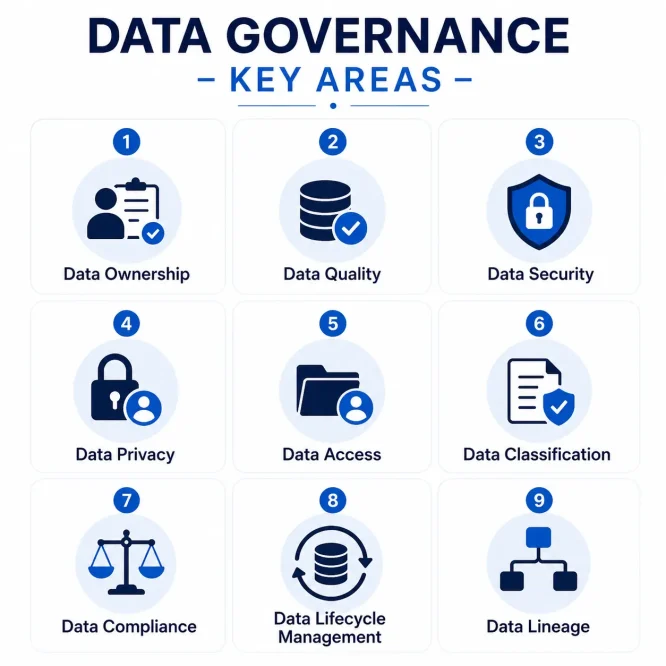
It can cover areas such as:
- Data ownership
- Data quality
- Data security
- Data privacy
- Data access
- Data classification
- Data compliance
- Data lifecycle management
- Data lineage
The goal is simple: make business data accurate, secure, accessible, and trustworthy.
This becomes even more important when organizations use that data to train or operate AI systems.
3. Why Data Governance Matters in the Age of AI
AI systems can process enormous amounts of information.
However, more data does not automatically mean better results.
Poor-quality data can create inaccurate predictions, misleading insights, and unreliable recommendations.
Consider a business that wants to build an AI model to predict customer churn.
If customer records contain duplicate profiles, missing information, outdated contact details, or incorrect purchase history, the model may learn from unreliable patterns.
Good data governance helps reduce these problems.
It establishes processes for checking data quality before information reaches analytics and AI systems.
Better AI Results
AI models depend on reliable information.
High-quality and well-managed data can improve the accuracy and consistency of AI outputs.
Improved Data Security
AI projects may use sensitive business and customer information. Governance helps organizations control who can access this data.
Greater Trust
Business leaders and employees are more likely to use AI recommendations when they understand where the data comes from and how it is managed.
Reduced Risk
Strong governance can help organizations identify privacy, security, compliance, and data-quality risks before they become larger problems.
Easier AI Scaling
Organizations with well-managed data can move from small AI experiments to larger enterprise deployments more efficiently.
4. Key Elements of an AI Data Governance Framework
A strong data governance framework should cover more than data storage.
It should define how information is managed throughout its lifecycle and how it can be safely used for analytics and AI.
Data Ownership
Every important dataset should have a clear owner.
Data owners are responsible for defining how information should be maintained and used.
Data Quality
Organizations need processes to identify missing, duplicate, outdated, or inaccurate information.
Good data quality is essential for reliable analytics and AI.
Data Security
Businesses should control access to sensitive information.
Role-based permissions, encryption, monitoring, and security policies can help protect valuable data.
Data Privacy
Organizations need to understand what personal or sensitive information they collect and how it can be used.
Privacy controls should be included when designing AI and analytics systems.
Data Classification
Not every dataset carries the same level of risk.
Businesses can classify information based on sensitivity and business importance.
Data Lineage
Data lineage helps organizations understand where information comes from and how it moves through different systems.
This can make it easier to investigate errors and understand AI outputs.
Data Cataloging
A data catalog helps teams discover available datasets and understand what they contain.
This reduces the time spent searching for reliable information.
5. How Data Quality Affects AI
Data quality is one of the most important parts of successful AI adoption.
An AI system may process thousands or millions of records, but the quality of those records still matters.
Poor data can introduce errors into analytics models.
For example, imagine a retail company trying to forecast product demand. If sales records contain incorrect quantities or missing dates, the resulting forecast may be unreliable.
Data governance helps organizations establish processes for:
- Identifying duplicate data
- Correcting inaccurate records
- Monitoring data quality
- Standardizing data formats
- Removing outdated information
- Tracking data changes
These processes create a stronger foundation for AI and Machine Learning.
Businesses should therefore treat data quality as an ongoing process rather than a one-time cleanup exercise.
6. Data Governance and AI Security
AI introduces new opportunities, but it can also create new security challenges.
AI applications may interact with customer information, financial records, internal documents, and other sensitive data.
Businesses need clear rules around access and usage.
A strong governance program can help organizations determine:
- Who can access specific datasets
- Which information can be used by AI systems
- How sensitive data should be protected
- How access should be monitored
- How data should be retained or deleted
Security should be considered from the beginning of an AI project rather than added later.
This approach helps organizations build AI systems that are not only useful but also secure and responsible.
7. Data Governance for Regulatory Compliance
Businesses operate in an environment where data privacy and security requirements continue to evolve.Organizations may need to demonstrate how customer and business information is collected, stored, processed, and protected.
Data governance helps create visibility into these processes.For example, data lineage can help organizations understand how information moves between systems, while access controls can help limit who can view sensitive information.
Governance does not replace legal or regulatory advice, but it provides the operational foundation needed to manage data responsibly.
Businesses should therefore consider compliance requirements when designing their data governance strategy.
8. How Businesses Can Build a Data Governance Strategy
Building governance does not need to happen all at once.
Businesses can start with a clear roadmap.
Step 1: Identify Critical Data
Determine which datasets are most important to business operations and AI initiatives.
Step 2: Assign Data Ownership
Define who is responsible for maintaining each important dataset.
Step 3: Establish Data Standards
Create common definitions, formats, quality rules, and access policies.
Step 4: Measure Data Quality
Use clear metrics to monitor accuracy, completeness, consistency, and timeliness.
Step 5: Implement Security Controls
Define appropriate access permissions and protection measures.
Step 6: Create Data Visibility
Use data catalogs and lineage tools to help teams understand available information.
Step 7: Monitor and Improve
Governance should evolve as the organization, technology, and data environment change.
The best governance strategies are practical and aligned with business goals.
9. Common Data Governance Mistakes
Businesses often face governance problems because they treat data management as only an IT responsibility.
Data is used across finance, marketing, sales, operations, HR, customer service, and other departments.
Governance therefore requires collaboration across the organization.
Some common mistakes include:
No Clear Data Ownership
If nobody is responsible for a dataset, quality problems can remain unresolved.
Too Many Complex Rules
Governance should make data easier to manage, not create unnecessary bureaucracy.
Ignoring Data Quality
AI projects built on poor-quality information may produce unreliable results.
Weak Security Controls
Sensitive information should not be accessible to everyone.
No Long-Term Strategy
Governance should evolve as new data sources, AI applications, and technologies are introduced.
A successful governance program balances control with usability.
10. How Wisecor Transformations Can Help
Building a reliable data foundation requires more than implementing a single technology.
Businesses need the right combination of data strategy, engineering, analytics, cloud infrastructure, security practices, and governance processes.
Wisecor Transformations helps organizations modernize their data environments and build solutions that support long-term business goals.
Our services include:
- Data Analytics Consulting
- Data Engineering
- Business Intelligence
- Cloud Data Analytics
- Data Integration
- Predictive Analytics
- Artificial Intelligence and Machine Learning
- Executive Dashboards
- Digital Transformation
Our approach focuses on connecting technology with business objectives.
We help organizations understand their existing data environment, identify gaps, improve data processes, and create a stronger foundation for analytics and AI.
For businesses preparing to scale AI, establishing reliable data practices can be an important step toward reducing risk and improving the value of future AI initiatives.
11. The Future of Data Governance
Data governance will become increasingly important as businesses adopt more AI-powered applications.
Future governance programs will likely focus on areas such as:
- Automated data quality monitoring
- AI-assisted data discovery
- Real-time governance
- Stronger privacy controls
- Automated data classification
- AI model monitoring
- Responsible AI practices
- Greater data transparency
The goal will not simply be to control data.
It will be to create an environment where people and AI systems can use trusted information safely and effectively.
Organizations that establish strong foundations today will be better prepared to adopt new AI technologies tomorrow.
Conclusion
AI is changing the way businesses create value from data.
But successful AI adoption requires more than powerful algorithms. Businesses also need reliable, secure, accessible, and well-managed information.
This is why data governance has become a critical part of modern data strategy.
A strong governance framework helps organizations improve data quality, protect sensitive information, support compliance, and create greater trust in analytics and AI systems.
Businesses should begin by identifying critical data, assigning ownership, establishing quality standards, improving security, and creating clear policies for responsible data use.
The right approach does not need to be complicated. It needs to be practical, scalable, and aligned with business objectives.
As AI adoption grows, companies with trusted data foundations will be in a stronger position to innovate, automate, and make better decisions.
Wisecor Transformations helps businesses build modern data environments through Data Analytics, Data Engineering, Business Intelligence, Cloud Analytics, AI/ML, and Digital Transformation solutions.
The future of AI depends on the quality of the data behind it. Building strong data governance today can help businesses create a more trusted and AI-ready organization tomorrow.
Frequently Asked Questions
1. What is data governance?
Data governance is a framework of policies, processes, roles, and controls used to manage business data effectively, securely, and consistently.
2. Why is data governance important for AI?
AI systems depend on data. Strong governance helps improve data quality, security, privacy, and accessibility, which can support more reliable AI and analytics outcomes.
3. What is an AI data governance framework?
An AI data governance framework defines how data used by AI systems should be managed, protected, monitored, and maintained throughout its lifecycle.
4. How can businesses improve data quality?
Businesses can improve data quality by standardizing data, removing duplicates, monitoring accuracy, assigning data ownership, and regularly reviewing critical datasets.
5. How does data governance support digital transformation?
Data governance creates a trusted foundation for analytics, cloud platforms, AI, automation, and Business Intelligence, helping organizations use data more effectively during digital transformation.
6. Can Wisecor Transformations help businesses with data governance?
Wisecor Transformations provides Data Analytics, Data Engineering, Business Intelligence, Cloud Analytics, AI/ML, Data Integration, Predictive Analytics, and Digital Transformation services that can support organizations building modern, data-driven environments.