

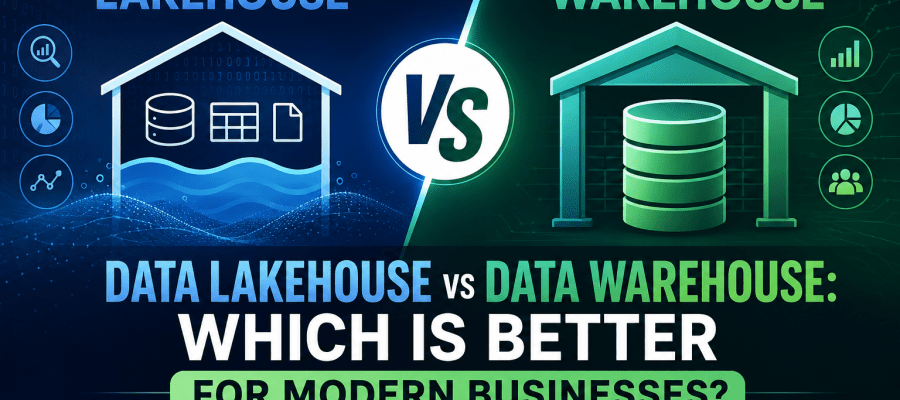
Businesses generate huge amounts of data every day. Sales records, customer details, website activity, financial reports, application logs, and marketing data all need to be stored and analyzed.
For years, businesses mainly used data warehouses to manage structured data and support reporting. Data lakes later became popular because they could store large amounts of raw and unstructured information.
Now, another architecture is gaining attention: the data lakehouse.
A data lakehouse combines some of the best features of data lakes and data warehouses. It gives businesses a flexible platform for analytics, reporting, Artificial Intelligence, and Machine Learning.
But does that mean a data lakehouse is always better than a data warehouse?
Not necessarily.
The right choice depends on your data, business goals, analytics workloads, budget, and technology environment.
In this guide, we will explain the difference between a data lakehouse and data warehouse, compare their key features, and help you understand which architecture may be better for a modern business.
What Is a Data Warehouse?
A data warehouse is a centralized system designed to store structured business data for reporting and analytics.
Businesses collect information from different systems such as CRM software, ERP platforms, financial applications, and sales tools. This data is cleaned, transformed, and loaded into the warehouse.
Once the data is prepared, business teams can use it for reporting, dashboards, and analysis.
For example, a retail company may store:
- Sales transactions
- Customer information
- Product details
- Store performance
- Revenue records
- Inventory information
A data warehouse makes it easier for analysts and business leaders to access consistent information.
It is especially useful when businesses need reliable reports and well-defined Key Performance Indicators (KPIs).
Key Characteristics of a Data Warehouse
A traditional data warehouse usually focuses on:
- Structured data
- Business reporting
- SQL-based analytics
- Historical data
- Data consistency
- Business Intelligence
- Dashboard reporting
Popular data warehouse technologies include Snowflake, Amazon Redshift, Google BigQuery, and Microsoft Fabric’s warehouse capabilities.
What Is a Data Lakehouse?
A data lakehouse is a modern data architecture that combines the flexibility of a data lake with many of the management and analytics capabilities of a data warehouse.
A data lake can store different types of information, including structured, semi-structured, and unstructured data.
The lakehouse builds additional management and analytics capabilities on top of this flexible storage model.
This makes it possible to support multiple workloads from the same data environment.
For example, a business may use a lakehouse for:
- Business Intelligence
- Data Analytics
- Machine Learning
- Artificial Intelligence
- Data Science
- Real-time analytics
- Historical analysis
Instead of moving data between several separate platforms, organizations can create a more unified data environment.
This can reduce complexity and help data teams work with the same trusted information.
Key Characteristics of a Data Lakehouse
A data lakehouse generally supports:
- Structured and unstructured data
- Large-scale data storage
- Analytics
- Machine Learning
- AI workloads
- Business Intelligence
- Data science
- Cloud-based data processing
Platforms such as Databricks and other modern cloud data technologies support lakehouse-style architectures.
Data Lakehouse vs Data Warehouse: Key Differences
The biggest difference between a data lakehouse and data warehouse is how they manage and use data.
A data warehouse is mainly designed for structured data and business analytics.
A data lakehouse provides a broader environment that can support structured, semi-structured, and unstructured data along with analytics, AI, and Machine Learning workloads.
Here is a simple comparison:
| Feature | Data Warehouse | Data Lakehouse |
| Data Types | Mainly structured | Structured, semi-structured and unstructured |
| Primary Use | Reporting and BI | Analytics, BI, AI and ML |
| Data Storage | Curated data | Raw and curated data |
| Flexibility | Moderate | High |
| Data Science | Limited compared with lakehouse | Strong support |
| Machine Learning | Often requires additional systems | Better suited |
| Scalability | High | Very high |
| Architecture | Traditional analytical platform | Modern unified architecture |
| Data Processing | Mainly structured workloads | Multiple data workloads |
The comparison shows that neither architecture is automatically better.
The better option depends on the organization’s requirements.
Data Lakehouse vs Data Warehouse: Data Types
One major difference is the type of data each architecture can handle.
Data warehouses are designed primarily for structured information.
This works well for business records that follow a consistent format.
For example:
Customer ID | Product | Sales | Revenue
Data lakehouses can work with a wider range of data.
This may include:
- Structured tables
- JSON files
- Application logs
- Images
- Audio
- IoT data
- Machine-generated data
- Text documents
This flexibility becomes valuable when businesses want to combine traditional business data with newer data sources.
For organizations using AI and Machine Learning, having access to different types of information can be particularly useful.
Performance and Analytics
Performance is another important consideration.
Data warehouses are highly optimized for structured analytical queries. They are excellent for dashboards, financial reports, sales analysis, and standard Business Intelligence workloads.
For example, an executive dashboard may need to answer questions such as:
- What were total sales this month?
- Which region generated the highest revenue?
- Which products are performing well?
- How did sales change compared with last year?
A warehouse can handle these workloads efficiently.
A data lakehouse can also support these analytical queries while providing a broader environment for data science and Machine Learning.
This makes lakehouses attractive for businesses that want to combine traditional BI with advanced analytics.
However, performance depends on the platform, data design, query patterns, infrastructure, and optimization practices.
Data Lakehouse for AI and Machine Learning
Artificial Intelligence is changing how businesses use data.
Organizations are no longer using data only for reports. They also want to predict customer behavior, detect fraud, forecast demand, automate processes, and build intelligent applications.
These workloads often require large volumes of different types of data.
A data lakehouse can provide a central environment where data teams can prepare data for both analytics and Machine Learning.
For example, an e-commerce business could combine:
- Customer transactions
- Website activity
- Product information
- Customer reviews
- Marketing data
Data scientists can then use this information to build recommendation models or customer prediction systems.
This ability to support both analytics and AI makes the lakehouse architecture attractive to organizations planning advanced data initiatives.
Included Keywords
Primary Keyword
- Data Lakehouse
Secondary Keywords
- Data Lakehouse Architecture
LSI Keywords
- Artificial Intelligence
- Machine Learning
- Predictive Analytics
- Data Science
- AI Analytics
When Should a Business Choose a Data Warehouse?
A data warehouse can be the right choice when your business mainly needs structured reporting and Business Intelligence.
Consider a data warehouse if:
- Your data is mostly structured.
- Your main requirement is reporting.
- You have established BI processes.
- Your analytics workloads are predictable.
- Your team already has warehouse expertise.
- You need consistent reporting across departments.
For example, a company that mainly needs financial reporting, sales dashboards, and operational KPIs may not need a complex lakehouse architecture.
A well-designed data warehouse can provide everything required for these workloads.
The goal should not be to adopt the newest architecture simply because it is popular.
The goal is to choose the architecture that solves your business problem effectively.
When Should a Business Choose a Data Lakehouse?
A data lakehouse may be a better fit when an organization has diverse data and wants to support multiple workloads from one platform.
Consider a lakehouse if:
- You manage large volumes of data.
- You have structured and unstructured data.
- You need Machine Learning.
- You plan to use Artificial Intelligence.
- You need advanced analytics.
- Your data sources are growing quickly.
- You want a modern cloud-based architecture.
- Data teams need a shared environment.
For example, a manufacturing company could combine machine sensor data, production records, maintenance information, and quality data.
The organization could then use the same environment for operational dashboards and predictive maintenance models.
Can a Business Use Both?
Yes.
Businesses do not always need to choose between a data lakehouse and a data warehouse.
In some environments, both architectures may exist.
For example, a company may use a warehouse for highly structured reporting while using a lake or lakehouse environment for data science and advanced analytics.
The important question is how these systems work together.
Poorly connected platforms can create data silos, duplicated information, higher costs, and additional maintenance.
A strong data strategy should define which platform is responsible for each workload and how information moves between systems.
How to Choose the Right Architecture
There is no single architecture that works for every organization.
Before choosing between a data lakehouse and data warehouse, consider five important questions.
1. What type of data do you have?
If most of your information is structured, a warehouse may be enough.
If you manage many different data formats, a lakehouse may provide greater flexibility.
2. What workloads do you need?
Reporting and BI may favor a warehouse.
AI, Machine Learning, data science, and advanced analytics may benefit from a lakehouse.
3. How fast is your data growing?
Rapid data growth can make scalable cloud architectures more attractive.
4. What skills does your team have?
Consider the technologies your engineers, analysts, and data scientists already understand.
5. What are your future goals?
Think beyond today’s reporting requirements.
If your organization plans to expand into AI, predictive analytics, or advanced data products, your architecture should support those goals.
Common Mistakes When Choosing a Data Architecture
Choosing a data platform based only on popularity can create unnecessary problems.
One common mistake is selecting technology before defining business requirements.
Another is focusing only on storage costs while ignoring engineering, maintenance, migration, governance, and operational costs.
Businesses should also avoid creating unnecessary complexity.
A modern architecture should make data easier to access and use, not create another layer of technical challenges.
Security and governance should also be considered from the beginning.
A scalable data platform is valuable only when the information inside it is accurate, secure, and trusted.
How Wisecor Transformations Can Help
Choosing between a data lakehouse and data warehouse is not only a technology decision. It is a business and data strategy decision.
Wisecor Transformations helps organizations evaluate their existing data environment, business requirements, analytics goals, and future technology plans.
Our services include:
- Data Analytics Consulting
- Data Engineering
- Business Intelligence
- Cloud Data Analytics
- Data Integration
- Predictive Analytics
- Artificial Intelligence and Machine Learning
- Executive Dashboards
- Digital Transformation
We help businesses design data environments that are scalable, secure, and aligned with business objectives.
Instead of recommending a platform simply because it is modern, the focus should be on finding an architecture that creates measurable business value.
For organizations planning a data modernization initiative, this approach can help reduce complexity and create a stronger foundation for future analytics and AI projects.
Conclusion: Data Lakehouse or Data Warehouse?
So, which is better for modern businesses?
The answer depends on your needs.
A data warehouse remains an excellent choice for organizations that primarily need structured data, reliable reporting, and Business Intelligence.
A data lakehouse may be more suitable for organizations that want to combine BI, advanced analytics, data science, AI, and Machine Learning in a more unified environment.
The most important decision is not choosing the trendiest technology.
It is choosing an architecture that supports your current workloads while giving your business room to grow.
Before making a decision, evaluate your data types, analytics requirements, team capabilities, security needs, budget, and long-term goals.
With the right modern data architecture, businesses can turn scattered information into a reliable foundation for smarter decisions, better analytics, and future innovation.
Frequently Asked Questions
Is a data lakehouse better than a data warehouse?
Not always. A data warehouse is highly effective for structured reporting and BI, while a lakehouse offers greater flexibility for mixed data and AI or Machine Learning workloads.
What is the main difference between a data lakehouse and data warehouse?
A warehouse primarily focuses on structured analytical data, while a lakehouse can support a broader range of data and workloads, including analytics, data science, AI, and Machine Learning.
Is a data lakehouse suitable for Business Intelligence?
Yes. A lakehouse can support BI workloads while also providing an environment for advanced analytics and Machine Learning.
Should a small business use a data lakehouse?
It depends on the company’s data volume, technology needs, and future plans. A simple warehouse or cloud analytics platform may be more practical for businesses with limited analytics requirements.
Can Wisecor Transformations help with data modernization?
Yes. Wisecor Transformations provides Data Analytics Consulting, Data Engineering, Business Intelligence, Cloud Data Analytics, Data Integration, AI/ML, and Digital Transformation services.