

Client Background
The client is a fast-growing retail organization operating multiple stores across different regions. The company managed thousands of SKUs across various product categories and experienced frequent fluctuations in customer demand due to seasonal trends, promotional campaigns, and changing buying behavior.
Despite having an ERP system and inventory management software, inventory planning relied heavily on historical sales reports and manual forecasting methods. As a result, inventory teams frequently struggled with stock shortages on fast-moving products while simultaneously carrying excess inventory of slow-moving items.
These inventory imbalances increased operational costs, reduced customer satisfaction, and negatively impacted overall profitability. Leadership recognized the need for a more intelligent and data-driven forecasting approach to optimize inventory planning.
To address these challenges, the retailer partnered with Wisecor Transformations to implement an AI-powered Demand Forecasting solution that leveraged predictive analytics, historical sales data, seasonal trends, and customer purchasing behavior to improve forecasting accuracy and inventory performance.
Challenges
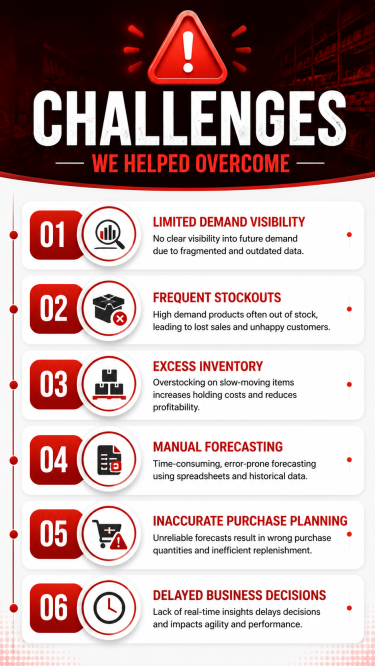
Before implementing the AI-powered Demand Forecasting solution, the retailer faced several inventory management challenges that affected operational efficiency, customer satisfaction, and profitability.
1.Limited Demand Visibility
Inventory planning relied primarily on historical sales reports, making it difficult to anticipate changes in customer demand caused by seasonal trends, promotions, and market fluctuations.
2. Manual Campaign Reporting
Marketing teams relied on spreadsheets to prepare campaign reports. The manual process consumed significant time and often resulted in inconsistent data and reporting errors.
3. Poor Customer Targeting
Without customer behavior analytics, promotional offers were sent to broad customer groups instead of the right audience, reducing campaign effectiveness and conversion rates.
4. Low Marketing ROI
The company invested heavily in promotional campaigns but lacked accurate insights into which campaigns generated the highest sales and customer engagement.
5. Delayed Business Decisions
Campaign performance reports were generated days after promotions ended, preventing marketing teams from making real-time adjustments during active campaigns.
Solutions
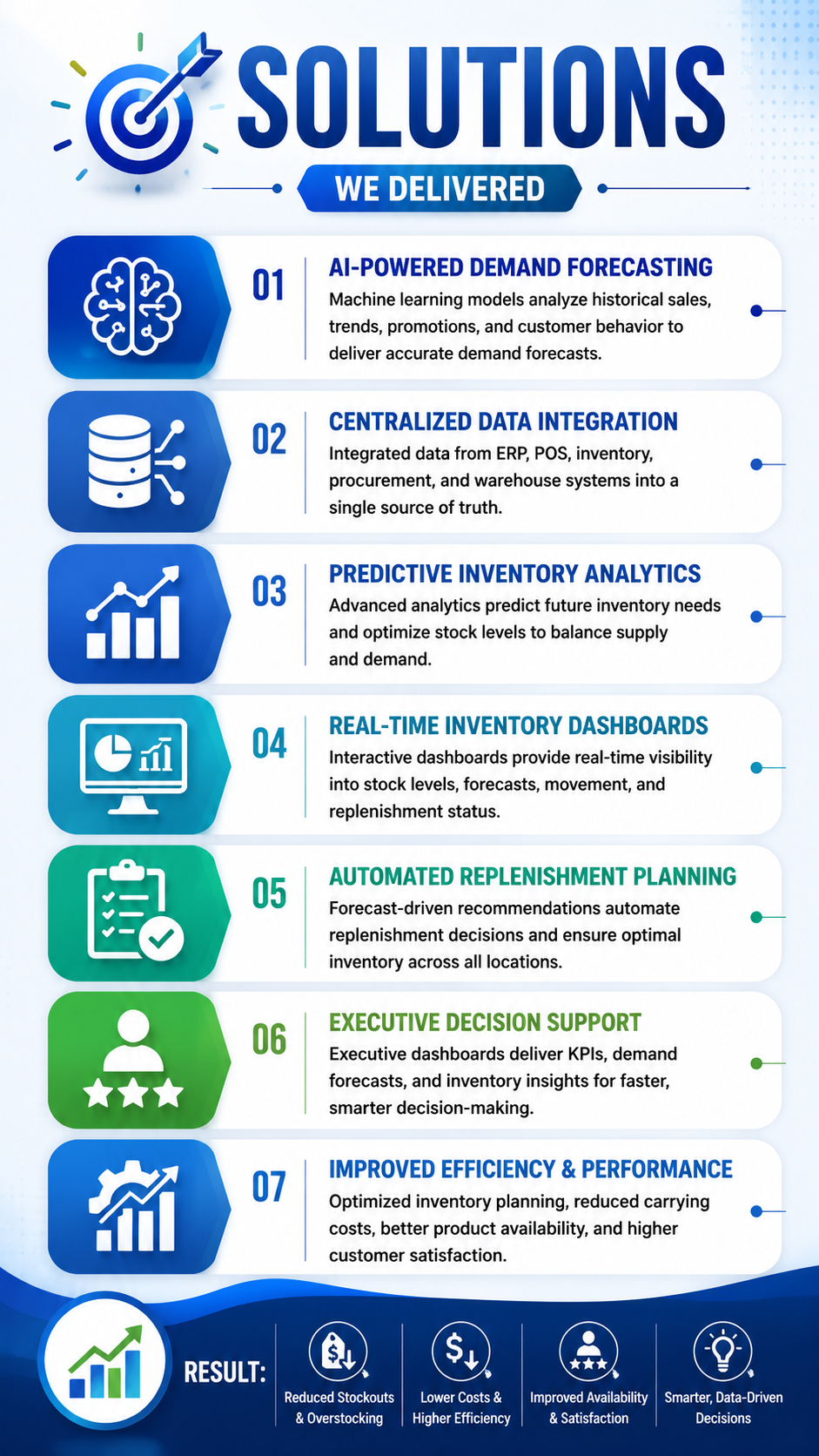
Wisecor Transformations implemented a comprehensive AI-powered Demand Forecasting framework that combined predictive analytics, centralized data, and real-time inventory intelligence.
AI-Powered Demand Forecasting
Machine Learning models analyzed historical sales, seasonal demand patterns, promotional activities, and customer purchasing behavior to generate highly accurate demand forecasts.
Centralized Data Integration
Data from ERP systems, Point of Sale (POS), inventory management software, warehouse systems, and procurement platforms was integrated into a centralized analytics platform, creating a single source of truth.
Predictive Inventory Analytics
Advanced analytics identified future inventory requirements, helping teams optimize stock levels while reducing both stock shortages and excess inventory.
Real-Time Inventory Dashboards
Interactive Business Intelligence dashboards enabled inventory managers to monitor stock availability, forecast accuracy, product movement, and replenishment status in real time.
Automated Replenishment Planning
Forecast-driven inventory recommendations helped procurement teams automate replenishment decisions, ensuring optimal inventory levels across stores and warehouses.
Executive Decision Support
Leadership dashboards provided real-time visibility into inventory performance, demand forecasts, procurement status, and inventory KPIs, enabling faster and more data-driven business decisions.
Results / Impact
Following the implementation of the AI-powered Demand Forecasting platform, the retailer achieved measurable improvements across inventory management and supply chain operations.
Technology Stack
Consulted & Recommended
Power BI / Tableau
Python & SQL
Cloud Data Warehouse (AWS / Google Cloud)
Client Testimonial

Ready to optimize your inventory with AI-powered Demand Forecasting? Contact Wisecor Transformations today and transform your supply chain with intelligent analytics.
Insights to Impact